If you’ve searched for a way to watch someone’s Instagram Story without them seeing your name pop up in the viewer list, you’ve probably landed on Insanony or one of its many near-identical competitors. Before you type a username into the search bar, it’s worth understanding what these tools actually do, what they collect, and where the line sits between “annoying Instagram doesn’t allow this” and “you could actually get burned.”
This isn’t a takedown and it isn’t an endorsement. It’s a straight answer to the two questions everyone actually has: is it safe, and is it legal.
What Is Insanony and How Does It Work?
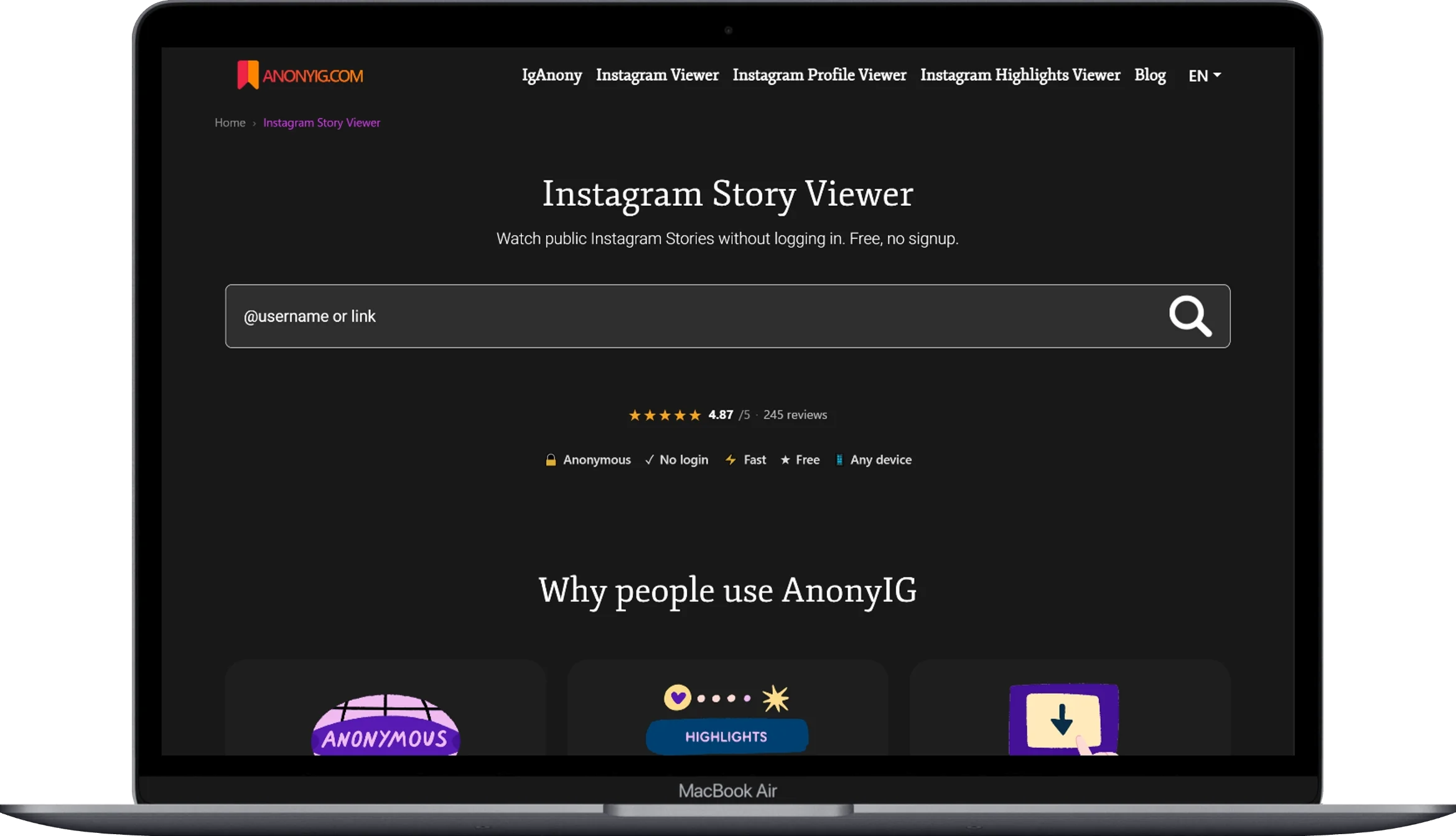
Insanony is a free, browser-based tool that lets you type in a public Instagram username and pull up that account’s Stories, Highlights, Reels, and posts — without logging into Instagram, without following the account, and without the account owner seeing your name in their viewer list. You enter a username, the site fetches whatever public content is currently live on that profile, and you can watch or download it directly from the browser.
Functionally, it works by querying Instagram’s public-facing data for the profile you search — the same data your own browser would load if you visited that public profile directly, just displayed through a different interface and stripped of the “seen by” tracking that normally comes with viewing a Story while logged in. That’s the entire trick: Instagram only notifies an account owner about story views that happen through a logged-in session tied to a viewer’s account. A tool that pulls the same public content without an authenticated session simply never generates that notification.
Two things follow from that mechanism, and they matter for both the safety and legality questions below. First, it only works on public accounts — anything posted by a private account is not accessible this way, no matter what a tool’s marketing copy implies. Second, because these tools operate entirely outside Instagram’s own systems, none of them are affiliated with, endorsed by, or accountable to Meta in any way.
Is Insanony Safe?
The honest answer is: safer than entering your real Instagram password somewhere it doesn’t belong, but not as safe as the “100% private and secure” language on these sites suggests.
What’s genuinely low-risk: You don’t need to log into your own Instagram account to search a public username, and legitimate tools in this category never ask for it. If a site claiming to be an Instagram story viewer asks you to “log in with Instagram to continue,” that’s not a feature — that’s a credential-phishing attempt, and you should close the tab immediately. This is the single most important safety rule in this entire category, and it’s worth treating as non-negotiable.
What’s genuinely worth caution:
- Data collection isn’t zero, whatever the marketing says. Several sites in this space are upfront in their own fine print that they log IP addresses and browser/device information “to provide the service,” even while advertising themselves as leaving “no traces.” That’s not necessarily malicious — plenty of legitimate sites log basic request metadata — but it directly contradicts the “100% anonymous, we know nothing about you” pitch these tools lead with.
- Ad-supported free tools mean ad-network risk. Free story viewers generate revenue through ads, and ad networks on lower-traffic sites are considerably more likely to serve intrusive redirects, fake “your browser is out of date” prompts, or push notification spam than ads on a major platform. This is the same risk profile you’d see on other free-to-use anonymity tools, and it’s worth being aware of that broader context on browser-level privacy risk if you use tools like this regularly.
- No accountable operator. These sites typically don’t disclose a company name, physical address, or any way to verify who’s actually running the service. That’s common across this entire category of free web tool, but it means there’s no real recourse if something goes wrong with a download or a data practice you weren’t expecting.
- Downloaded files deserve the same scrutiny as any download from an unfamiliar site. A “download” button on an ad-monetized site is a more attractive target for malicious ad injection than the same button on Instagram’s own app. Scan anything you download before opening it, the same way you would with any file from a site you don’t fully trust.
The Red Flag Most Reviews Skip: These Sites Are Not One Product
Here’s something that doesn’t show up in most coverage of this topic, and it’s worth knowing before you trust any single “Insanony review”: there isn’t one Insanony. Searching the name turns up multiple, separately-branded domains — insanony.us and insanony.app among them — running near-identical marketing copy, identical feature claims, and identical FAQ answers, word for word in places. The same templated copy also shows up, with the brand name swapped, across entirely differently-named sites like InsMask, InSnoop, IgAnony, and StoryNavigation.
That pattern — dozens of interchangeable, identically-worded “anonymous viewer” sites under different names — is a hallmark of a low-cost, templated site factory, not a single company with a real product and a track record. It doesn’t automatically mean any individual site is malicious. It does mean the trust signals you’d normally use to evaluate a service — a distinct product, a consistent brand, reviews tied to one identifiable operator — mostly don’t apply here. You’re not choosing “Insanony vs. its competitors” so much as choosing which copy of the same basic template to trust with your browsing session.
Is Using Insanony Legal?
This splits into two separate questions that get conflated constantly: is it against Instagram’s rules, and is it against the law. Those are not the same thing.
Against Instagram’s Terms of Use: Yes, almost certainly. Instagram’s Terms of Use prohibit collecting data from the platform through automated means outside its official API, and every tool in this category works by doing exactly that — querying public profile data through unofficial methods rather than through Instagram’s sanctioned channels. This is the same underlying issue that comes up whenever web scraping legality gets discussed generally: scraping publicly visible data isn’t automatically illegal, but it very often violates the platform’s own terms of service, which is a contract issue between the tool and Instagram, not a criminal matter for the person using the tool.
Against actual law: Viewing publicly available content anonymously is not illegal in most jurisdictions — you’re looking at content the account owner chose to make public. Downloading it is a murkier area. The photos and videos in someone’s Story are their copyrighted work the moment they’re created; downloading a copy for personal viewing is generally treated as low-risk, but re-uploading, redistributing, or using someone else’s Story content commercially without permission crosses into copyright infringement regardless of which tool you used to obtain it. The tool doesn’t change who owns the content — it just changes who notices you looked at it.
Practically speaking: The realistic consequence of using a tool like this isn’t a lawsuit — it’s Instagram’s own enforcement. Meta has periodically taken legal and technical action against third-party scraping tools and services that violate its terms, which is part of why this category of site churns through domain names so often; if one gets blocked or shut down, a near-identical replacement appears under a new name within weeks. That instability is a better predictor of a tool disappearing on you mid-use than any individual legal risk to you personally.
What These Tools Can and Can’t Actually Do
Worth being precise here, since marketing copy in this space tends to overstate capability:
- They work on public profiles only. Nothing about this category of tool can access a private account’s Stories. Any site implying otherwise is either misleading you or attempting something closer to account-compromise territory, which is a different and much more serious risk category entirely.
- They can’t see who’s viewed a Story, who’s liked a post, or private message content, regardless of what feature lists claim — that data isn’t publicly exposed by Instagram in the first place, so no external tool can surface it.
- They only show what’s currently live. Stories that have expired (Instagram Stories disappear after 24 hours unless saved to Highlights) generally aren’t retrievable through these tools any more than they would be through Instagram itself, unless the account owner has archived them into Highlights.
Safer Alternatives Worth Considering
If your actual goal is just staying current on someone’s public content without appearing in their view list, there are lower-risk paths:
- A secondary or “lurker” Instagram account with no profile picture or identifying information, used only for browsing, keeps everything inside Instagram’s own systems rather than routing your activity through an unaffiliated third-party site.
- Instagram’s own “Close Friends” and mute features, used the other direction, address the more common underlying concern (not wanting your own activity broadcast) without needing a third-party tool at all.
- If your interest is research or competitive monitoring rather than personal curiosity, it’s worth looking at what legitimate social listening and analytics tools offer instead — the same due-diligence questions apply that come up with any tools that touch platform data through unofficial channels, and a paid, accountable vendor is generally a better bet for anything business-related than a free anonymous viewer with no identifiable operator.
Practical Safety Rules If You Use It Anyway
- Never enter your real Instagram username or password on a third-party story viewer. Legitimate tools only ever need the target’s public username, never your own login.
- Treat every ad and every “continue” or “verify” pop-up as untrusted; close it rather than clicking through.
- Use a browser extension ad blocker and keep it active on these sites specifically — this is a category where it earns its keep.
- Don’t grant browser notification permissions if prompted; that’s a common vector for the persistent ad spam this category is known for.
- Scan downloaded files before opening them, and avoid downloading anything beyond the image or video you actually intended to save.
- Assume nothing about the site’s data-handling promises is enforceable, since there’s typically no identifiable company behind it to hold accountable.
Frequently Asked Questions
Can Insanony view private Instagram accounts?
No. It and every tool like it only work on public profiles. Anything claiming otherwise for a private account should be treated as unreliable at best and a phishing attempt at worst.
Will the person know I viewed their Story?
No — that’s the specific mechanism these tools rely on. Because the view happens outside a logged-in Instagram session, it doesn’t generate the “seen by” notification Instagram normally attaches to Story views.
Is it illegal to download someone’s Instagram Story?
Downloading a copy for personal viewing carries low practical legal risk in most cases, but the content remains copyrighted by whoever posted it. Re-sharing, redistributing, or using it commercially without permission is a separate matter and can constitute copyright infringement regardless of the tool used.
Is Insanony affiliated with Instagram or Meta?
No. No third-party story viewer in this category is affiliated with, endorsed by, or accountable to Meta. They operate entirely outside Instagram’s official systems.
Why are there so many sites with nearly identical names and copy?
Because this is a low-cost, easily replicated site category. When one domain gets blocked, restricted, or loses trust, a near-identical version reappears under a new name — which is exactly why sites like Insanony, InsMask, InSnoop, and IgAnony all read like the same product with a different label on it.
Is there a safer way to browse Instagram anonymously?
A dedicated secondary account with no identifying details, used purely for browsing, keeps your activity inside Instagram’s own systems rather than handing your browsing behavior to an unaffiliated third-party site.
The Bottom Line
Insanony and its many lookalikes will generally do what they claim on the surface — you can view and download public Instagram Stories without appearing in the viewer list. The realistic risks aren’t dramatic, but they’re real: data collection that doesn’t fully match the “100% anonymous” marketing, ad-network exposure typical of free tools, no accountable operator if something goes wrong, and a template-factory pattern across dozens of near-identical sites that makes it hard to evaluate any single one on its own merits. Legally, you’re on the wrong side of Instagram’s Terms of Use rather than the law itself for viewing — the bigger legal question only shows up if you redistribute what you download.
If you decide to use a tool like this, the one rule that matters more than any other: never enter your real Instagram credentials anywhere except Instagram’s own app or website. Everything else here is a manageable, ordinary internet risk. That one mistake is the kind that actually costs people their account.
You May Also Like
 Cyber Security
Can Ransomware Infect iCloud? What Mac and iPhone Users Need to Know
 Data Security & Privacy
Is a Password Manager Safe? How to Use One Securely
 WordPress
12 Best Cheap SSL Certificate Providers To Secure Your Website
 Data Security & Privacy
Is Password Protection the Same as Encryption? Differences in Data Security
 Data Security & Privacy
What Is End-to-End Encryption? Your Complete Guide to Secure Communication
 Data Security & Privacy
What Is a Cloud Security Scanner for AWS, Azure, and Google Cloud?
 Cyber Security
Is Temu Legit or a Scam? The Complete Truth You Need to Know
 VPN
VPNHow to Block Ads on FirstRowSports: A Step-by-Step Guide
 Proxies