Transaction verification on a cryptocurrency network uses cryptography and consensus to ensure security. When you send cryptocurrency, your transaction must be verified by many participants. This process prevents fraud and double-spending. It keeps the network secure without needing banks or central authorities. Understanding the role of data encryption is crucial for grasping how these security measures work. To understand the whole process better, check out how cryptocurrency transactions work.
The verification process combines digital signatures, hashing, and consensus mechanisms. These technologies work together to create a transparent system. No single entity controls the entire network. This makes cryptocurrency transactions both secure and tamper-resistant.
What Is Transaction Verification in Cryptocurrency Networks?
Transaction verification validates transactions before adding them to the blockchain. This process checks that transactions are legitimate. It ensures the sender has enough funds. It prevents the same digital asset from being spent twice. Unlike banks, cryptocurrency networks use decentralized verification.
Verification serves multiple critical functions in cryptocurrency networks. It prevents fraudulent activities. It ensures the blockchain remains unchangeable. It maintains agreement among all participants. When you send Bitcoin or Ethereum, your transaction goes through this process. It becomes complete and irreversible only after verification.
Why Transaction Verification Matters
Transaction verification is crucial for ensuring the security of cryptocurrencies. Without proper verification, cryptocurrencies would face double-spending attacks. The same digital asset could be spent multiple times. This would destroy the cryptocurrency value as scarce digital assets.
The verification process ensures only valid transactions join the blockchain. Each verified transaction becomes part of a permanent record. This record cannot be altered. It creates a transparent history of all transactions. This transparency is a key innovation of blockchain technology.
Key Players in Transaction Verification
Several participants work together to verify transactions in cryptocurrency networks. Nodes, miners, validators, and users all play important roles. Nodes are computers connected to the network. They maintain copies of the blockchain. They help validate transactions.
Miners and validators create new blocks and add verified transactions to the blockchain. Users initiate transactions by creating and signing them with private keys. Each participant has a specific role in ensuring transactions are properly validated. This creates a system of checks and balances.

The Components of a Cryptocurrency Transaction
A cryptocurrency transaction contains several essential components. These components work together to transfer digital assets between parties. Understanding these parts helps you grasp how transactions are verified. Each transaction includes specific information for validation.
The main components include sender address, recipient address, amount, fees, and digital signature. These elements follow a specific format. The format varies slightly between different cryptocurrencies. But they generally follow the same basic principles. Let’s examine each component in detail.
Transaction Inputs and Outputs
Transaction inputs specify where the funds come from. They reference previous transaction outputs that the sender controls. Each input includes a digital signature. This signature is created with the sender’s private key. It proves ownership and authorization to spend the funds.
Transaction outputs determine where the funds go. Each output includes the recipient’s address and amount. Outputs can also include change outputs. These return excess funds back to the sender. Verification ensures inputs equal outputs plus fees. This maintains value conservation in the system.
Transaction Fees and Gas Limits
Transaction fees compensate network participants for processing transactions. In Bitcoin and many cryptocurrencies, users set their own fees. Higher fees usually mean faster processing. These fees incentivize miners and validators to include transactions in blocks.
Gas limits specify maximum computational work for processing transactions. This is primarily used in Ethereum and smart contract platforms. It prevents infinite loops or overly complex operations. During verification, nodes check that fees cover the required gas. This ensures miners and validators are properly compensated.
Transaction ID and Timestamp
Every cryptocurrency transaction has a unique Transaction ID (TXID). This ID is generated by hashing the transaction data. It serves as a permanent reference on the blockchain. Nodes use the TXID to check if a transaction has been processed. This prevents duplicate transactions.
Timestamps record when a transaction was created. They help maintain chronological order of transactions. They are essential for resolving conflicts. During verification, nodes check that timestamps are reasonable. This prevents manipulation of the network.
How Transactions Are Created and Initiated
Creating a cryptocurrency transaction is the first step in verification. When you want to send cryptocurrency, you must follow specific rules. You specify the recipient’s address, amount, and transaction fee. The process involves several technical procedures to ensure proper formatting.
The process includes generating a digital signature with your private key. This signature provides cryptographic proof of authorization. The wallet software creates a hash of the transaction data. It then signs this hash with your private key. Anyone can verify this signature with your public key. But only you can create it with your private key.
Wallet Software and Transaction Creation
Wallet software handles the complex cryptographic operations for you. When you initiate a transaction, the software automatically selects inputs. It covers the amount plus fees. It creates necessary outputs. It generates the digital signature required for verification.
Modern wallets also handle technical details like fees and change addresses. They calculate appropriate fees for timely processing. They may let you adjust fees based on how fast you want confirmation. The wallet ensures change goes to a new address. This enhances privacy by making transactions harder to link.
Digital Signatures and Authorization
Digital signatures prove you authorized the transaction. The process starts with hashing the transaction data. This hash is then signed with your private key. The resulting signature is unique to both the transaction and your private key. This makes forgery virtually impossible.
During verification, nodes use your public key to check the signature. This confirms two critical things. First, that you created the transaction with your private key. Second, that the transaction data hasn’t been altered since signing. Any changes would invalidate the signature.
Broadcasting Transactions to the Network
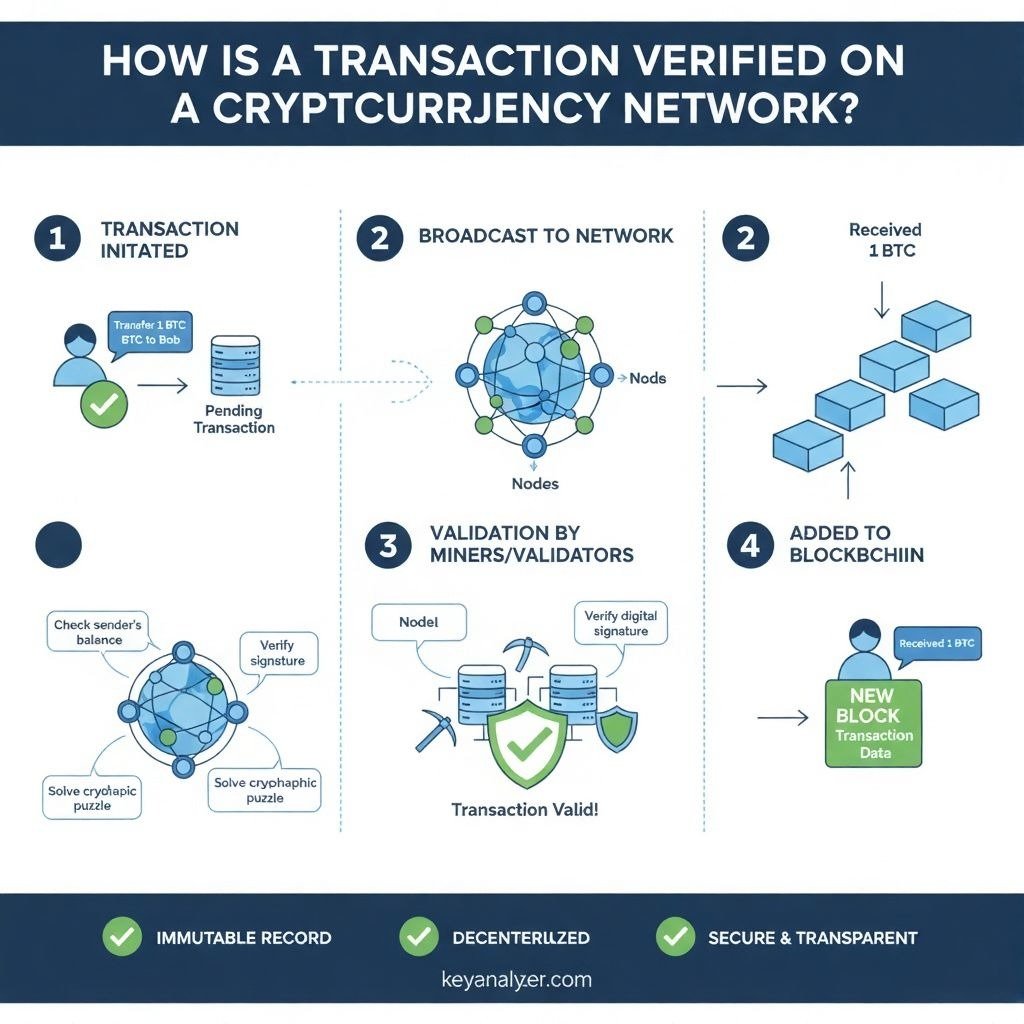
Once created and signed, transactions must be broadcast to the network. Your wallet sends the transaction to connected nodes. These nodes then propagate it to their peers. This peer-to-peer propagation spreads the transaction quickly throughout the network.
Broadcasting follows a flooding protocol. Each node forwards new transactions to all peers except the sender. This creates a rapid cascade effect. Transactions reach most network participants in seconds. During propagation, nodes perform initial validation checks. They reject invalid transactions before forwarding them.

Transaction Propagation in the Network
Transaction propagation spreads new transactions across the network. This process reaches nodes that will verify and include them in blocks. Propagation is essential for decentralization. It ensures no single point of failure exists. Transactions reach multiple independent validators.
During propagation, nodes perform initial validation checks. They filter out invalid transactions before forwarding. These checks include verifying the transaction structure. They check digital signatures. They ensure inputs refer to existing outputs. They confirm adequate fees. Invalid transactions are rejected and not propagated.
The Mempool: Pending Transactions
The mempool holds unconfirmed transactions waiting to be included in blocks. Each node maintains its own mempool. When a node receives a valid transaction, it adds it to the mempool. Different nodes’ mempools may vary slightly. But there is usually significant overlap between them.
Miners and validators select transactions from the mempool for blocks. They typically prioritize transactions with higher fees. The mempool size fluctuates with network activity. It grows during high transaction volume. It shrinks when blocks are mined. You can monitor mempool size to estimate appropriate fees.
Peer-to-Peer Network Structure
Cryptocurrency networks operate on a peer-to-peer structure. Each node connects to multiple other nodes. This creates a decentralized mesh network. The structure eliminates single points of failure. It makes the network resilient to attacks or outages.
The P2P structure ensures transactions and blocks propagate quickly. Even if some nodes go offline, the network continues functioning. Nodes use bootstrap nodes and discovery mechanisms to find peers. Connections are typically encrypted to protect data integrity.
Transaction Prioritization and Selection
Not all transactions are treated equally. Miners and validators prioritize transactions based on several factors. Transaction fees are the most significant. In Bitcoin, miners sort by fee per unit size. They include the highest-paying transactions first until the block is full.
Prioritization mechanisms vary between different cryptocurrencies. Some consider transaction age, giving preference to older transactions. Others prioritize transactions from certain addresses. Understanding these rules helps you optimize fees and confirmation times.
The Role of Nodes in Transaction Verification
Nodes are fundamental components that verify transactions and maintain blockchain integrity. These computers run specialized software. They participate in the network by validating transactions. They propagate transactions to other nodes. They maintain copies of the blockchain. Nodes enforce the network’s rules.
Different types of nodes serve specific functions in verification. Full nodes download and validate the entire blockchain. They check every transaction against consensus rules. Light nodes download only block headers. They verify transactions using simplified methods. Mining and validator nodes create new blocks.
Full Nodes: The Backbone of Verification
Full nodes perform comprehensive transaction verification. They independently validate every transaction and block. They maintain complete copies of the blockchain. They check digital signatures. They prevent double-spending. They confirm proper output structure. Full nodes reject invalid transactions and blocks.
The decentralized nature of full nodes makes networks resilient. Anyone can run a full node. No central authority controls which transactions are valid. This distribution of verification power ensures security. It remains trustworthy even if some nodes are compromised. Full nodes provide services to light nodes and other participants.
Light Nodes and Simplified Verification
Light nodes offer a resource-efficient way to participate. They download only block headers. Block headers contain summary information about each block. This includes the Merkle root of all transactions. Light nodes use Merkle proofs to verify specific transactions. They don’t download all transaction data.
Light nodes rely on full nodes for complete verification. They are less secure than full nodes. They trust that the majority of mining power is honest. They believe the longest chain represents the valid blockchain. This trade-off makes light nodes suitable for mobile wallets and applications with resource constraints.
Mining and Validator Nodes
Mining nodes and validator nodes perform specialized roles. In Proof of Work systems, mining nodes compete to solve mathematical puzzles. The first to solve earns the right to create the next block. In Proof of Stake systems, validator nodes are chosen based on staked cryptocurrency.
These specialized nodes perform additional verification steps. They select transactions from the mempool. They organize them into blocks. They perform work required by the consensus mechanism. Once a block is created, they broadcast it to the network. Other nodes verify it before adding it to their blockchain.
Cryptographic Verification: Digital Signatures and Hashing
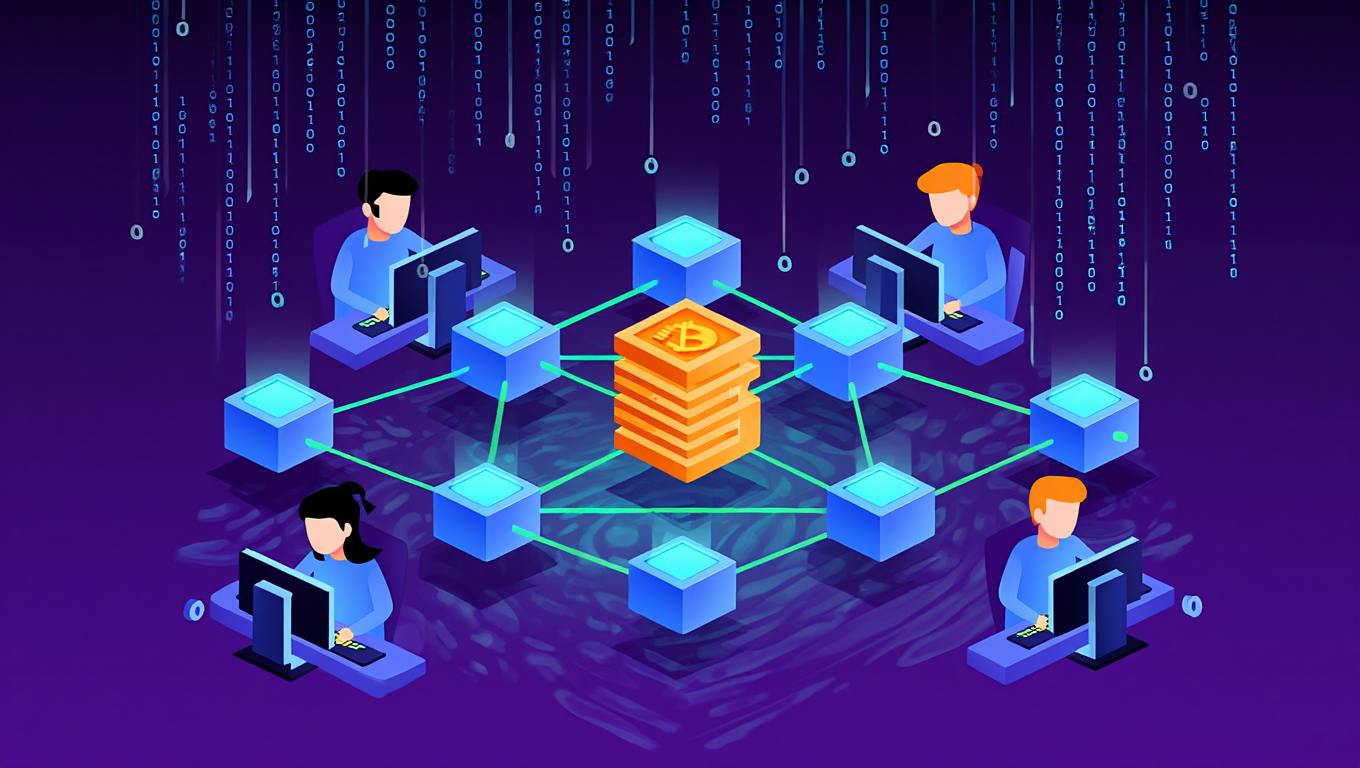
Cryptographic verification forms the technical foundation of transaction validation. It uses advanced mathematical techniques to ensure security. Two primary methods are employed: digital signatures and hashing. These work together to create a verifiable system. Transactions can be verified by anyone but not forged by unauthorized parties. To get a better idea of how these security measures function, check out data encryption. Also, understanding the difference between hashing and encryption is crucial for these security concepts.
Digital signatures use public-key cryptography. You have a pair of keys: a private key you keep secret and a public key you share openly. When you initiate a transaction, you create a digital signature. You apply a mathematical function to the transaction data using your private key. Anyone can verify this signature with your public key.
Public-Key Cryptography and Digital Signatures
Public-key cryptography uses two mathematically related keys. One is for encryption (the public key). One is for decryption (the private key). In cryptocurrency systems, this technology creates digital signatures. Your private key creates signatures proving ownership and authorization. Your public key verifies those signatures. To better understand this cryptographic method, you can learn about asymmetric encryption.
The digital signature process starts with creating a transaction hash. This hash is encrypted with your private key to create the signature. When a node receives the transaction, it verifies the signature. It decrypts the signature with your public key. It compares the result to its own hash of the transaction data. If they match, the signature is valid.
Hash Functions and Their Role in Verification
Hash functions take input data of any size and produce a fixed-size output. This output is called a hash or digest. In cryptocurrency systems, hash functions serve multiple purposes. They create unique identifiers for transactions and blocks. They enable efficient verification of data integrity. They form the basis of Proof of Work consensus.
Cryptographic hash functions have specific properties. They are deterministic—the same input always produces the same hash. They have preimage resistance—you can’t determine input from hash. They have collision resistance—finding two inputs with same hash is difficult. They show the avalanche effect—small input changes create very different hashes.
Merkle Trees and Efficient Verification
Merkle trees enable efficient verification of large datasets. They organize hashes in a tree-like structure. In cryptocurrency systems, Merkle trees summarize all transactions in a block. This creates a single hash called the Merkle root. The Merkle root is included in the block header. This allows nodes to verify specific transactions without downloading all data.
The Merkle tree is constructed by hashing individual transactions. Then pairs of hashes are repeatedly hashed until only one remains. This final hash is the Merkle root. To verify a transaction, a node needs the transaction and a Merkle proof. By hashing the transaction with appropriate hashes from the proof, it can verify inclusion in the block.
Consensus Mechanisms: Proof of Work vs. Proof of Stake
Consensus mechanisms enable distributed nodes to agree on blockchain state. They solve the challenge of achieving consensus in decentralized systems. By following predefined rules, nodes independently verify transactions and blocks. They reach agreement on which blockchain version is correct. This works even with malicious actors or network issues.
The two most widely used consensus mechanisms are Proof of Work and Proof of Stake. Proof of Work requires nodes to perform computationally intensive work. Proof of Stake selects block creators based on staked cryptocurrency. Both mechanisms secure the network but use different methods.
Proof of Work: Mining and Computational Power
Proof of Work requires miners to solve complex mathematical puzzles. These puzzles involve finding a nonce value. When combined with block data and hashed, it produces a result below a target value. This process requires significant computational power and energy. It makes attacking the network expensive.
The difficulty of Proof of Work puzzles is automatically adjusted. This maintains consistent block creation time. For Bitcoin, this is about 10 minutes per block. As more miners join, puzzles become harder. This maintains system security. Successful miners receive newly created cryptocurrency and transaction fees.
Proof of Stake: Validation and Economic Incentives
Proof of Stake selects validators based on staked cryptocurrency. Instead of competing with computational power, validators are chosen randomly. Selection considers stake size and staking duration. This approach significantly reduces energy consumption compared to Proof of Work.
In Proof of Stake systems, validators lock up cryptocurrency as stake. This stake can be forfeited if they act maliciously. This economic incentive encourages honest behavior. When chosen to create a block, validators verify transactions and organize them into a block. They broadcast it to the network for verification.
Comparing Consensus Mechanisms
Proof of Work and Proof of Stake represent different approaches. Proof of Work has a proven security track record. Bitcoin has operated successfully since 2009 without a successful 51% attack. However, it requires significant energy consumption. This can lead to mining centralization in regions with cheap electricity.
Proof of Stake offers improved energy efficiency. It potentially enables greater decentralization. Unlike Proof of Work, where miners need expensive hardware, anyone with minimum stake can participate. This reduces environmental impact and may improve resistance to certain attacks. However, Proof of Stake is newer with less proven security.

Mining and Block Creation Process
Mining creates new blocks and adds them to the blockchain. This process is fundamental to Proof of Work cryptocurrencies like Bitcoin. Miners compete to solve complex mathematical puzzles. These puzzles require significant computational resources. The first miner to solve the puzzle earns the right to create the next block. They receive rewards in newly minted cryptocurrency and transaction fees.
The block creation process involves several key steps. Miners select transactions from the mempool. They organize them into a candidate block. They perform the Proof of Work computation. They broadcast the completed block to the network. Each block contains a block header with metadata and a list of verified transactions.
Transaction Selection and Block Assembly
Miners begin by selecting transactions from the mempool. Selection is typically based on transaction fees. Miners prioritize transactions with higher fees per unit size. This maximizes their rewards. The miner creates a candidate block by organizing selected transactions. They calculate the Merkle root, which summarizes all transactions.
Block assembly also involves creating a block header. This header contains essential metadata. It includes the previous block’s hash, a timestamp, the Merkle root, a target difficulty value, and a nonce. The block header is what miners focus on during mining. They need to hash it to find a valid solution.
The Proof of Work Computation
The Proof of Work computation is the core of mining. Miners repeatedly hash the block header with different nonce values. They look for a hash that meets the network’s difficulty target. This involves generating SHA-256 hashes (for Bitcoin) of the block header. They check if the result is less than or equal to the target value. If not, they increment the nonce and try again.
The difficulty is automatically adjusted by the network. For Bitcoin, this happens every 2016 blocks (about two weeks). This maintains consistent block creation time. As more miners join and computational power increases, puzzles become harder. This adjustment is crucial for maintaining security.
Block Propagation and Verification
Once a miner solves the Proof of Work puzzle, they broadcast the block. This propagation follows the same peer-to-peer process as transaction broadcasting. Each node that receives the block forwards it to its peers. As the block propagates, nodes perform comprehensive verification checks. They add it to their blockchain only if it’s valid.
Verification includes multiple checks. Nodes verify the block header produces a valid hash. They check all transactions in the block are valid. They confirm the Merkle root correctly summarizes transactions. They ensure the block properly extends the existing blockchain. Only blocks passing all checks are added to the blockchain.
Block Confirmation and Finality
Block confirmation measures how deeply embedded a block is in the blockchain. When a block is first added, it has one confirmation. As more blocks are added on top, confirmations increase. Each additional confirmation makes it harder to reverse or alter transactions in that block. This concept is crucial for understanding when transactions become final.
Finality refers to when a transaction becomes irreversible. Different cryptocurrencies achieve finality differently. Bitcoin relies on probabilistic finality. The probability of reversal becomes negligible after certain confirmations. Other cryptocurrencies implement more explicit finality mechanisms. Understanding confirmation and finality is essential for accepting cryptocurrency payments.
Understanding Block Confirmations
Block confirmations measure how deep a block is in the blockchain. For example, if a transaction is in block 700,000, it has one confirmation when added. When block 700,001 is added, it has two confirmations. As confirmations increase, security increases. It becomes exponentially harder to reverse or alter the transaction.
Required confirmations vary based on transaction value and cryptocurrency. For small Bitcoin transactions, one confirmation might suffice. For larger transactions, six or more are recommended. This variation exists because chain reorganization risk decreases with each confirmation. Higher-value transactions need more confirmations for security.
Chain Reorganizations and Orphan Blocks
Chain reorganizations occur when two blocks are mined simultaneously. This creates a temporary fork in the blockchain. Nodes follow the rule of accepting the longest valid chain. Whichever chain receives the next block first becomes the main chain. The other block becomes an orphan block. This is normal for blockchain networks.
Orphan blocks are valid blocks not included in the main blockchain. They are part of shorter chains during reorganization. These blocks contain valid transactions that need re-inclusion in future blocks. Miners who created orphan blocks don’t receive rewards. This incentivizes miners to propagate blocks quickly and build on the longest chain.
Finality in Different Consensus Mechanisms
Finality concepts vary between consensus mechanisms. In Proof of Work systems like Bitcoin, finality is probabilistic. Transactions are never technically 100% final. But the reversal probability becomes negligible after certain confirmations. This relies on the economic and computational costs of reversal.
Proof of Stake systems often implement more explicit finality. Ethereum’s Casper protocol includes a finality mechanism. Validators explicitly vote on blocks. When a supermajority (2/3) votes for a block, it achieves “finalized” status. It cannot be reversed without significant stake being slashed. This provides stronger guarantees than probabilistic finality.
Security Measures: Preventing Double-Spending and Attacks
Cryptocurrency networks implement multiple security measures. These prevent double-spending and various attacks. Double-spending is the risk that digital currency could be spent twice. This would undermine cryptocurrency value as scarce assets. Networks combine cryptographic techniques, consensus mechanisms, and economic incentives. This makes attacks expensive or technically impossible.
Network security relies on no single entity controlling the majority of power. In Proof of Work, this means no one controls more than half the mining power. In Proof of Stake, no one controls more than half the staked cryptocurrency. This assumption ensures honest participants can outpace attackers. Additional security measures work together to create a robust system.
Double-Spending Prevention
Double-spending prevention is critical for cryptocurrency security. It ensures each unit of cryptocurrency can only be spent once. This is achieved through blockchain structure. Each transaction references previous unspent outputs as inputs. It creates new outputs. Once a transaction is confirmed, its inputs are considered spent. They cannot be used again.
The blockchain’s structure makes double-spending practically impossible. After sufficient confirmations, transactions cannot be reversed. If someone tries to spend the same cryptocurrency twice, the network accepts only the first confirmed transaction. The second attempt is rejected because the inputs are already spent. This mechanism ensures cryptocurrency scarcity and integrity.
51% Attacks and Network Security
A 51% attack occurs when one entity controls the majority network power. In Proof of Work, this means controlling more than half the mining power. In Proof of Stake, it means controlling more than half the staked cryptocurrency. With majority control, an attacker could reverse transactions or double-spend cryptocurrency.
Network security against 51% attacks relies on economic costs. In large networks like Bitcoin, the required computational power would cost billions. Additionally, such attacks would likely crash the cryptocurrency’s value. This makes attacks economically irrational. Economic disincentives are crucial for cryptocurrency security.
Sybil Attack Resistance and Byzantine Fault Tolerance
Sybil attacks involve creating multiple fake identities. Attackers use these to gain disproportionate network influence. Cryptocurrency networks resist Sybil attacks through consensus mechanisms. Proof of Work and Proof of Stake require participants to demonstrate ownership of scarce resources. This makes creating influential fake identities prohibitively expensive.
Byzantine Fault Tolerance (BFT) allows correct operation despite failures. Systems with BFT can function even if some components fail or act maliciously. Cryptocurrency networks achieve BFT through consensus mechanisms. These allow honest nodes to reach agreement despite malicious nodes. Different consensus algorithms offer varying BFT levels.
Advanced Verification Techniques
As cryptocurrency technology evolves, advanced verification techniques have emerged. These techniques build on foundational concepts. They address specific challenges faced by early blockchain systems. From privacy technologies to innovative consensus mechanisms, these approaches expand network capabilities. They enable new use cases beyond simple value transfer.
Modern networks implement sophisticated verification methods. These balance security with performance and user experience. Techniques include zero-knowledge proofs for privacy-preserving verification. Sharding divides networks into manageable pieces. Layer 2 solutions process transactions off-chain before settling on-chain. Each approach represents an evolution in transaction verification.
Zero-Knowledge Proofs and Privacy
Zero-knowledge proofs (ZKPs) allow verification without revealing information. One party can prove a statement is true without revealing anything beyond its validity.In cryptocurrency, ZKPs allow transaction verification without revealing details like the sender, recipient, or amount. This tech is key in privacy-focused cryptocurrencies like Zcash. If you’re curious about how privacy works in digital systems, check out privacy engineering for useful insights on similar ideas.
Common ZKP types in cryptocurrency include zk-SNARKs and zk-STARKs. These cryptographic tools enable efficient verification of complex computations while maintaining privacy. For example, they can prove a transaction is valid without revealing sensitive information. This provides both verification and privacy protection simultaneously.
Sharding and Network Partitioning
Sharding is a scalability solution that divides networks into smaller pieces. These pieces, called shards, can process transactions independently. This allows parallel processing rather than sequential processing. It significantly increases throughput. Each shard maintains its own state and processes a subset of transactions. Periodic cross-shard communication ensures consistency.
Sharding adds complexity to the verification process. Nodes must verify transactions across different shards. To address this, networks use techniques like cross-shard receipts and random shard assignment. Ethereum’s upgrade to Ethereum 2.0 includes sharding to improve scalability while maintaining security and decentralization.
Layer 2 Solutions and Off-Chain Verification
Layer 2 solutions process transactions off-chain before settling on-chain. They leverage underlying blockchain security while improving throughput and reducing fees. Common solutions include payment channels (like Lightning Network for Bitcoin), sidechains, and rollups (like Optimistic and ZK-Rollups for Ethereum).
Verification in Layer 2 solutions combines on-chain and off-chain processes. In payment channel networks, most transactions occur off-chain between participants. Only channel opening and closing are recorded on-chain. In rollups, multiple transactions are processed off-chain. A cryptographic proof of validity is submitted to the main blockchain for efficient verification.
How Is a Transaction Verified on a Cryptocurrency Network Infographic
The Future of Transaction Verification
The future of transaction verification will be shaped by ongoing research. Development continues in scalability, security, and usability. New verification methods and consensus mechanisms address current system limitations. These innovations aim to make networks more efficient and accessible. They will support broader applications beyond financial transactions.
Emerging trends include energy-efficient consensus mechanisms. Improved privacy-preserving verification techniques are also emerging. Novel approaches achieve scalability without compromising decentralization. These advances will enable networks to process transactions at traditional payment system speeds. They will maintain the security and decentralization that make cryptocurrencies unique.
Energy-Efficient Consensus Mechanisms
The environmental impact of Proof of Work has driven research into alternatives. Proof of Stake has emerged as the leading alternative. Other approaches include Proof of Authority, Proof of Space, Proof of Time, and hybrid mechanisms. These alternatives maintain security while drastically reducing energy consumption.
The transition to energy-efficient consensus is already underway. Ethereum’s transition from Proof of Work to Proof of Stake (“The Merge”) reduced energy consumption by over 99%. Other networks explore different approaches. Chia uses Proof of Space and Time, which uses storage capacity rather than computational power. These developments make networks more sustainable and accessible.
Quantum-Resistant Cryptography
Quantum computing poses potential threats to current cryptographic methods. Quantum computers could break elliptic curve cryptography and hash functions. This would make digital signatures vulnerable to forgery. In response, researchers are developing quantum-resistant cryptographic algorithms.
Transitioning to quantum-resistant cryptography will be challenging. It needs careful planning and coordination to keep security during upgrades. Several methods are being looked at, such as lattice-based cryptography, hash-based signatures, and multivariate polynomial cryptography. Some newer cryptocurrencies already use quantum-resistant algorithms.
Interoperability and Cross-Chain Verification
As blockchain networks grow, interoperability has become increasingly important. Cross-chain verification enables different blockchains to communicate and exchange value. This is essential for creating a connected ecosystem of networks that work together rather than in isolation.
Cross-chain verification methods differ in approach. Atomic swaps use smart contracts for trustless asset exchange between blockchains. Cross-chain bridges lock assets on one chain and mint equivalents on another. As these technologies improve, we can expect better verification methods that ensure security while allowing complex interactions between networks.
Conclusion
Transaction verification on cryptocurrency networks combines multiple technologies. It uses cryptography, distributed systems, and economic incentives. This creates secure, decentralized financial systems. From digital signatures to block creation through mining or validation, each step ensures network integrity. This process prevents double-spending and protects against attacks. It maintains consensus without centralized authorities.
The evolution of verification techniques continues to advance blockchain capabilities. Innovations like zero-knowledge proofs, sharding, and Layer 2 solutions address limitations of early systems. They enable greater scalability, privacy, and efficiency. New consensus mechanisms reduce environmental impact while maintaining security and decentralization.
Understanding transaction verification is essential for anyone interested in future finance. As these technologies mature and integrate with existing infrastructure, verification processes will play increasingly important roles in our digital economy. Whether you’re a developer, investor, or curious individual, understanding verification provides valuable insights into blockchain’s revolutionary potential.
The future of transaction verification will bring greater efficiency and privacy. Seamless interoperability between different blockchain networks will emerge. As quantum computing advances, new cryptographic techniques will develop. These advances will help networks scale to global adoption while maintaining core principles of decentralization, security, and transparency.
Frequently Asked Questions
Can a cryptocurrency transaction be reversed once it’s confirmed?
No, a confirmed cryptocurrency transaction cannot be reversed. Once a transaction has sufficient confirmations (typically six or more for Bitcoin), it becomes practically irreversible. The blockchain’s structure and consensus mechanism make altering confirmed transactions computationally infeasible without controlling majority network power.
Is transaction verification the same across all cryptocurrency networks?
No, verification processes vary significantly between networks. While all use cryptography and consensus, implementations differ. Bitcoin uses Proof of Work where miners solve mathematical puzzles. Ethereum uses Proof of Stake where validators are chosen based on their stake. Other networks use different mechanisms like Proof of Authority, each with unique verification processes.
Do all nodes in a cryptocurrency network verify every transaction?
Yes, in most networks, full nodes verify every transaction according to consensus rules. This comprehensive verification maintains blockchain security and integrity. However, light nodes (SPV nodes) perform simplified verification by checking only block headers and using Merkle proofs to verify specific transactions rather than validating every transaction individually.
Can someone verify a cryptocurrency transaction without participating in the network?
Yes, anyone can verify transactions without active participation by running nodes in non-validating mode or using blockchain explorers. Blockchain explorers are web-based tools that allow viewing and verifying transactions without running personal nodes. Some cryptocurrencies offer light clients for verifying specific transactions without downloading the entire blockchain.
Is it possible to verify a transaction without revealing sensitive information?
Yes, advanced techniques like zero-knowledge proofs enable verification without revealing sensitive information. Privacy-focused cryptocurrencies like Zcash use these technologies for verification while maintaining privacy. Verifiers can confirm transaction validity (sufficient funds and authorization) without learning sender, recipient, or transaction amount details.
Does transaction verification require internet access?
Yes, verification typically requires internet access to communicate with other nodes and receive latest blockchain data. However, some specialized use cases and offline verification methods exist. In Bitcoin, offline verification is possible with relevant block headers and Merkle proofs, though this requires prior network synchronization. Active participation generally needs internet connectivity.
Can quantum computers break cryptocurrency transaction verification?
Potentially, quantum computers could theoretically break some cryptographic methods used in verification, particularly elliptic curve cryptography for digital signatures. However, this threat remains theoretical as practical quantum computers capable of breaking these methods don’t exist yet. Researchers are developing quantum-resistant algorithms for future implementation in cryptocurrency networks.
Is transaction verification faster in centralized systems than in cryptocurrency networks?
Yes, verification is typically faster in centralized systems like traditional payment processors. Centralized systems can verify transactions almost instantly with single authority control. Cryptocurrency networks require distributed consensus, which takes time. However, this speed trade-off provides the security, transparency, and decentralization that are core benefits of cryptocurrency systems.
Do all verified transactions get added to the blockchain immediately?
No, not all verified transactions are added immediately. Transactions passing initial verification enter the mempool, waiting for inclusion in blocks. Time in the mempool depends on network congestion and transaction fees. Higher-fee transactions are typically prioritized and added to blocks more quickly than lower-fee transactions.
Can transaction verification be done manually by humans?
No, transaction verification cannot be practically done manually due to complexity and volume of cryptographic operations. Verification requires rapid computation of hash functions, digital signature verification, and consensus rule validation, all performed by computers. While humans can examine transaction data using explorers, actual verification is entirely automated by specialized software. Similar to how automation in software testing has transformed traditional testing processes, automated verification is essential for handling the complexity and scale of cryptocurrency networks.
You May Also Like
 Cyber Security
Can Ransomware Infect iCloud? What Mac and iPhone Users Need to Know
 Data Security & Privacy
Two-Factor Authentication (2FA): How It Works, Which Method to Use, and How to Stay Safe
 Data Security & Privacy
Is a Password Manager Safe? How to Use One Securely
 Data Security & Privacy
19 Best Email Service Providers for Personal and Business Use
 WordPress
12 Best Cheap SSL Certificate Providers To Secure Your Website
 Data Security & Privacy
Is Password Protection the Same as Encryption? Differences in Data Security
 Data Security & Privacy
How Your Digital Footprint Can Make or Break Your Career Opportunities
 Data Security & Privacy
What Is End-to-End Encryption? Your Complete Guide to Secure Communication
 Data Security & Privacy