GLM-4.5 and GPT-5 represent two of the most advanced AI language models available in 2025, each with distinct strengths and capabilities. GLM-4.5, developed by China’s Z.ai (formerly Zhipu AI), is an open-source model that has achieved remarkable performance as the third-ranked model overall in comprehensive benchmarking. GPT-5, created by OpenAI, is a proprietary system that introduces significant advances in reasoning, coding, and multimodal understanding with reduced hallucinations and improved efficiency.
When comparing these models directly, GPT-5 generally outperforms GLM-4.5 in most benchmark categories, particularly in math (94.6% vs 91.0% on AIME), coding (74.9% vs 64.2% on SWE-bench Verified), and multimodal understanding (84.2% on MMMU vs GLM-4.5’s unreported score). However, GLM-4.5 excels in agentic tasks with best-in-class tool calling capabilities (90.6% success rate) and offers the significant advantage of being open-source, allowing for local deployment, customization, and cost-effective implementation without ongoing API fees.
Technical Specifications and Architecture
GLM-4.5 Technical Specifications
GLM-4.5 features an innovative Mixture of Experts (MoE) architecture with 355 billion total parameters and 32 billion active parameters in its flagship version. The model utilizes a deeper, narrower MoE design that increases model depth while reducing width, resulting in enhanced reasoning capacity. GLM-4.5 incorporates an enhanced attention mechanism with 96 attention heads—2.5 times more than typical models—which consistently improves performance on reasoning benchmarks.
The model is available in two variants:
- GLM-4.5: 355B total/32B active parameters
- GLM-4.5-Air: 106B total/12B active parameters (lighter version for resource-constrained environments)
GLM-4.5 maintains a 128,000-token context window and incorporates advanced training techniques including QK-Norm for stability and speculative decoding for faster inference. The model also utilizes a Muon Optimizer that accelerates convergence and allows for larger batch sizes during training.
GPT-5 Technical Specifications
GPT-5 introduces a unified system architecture that combines multiple models into a cohesive framework designed for optimal performance across different task types. The system consists of three main components:
- Smart, efficient model: Handles most questions and straightforward tasks
- Deeper reasoning model (GPT-5 thinking): Addresses complex problems requiring extensive analysis
- Real-time router: Intelligently decides which model to use based on conversation type, complexity, tool needs, and user intent
GPT-5 features a 400,000-token context window—more than three times larger than GLM-4.5’s context window. The router component is continuously trained on real signals including user model switches, preference rates for responses, and measured correctness, allowing it to improve over time.
Architectural Differences
The most significant architectural difference between GLM-4.5 and GPT-5 lies in their approach to model deployment and reasoning. GLM-4.5 employs a hybrid reasoning architecture with distinct Thinking Mode and Non-Thinking Mode options, allowing users to choose between step-by-step analysis for complex reasoning and instant responses for straightforward queries.
GPT-5, conversely, automates this decision-making process through its intelligent router system that automatically selects the appropriate model based on the task requirements. This approach aims to provide the best of both worlds without requiring users to manually select the optimal mode.
Another key difference is in their parameter activation strategies. GLM-4.5’s MoE architecture activates only a fraction of its total parameters (32B out of 355B) for any given task, making it more efficient during inference. GPT-5’s architecture details are less transparent due to its proprietary nature, but it appears to utilize a more traditional approach with specialized models for different types of reasoning.
Benchmark Performance Comparison

Overall Performance Comparison
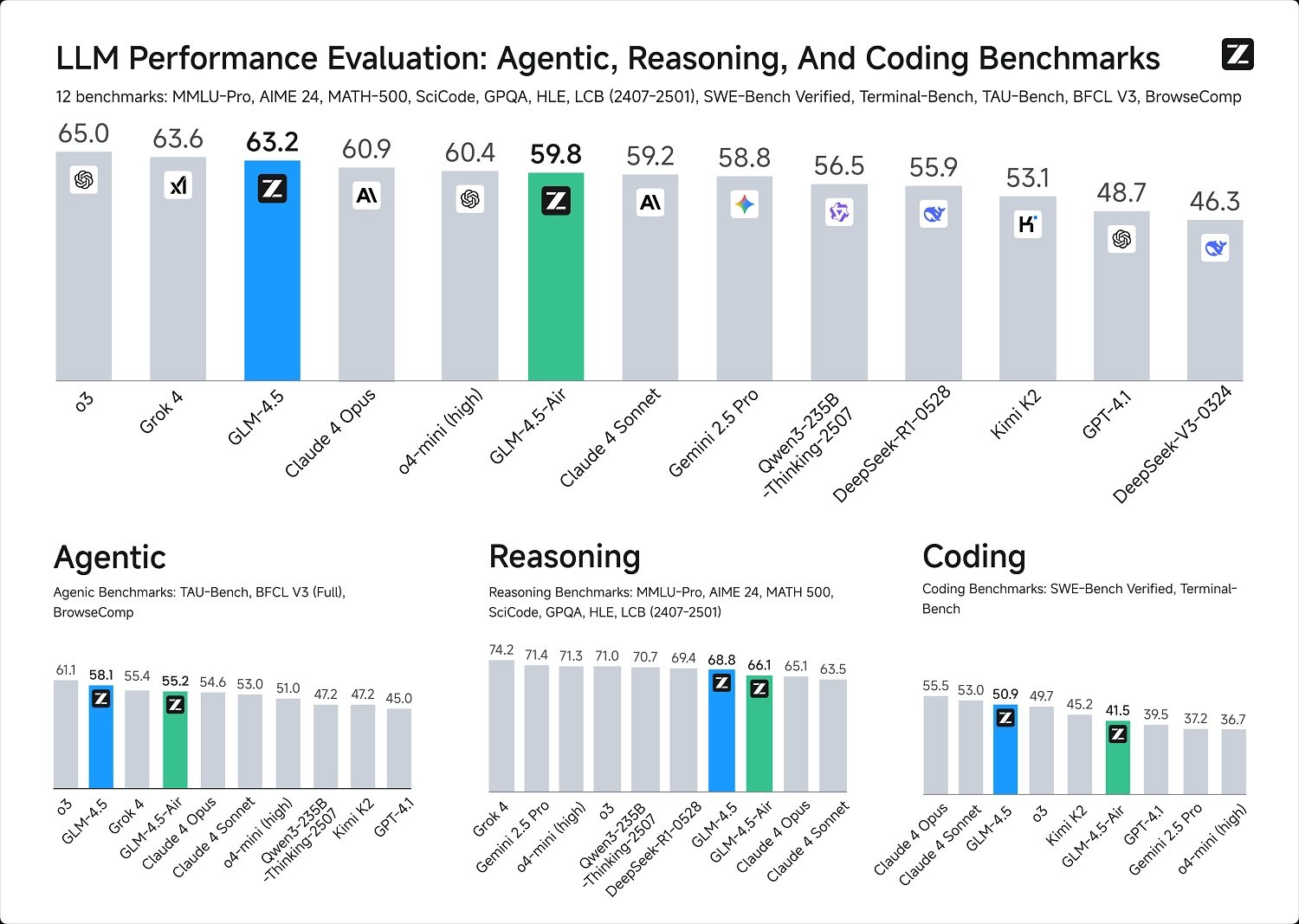
GPT-5 demonstrates superior overall performance across most benchmark categories, establishing itself as a state-of-the-art model in multiple domains. In comprehensive benchmarking across 12 key metrics, GLM-4.5 achieves 3rd place overall, trailing only OpenAI’s o3 and Grok 4, while outperforming Claude 4 Opus and Claude 4 Sonnet. However, GPT-5’s performance across similar benchmarks generally exceeds that of GLM-4.5.
The following table provides a direct comparison of benchmark performance between the two models:
| Benchmark Category | GLM-4.5 Score | GPT-5 Score | Advantage |
|---|---|---|---|
| MMLU Pro (Reasoning & Knowledge) | 84.6% | Not specified | – |
| AIME 2025 (Math) | 91.0% | 94.6% | GPT-5 (+3.6%) |
| MATH 500 | 98.2% | Not specified | – |
| SWE-bench Verified (Coding) | 64.2% | 74.9% | GPT-5 (+10.7%) |
| Aider Polyglot (Coding) | Not specified | 88.0% | – |
| MMMU (Multimodal Understanding) | Not specified | 84.2% | – |
| GPQA (Scientific Reasoning) | 79.1% | 88.4% (with reasoning) | GPT-5 (+9.3%) |
| Tool Calling Success Rate | 90.6% | Not specified | – |
| BrowseComp (Web Browsing) | 26.4% | Not specified | – |
Math Performance
GPT-5 outperforms GLM-4.5 in mathematical reasoning, achieving 94.6% on the AIME 2025 benchmark compared to GLM-4.5’s 91.0%. This represents a 3.6 percentage point advantage for GPT-5 in advanced mathematical problem-solving. Both models demonstrate exceptional math capabilities, with GLM-4.5 scoring 98.2% on the MATH 500 benchmark, though a direct comparison with GPT-5 on this specific benchmark is not available.
The mathematical reasoning capabilities of both models make them suitable for advanced applications in scientific computing, engineering, and mathematical research. However, GPT-5’s slight edge in this category suggests it may be better suited for the most challenging mathematical problems.
Coding Performance
GPT-5 demonstrates significantly stronger coding performance than GLM-4.5, achieving 74.9% on the SWE-bench Verified benchmark compared to GLM-4.5’s 64.2%. This represents a substantial 10.7 percentage point advantage for GPT-5 in real-world coding scenarios. Additionally, GPT-5 scores 88.0% on the Aider Polyglot benchmark, though a direct comparison with GLM-4.5 on this metric is not available.
GLM-4.5 scores 37.5% on the Terminal-Bench benchmark, compared to Claude 4 Opus’s 43.2%, indicating that while its coding performance is solid, it doesn’t lead in this category. However, GLM-4.5 excels in full-stack development and complex artifact generation, making it particularly useful for web application development.
Reasoning and Knowledge Performance
Both models demonstrate strong reasoning and knowledge capabilities, with GLM-4.5 scoring 84.6% on the MMLU Pro benchmark. This places GLM-4.5 slightly behind Claude 4 Opus (87.3%) and Gemini 2.5 Pro (86.2%) but still in the top tier of models for reasoning and knowledge tasks.
GPT-5’s performance on similar reasoning benchmarks is not directly specified, but its overall advanced capabilities suggest strong performance in this category as well. GPT-5’s unified architecture with specialized reasoning models likely gives it an advantage in complex reasoning tasks that require deep analysis.
Efficiency Metrics
GPT-5 demonstrates superior efficiency, performing better than OpenAI o3 with 50-80% less output tokens across capabilities including visual reasoning, agentic coding, and graduate-level scientific problem solving. This efficiency advantage makes GPT-5 more cost-effective for applications where output token count impacts pricing.
GLM-4.5’s MoE architecture provides impressive inference speed while maintaining good accuracy, particularly in its lighter GLM-4.5-Air variant. The model’s efficient design allows it to deliver strong performance without requiring activation of all parameters for every task.
Key Features and Capabilities
GLM-4.5 Features
GLM-4.5 offers several distinctive features that make it particularly valuable for specific use cases:
- Hybrid Reasoning Architecture: The model provides dual processing modes with Thinking Mode for step-by-step analysis of complex reasoning tasks and Non-Thinking Mode for instant responses to straightforward queries.
- Native Function Calling: Built-in function calling capabilities make GLM-4.5 exceptionally well-suited for agentic applications without requiring external frameworks.
- Open-Source Nature: Unlike proprietary competitors, GLM-4.5 offers open weights and local deployment options, making it significantly more cost-effective and customizable.
- Strong Agentic Performance: GLM-4.5 dominates in tool-using applications with a best-in-class tool calling success rate of 90.6%, beating Claude 4 Sonnet (89.5%) and all other tested models.
- Web Browsing Capabilities: The model outperforms Claude 4 Opus on web browsing tasks, scoring 26.4% on the BrowseComp benchmark compared to Claude’s 18.8%.
GPT-5 Features
GPT-5 introduces several groundbreaking features that set it apart from previous models and competitors:
- Unified System Architecture: The smart routing system automatically selects between efficient and reasoning models based on task complexity, optimizing both performance and resource usage.
- Reduced Hallucinations: GPT-5’s responses are ~45% less likely to contain factual errors than GPT-4o, and when thinking, ~80% less likely than OpenAI o3.
- Improved Honesty: GPT-5 more accurately recognizes when tasks can’t be completed and communicates its limits clearly, with deception rates reduced from 4.8% for o3 to 2.1%.
- Multimodal Understanding: Strong performance across visual, video-based, spatial, and scientific reasoning benchmarks enables better interpretation of charts, images, and diagrams.
- Advanced Safety Training: The new “safe completions” training approach teaches the model to give the most helpful answer possible while staying within safety boundaries, offering more flexibility than previous refusal-based systems.
Unique Capabilities Comparison
When comparing unique capabilities, GLM-4.5 excels in agentic tasks and tool usage, while GPT-5 leads in reasoning efficiency and multimodal understanding. GLM-4.5’s open-source nature provides unparalleled customization and deployment flexibility, making it ideal for organizations that require control over their AI infrastructure.
GPT-5’s unified architecture and advanced reasoning capabilities make it particularly well-suited for complex, multi-step tasks that require deep analysis. Its reduced hallucination rate and improved honesty make it more reliable for applications where factual accuracy is critical.
Real-World Applications
Best Use Cases for GLM-4.5
GLM-4.5 excels in several practical domains that leverage its unique strengths:
- Agentic Coding Applications: The model can seamlessly integrate with existing coding toolkits like Claude Code, Roo Code, and CodeGeex. It demonstrates strong capabilities in building complete web applications from scratch, including frontend, backend, and database components.
- Web Browsing and Research Tasks: With its native web browsing capabilities, GLM-4.5 can conduct complex research tasks, gathering and synthesizing information from multiple sources more effectively than many competitors.
- Content Creation: The model can generate presentation materials, slides, and posters, with enhanced capabilities when combined with agentic tools for information retrieval.
- Cost-Sensitive Deployments: Organizations with limited budgets or those requiring extensive customization benefit from GLM-4.5’s open-source nature, which eliminates ongoing API costs and allows for local deployment.
- Tool-Intensive Applications: Applications that rely heavily on function calling and tool usage benefit from GLM-4.5’s best-in-class tool calling success rate of 90.6%.
Best Use Cases for GPT-5
GPT-5 is particularly well-suited for applications that demand the highest levels of performance and reliability:
- Advanced Mathematical and Scientific Applications: GPT-5’s superior performance on math benchmarks (94.6% on AIME 2025) makes it ideal for scientific computing, engineering, and mathematical research applications.
- Complex Software Development: With 74.9% on SWE-bench Verified and 88% on Aider Polyglot, GPT-5 excels at challenging coding tasks, including debugging larger repositories and complex front-end generation.
- Multimodal Applications: GPT-5’s strong performance on MMMU (84.2%) and other multimodal benchmarks makes it ideal for applications that need to interpret and reason about images, charts, and other visual content.
- Health-Related Applications: GPT-5 scores significantly higher than any previous model on HealthBench, making it valuable for health-related question answering and research applications.
- Applications Requiring High Accuracy: For applications where factual accuracy is critical, GPT-5’s reduced hallucination rate (~45% less than GPT-4o) and improved honesty make it the more reliable choice.
Application-Specific Recommendations
For organizations deciding between GLM-4.5 and GPT-5, the choice largely depends on specific application requirements and constraints:
Choose GLM-4.5 if:
- Budget constraints are significant
- Customization and local deployment are required
- Applications rely heavily on tool calling and agentic capabilities
- Web browsing and research are primary functions
- Open-source transparency is important for compliance or security reasons
Choose GPT-5 if:
- Maximum performance is the primary consideration
- Applications involve complex mathematical or scientific reasoning
- Multimodal understanding (images, charts, diagrams) is required
- Factual accuracy and reduced hallucinations are critical
- Budget allows for ongoing API costs
Strengths and Limitations
GLM-4.5 Strengths and Limitations
GLM-4.5 offers several compelling advantages but also has important limitations to consider:
Strengths:
- Open-Source Accessibility: Complete access to model weights enables customization, fine-tuning, and deployment without vendor lock-in.
- Cost-Effectiveness: No ongoing API costs make it significantly more economical for high-volume applications.
- Agentic Excellence: Best-in-class tool calling capabilities (90.6% success rate) make it ideal for agentic applications.
- Strong Reasoning: Solid performance on reasoning benchmarks (84.6% on MMLU Pro, 91.0% on AIME24).
- Web Browsing: Outperforms competitors on web browsing tasks (26.4% on BrowseComp).
Limitations:
- Resource Requirements: Running the full GLM-4.5 model requires significant computational resources.
- Coding Performance: While solid, its coding performance (64.2% on SWE-bench Verified) lags behind leading models.
- No Multimodal Support: Unlike GPT-5, GLM-4.5 does not support image input or multimodal understanding.
- Specialized Training Focus: RL training focuses on specific verifiable tasks, potentially limiting performance in highly specialized domains.
- Benchmark Gaps: Doesn’t achieve state-of-the-art performance on all benchmarks, trailing models like OpenAI’s o3 in certain areas.

GPT-5 Strengths and Limitations
GPT-5 represents a significant advancement but also comes with its own set of constraints:
Strengths:
- Superior Performance: Generally outperforms GLM-4.5 across most benchmark categories.
- Reduced Hallucinations: ~45% less likely to contain factual errors than GPT-4o, with ~80% reduction compared to o3 when thinking.
- Advanced Reasoning: Unified architecture with specialized reasoning models for complex tasks.
- Multimodal Capabilities: Strong performance on visual, video-based, spatial, and scientific reasoning tasks.
- Improved Honesty: More accurately communicates limitations and capabilities, with reduced deception rates.
Limitations:
- Proprietary Nature: Closed system limits customization and requires ongoing API costs.
- Cost Considerations: API-based pricing can become expensive for high-volume applications.
- Limited Deployment Options: Cannot be deployed locally or customized extensively.
- Dependency on OpenAI: Organizations become dependent on OpenAI’s infrastructure and pricing decisions.
- Black-Box Nature: Limited transparency into model architecture and decision-making processes.
Comparative Analysis
When directly comparing the strengths and limitations of both models, several key trade-offs emerge:
GLM-4.5’s open-source nature provides unparalleled flexibility and cost-effectiveness but comes with performance trade-offs, particularly in coding and multimodal applications. Organizations that prioritize customization, control, and long-term cost efficiency will find GLM-4.5 more appealing despite its performance gap in certain areas.
GPT-5 offers superior performance across most benchmarks and advanced capabilities like multimodal understanding but requires organizations to accept vendor lock-in and ongoing API costs. For applications where maximum performance is critical and budget constraints are less pressing, GPT-5 represents the better choice.
The decision between GLM-4.5 and GPT-5 ultimately hinges on specific use case requirements, organizational priorities, and resource constraints. There is no one-size-fits-all answer, and many organizations may find value in using both models for different applications based on their respective strengths.
Accessibility and Deployment Options
GLM-4.5 Accessibility
GLM-4.5 offers multiple access and deployment options, reflecting its open-source philosophy:
- Z.ai Platform: Direct access through the web interface at https://z.ai, providing easy experimentation and usage without technical setup.
- API Access: OpenAI-compatible API for integration into applications, allowing developers to leverage GLM-4.5’s capabilities with minimal code changes.
- Open Weights: Model weights are available on HuggingFace and ModelScope for local deployment, enabling organizations to run the model on their own infrastructure.
- Inference Frameworks: Supports vLLM and SGLang for efficient serving, optimizing performance and resource utilization.
- Commercial Use: The open weights allow for commercial use without licensing fees, though organizations should verify specific terms for their use cases.
This multi-channel accessibility makes GLM-4.5 one of the most flexible and accessible frontier AI models available, particularly for organizations that require control over their AI infrastructure.
GPT-5 Accessibility
GPT-5 follows a more traditional proprietary model approach with specific access tiers:
- ChatGPT Integration: Available to all ChatGPT users, with Plus subscribers getting more usage and Pro subscribers getting access to GPT-5 pro with extended reasoning.
- API Access: Available through OpenAI’s API platform with various tiers including GPT-5 (high), GPT-5 (medium), GPT-5 (low), GPT-5 mini, and GPT-5 nano, allowing organizations to select the appropriate balance of performance and cost.
- Managed Service: Fully managed by OpenAI, eliminating infrastructure management concerns but limiting customization options.
- Usage-Based Pricing: Costs are determined by token usage, with different rates for input and output tokens, making it predictable but potentially expensive for high-volume applications.
- Enterprise Options: Special enterprise offerings with additional security, compliance, and support features for large organizations.
GPT-5’s accessibility model prioritizes ease of use and managed service benefits but limits customization and control compared to GLM-4.5’s open approach.
Cost Considerations
The cost structures of GLM-4.5 and GPT-5 differ significantly, impacting total cost of ownership:
GLM-4.5 Cost Structure:
- Initial Investment: Higher upfront costs for infrastructure and setup
- Ongoing Costs: Minimal ongoing costs beyond infrastructure maintenance
- Scaling Costs: Linear scaling with usage, primarily infrastructure-related
- Customization Costs: No additional costs for fine-tuning or customization
- Total Cost of Ownership: Lower for high-volume, long-term applications
GPT-5 Cost Structure:
- Initial Investment: Minimal upfront costs beyond API integration
- Ongoing Costs: Per-token usage fees that accumulate with volume
- Scaling Costs: Costs scale directly with usage, potentially becoming expensive
- Customization Costs: Limited customization options, primarily through prompt engineering
- Total Cost of Ownership: Lower for low-volume, short-term applications; higher for high-volume usage
For organizations with high-volume or long-term AI needs, GLM-4.5 typically offers a lower total cost of ownership despite higher initial infrastructure investments. For organizations with lower volume needs or those prioritizing convenience over cost, GPT-5’s pay-as-you-go model may be more appealing.
FAQ
Is GLM-4.5 better than GPT-5 for coding tasks?
No. GPT-5 outperforms GLM-4.5 in coding benchmarks, achieving 74.9% on SWE-bench Verified compared to GLM-4.5’s 64.2%. GPT-5 also scores 88% on the Aider Polyglot benchmark, demonstrating superior coding capabilities across multiple programming languages and scenarios.
Does GLM-4.5 support image input like GPT-5?
No. GLM-4.5 does not support image input, while GPT-5 offers robust multimodal capabilities including image understanding and interpretation. This makes GPT-5 more suitable for applications that require analysis of visual content, charts, diagrams, or other image-based inputs.
Is GLM-4.5 more cost-effective than GPT-5 for high-volume applications?
Yes. GLM-4.5’s open-source nature eliminates ongoing API costs, making it significantly more cost-effective for high-volume applications. Organizations can deploy GLM-4.5 locally without per-token fees, resulting in lower total cost of ownership for extensive usage scenarios.
Does GPT-5 have fewer hallucinations than GLM-4.5?
Yes. GPT-5’s responses are ~45% less likely to contain factual errors than GPT-4o, and ~80% less likely than OpenAI o3 when using its thinking mode. While direct comparison with GLM-4.5 isn’t available, GPT-5’s advanced architecture and training specifically target hallucination reduction.
Can GLM-4.5 be customized more than GPT-5?
Yes. GLM-4.5’s open weights allow for extensive fine-tuning, customization, and domain-specific adaptation. Organizations can modify the model for specific use cases, industries, or requirements. GPT-5, being proprietary, offers limited customization options primarily through prompt engineering.
Is GPT-5 faster than GLM-4.5 in response time?
Yes. GPT-5 performs better than OpenAI o3 with 50-80% less output tokens across capabilities, indicating superior efficiency. While direct speed comparison with GLM-4.5 isn’t available, GPT-5’s unified architecture and optimized routing system contribute to faster response times, especially for complex reasoning tasks.
Does GLM-4.5 have better tool calling capabilities than GPT-5?
Yes. GLM-4.5 demonstrates best-in-class tool calling capabilities with a 90.6% success rate, outperforming Claude 4 Sonnet (89.5%) and all other tested models. While direct comparison with GPT-5 isn’t available, GLM-4.5’s native function calling capabilities and strong agentic performance suggest it leads in this specific capability.
Is GPT-5 better for mathematical reasoning than GLM-4.5?
Yes. GPT-5 achieves 94.6% on the AIME 2025 math benchmark compared to GLM-4.5’s 91.0%, representing a 3.6 percentage point advantage. This indicates GPT-5’s superior performance in advanced mathematical problem-solving and reasoning tasks.
Can GLM-4.5 be deployed locally while GPT-5 cannot?
Yes. GLM-4.5’s open weights allow for local deployment on organization-controlled infrastructure, providing data privacy, customization, and independence from external services. GPT-5, being proprietary, is only accessible through OpenAI’s API or ChatGPT platform and cannot be deployed locally.
Does GPT-5 have a larger context window than GLM-4.5?
Yes. GPT-5 features a 400,000-token context window, more than three times larger than GLM-4.5’s 128,000-token context window. This allows GPT-5 to process and reason about significantly larger amounts of information in a single context, making it better suited for tasks involving extensive documents or long conversations.
Conclusion
The comparison between GLM-4.5 and GPT-5 reveals two distinct approaches to advanced AI development, each with compelling advantages for different use cases. GPT-5 generally outperforms GLM-4.5 across most benchmark categories, particularly in math (94.6% vs 91.0% on AIME), coding (74.9% vs 64.2% on SWE-bench Verified), and multimodal understanding. Its unified architecture, reduced hallucinations, and improved honesty make it particularly valuable for applications where maximum performance and factual accuracy are critical.
However, GLM-4.5 offers significant advantages in accessibility, customization, and cost-effectiveness. Its open-source nature eliminates ongoing API costs, allows for extensive fine-tuning, and enables local deployment—capabilities that GPT-5 cannot match due to its proprietary nature. GLM-4.5 also excels in agentic tasks with best-in-class tool calling capabilities (90.6% success rate) and demonstrates strong performance in web browsing and research applications.
For organizations deciding between these models, the choice largely depends on specific requirements and priorities:
Choose GPT-5 if:
- Maximum performance across benchmarks is the primary consideration
- Applications require multimodal understanding or advanced mathematical reasoning
- Budget allows for ongoing API costs
- Managed service convenience outweighs the need for customization
Choose GLM-4.5 if:
- Cost-effectiveness and long-term savings are important
- Customization and local deployment are required
- Applications rely heavily on tool calling and agentic capabilities
- Open-source transparency aligns with organizational values or compliance requirements
Looking ahead, both models represent significant advancements in AI capabilities, and their competition will likely drive further innovation across the industry. The emergence of a high-performing open-source model like GLM-4.5 that genuinely competes with proprietary frontier models like GPT-5 marks an important milestone in the democratization of AI technology.
Ultimately, the choice between GLM-4.5 and GPT-5 should be based on a careful evaluation of specific use case requirements, organizational priorities, and resource constraints. Many organizations may find value in leveraging both models for different applications, using each where its unique strengths provide the greatest advantage. As the AI landscape continues to evolve rapidly, both models will likely see further improvements, narrowing current gaps and potentially introducing new capabilities that could shift the competitive balance.
You May Also Like
 Best Software
12 Best AI Chatbot Software To Increase Your Conversions In 2026
 AI technology
Will AI Replace Customer Service? Data, Trends, and What Comes Next for Human Agents
 AI technology
What Jobs Has AI Already Replaced? Prepare Yourself — The Shift Is Already Here
 AI Tools
PicWish AI Photo Editor: My Personal Experience Review
 AI technology
How AI Is Revolutionizing Business Intelligence: Transforming Data into Strategic Assets
 AI technology
Dynamic Communicator Software: The Future of Communication
 AI Tools
Dreamina AI Image Generator: Is It Really Worth Your Time? Review Based on My Experience
 AI technology
How to Remove My AI on Snapchat: Guide to Disabling and Deleting
 AI technology