Kuta Software is a specialized educational tool designed for math teachers that creates custom worksheets in minutes. Developed by Kuta Software LLC, a company based in North Bethesda, Maryland, this software provides math educators with powerful tools to generate unlimited math problems, assignments, and assessments across various mathematical subjects. The software covers Pre-Algebra, Algebra 1, Geometry, Algebra 2, Precalculus, and Calculus, making it a comprehensive solution for high school mathematics education.
Kuta Software stands out in the educational technology market because it was created by math teachers with classroom experience. The founders spent years teaching math and gained valuable insight into the specific needs of today’s math teachers. This experience is reflected in the software’s design and functionality, which focuses on providing practical tools that save time and enhance teaching effectiveness. The company’s mission is clear: “Better tools. Better teaching. Better learning.”
Who Uses Kuta Software?
Kuta Software is primarily used by math teachers in middle schools, high schools, and colleges across the United States and internationally. The software has become particularly popular among educators who teach Pre-Algebra through Calculus, as it provides specialized tools for each of these subjects. Math teachers in public schools, private schools, and charter schools all utilize Kuta Software to streamline their lesson planning and assessment creation processes.
Homeschooling parents and tutors also find Kuta Software valuable for creating structured math practice materials. The software’s ability to generate unlimited practice problems makes it an excellent resource for parents who need to create customized worksheets for their children. Additionally, math tutors use Kuta Software to develop targeted practice materials that address specific areas where their students need improvement.
Key Features of Kuta Software
Unlimited Question Generation
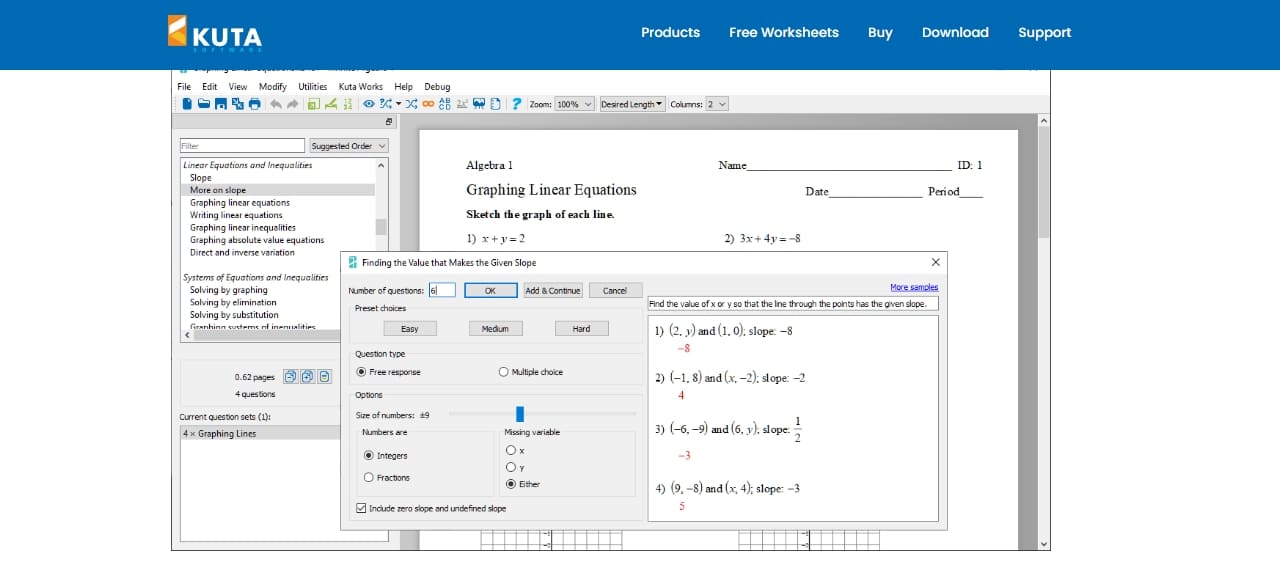
Kuta Software’s most powerful feature is its ability to generate unlimited math questions with a single click. Once you create an assignment, you can regenerate all of its questions instantly while maintaining the same parameters and difficulty level. This feature is at the heart of the software and what makes it so valuable for teachers. Instead of searching for or creating problems manually, educators can focus on teaching while the software handles the problem generation.
The unlimited question feature works by allowing teachers to select the properties and parameters of questions rather than the questions themselves. When a question is replaced, the software generates a new one that follows the same mathematical concepts but uses different numbers, variables, or scenarios. This ensures that students get practice with the same skills without simply memorizing answers to specific problems.
Easy Spacing and Formatting
Kuta Software allows teachers to control the spacing and formatting of worksheets with just one click. Educators can easily give students enough room to show their work by increasing the spacing between problems, or save paper by decreasing the spacing when necessary. This feature is particularly useful for different types of assignments—tests might need more space for work, while practice worksheets can be more condensed.
The software also provides manual spacing controls for teachers who want more precise formatting. Additionally, Kuta Software supports various paper sizes and margins, allowing educators to print assignments on any paper their printer supports. The questions automatically reposition for different paper sizes, eliminating the need for cutting and pasting to fit assignments properly.
Presentation Mode for Classroom Teaching
Kuta Software includes a presentation mode that transforms the software into a powerful teaching aid when used with an LCD projector or display system. This feature allows teachers to display one to four questions at a time on a screen, making it ideal for classroom instruction, homework review, or interactive lessons.
When using presentation mode, teachers can:
- Change the zoom level to ensure students in the back of the room can read clearly
- Draw lines beside questions to organize work when solving problems
- Jump quickly to different questions during review sessions
- Reveal answers to check student understanding
- Show or hide question numbers and directions as needed
This feature saves significant time during both lesson planning and classroom instruction. Teachers can prepare examples with the software and then display them professionally during class, eliminating the need to write problems by hand on the board.
Multiple-Version Printing
Kuta Software enables teachers to print multiple versions of the same assignment with different questions or scrambled order. This feature is invaluable for creating unique tests for different class periods, preventing cheating, and providing make-up exams that cover the same material with different problems.
Teachers have complete control over how new versions are created:
- Scramble multiple-choice answer choices
- Scramble the order of questions
- Generate entirely new questions while maintaining the same parameters
- Save each new version after creation for future use
This version control capability ensures that each student receives a unique assessment while covering the same mathematical concepts and difficulty levels.
Assignment Scaling
The scaling feature allows teachers to proportionally increase or decrease the number of questions in an assignment. This is particularly useful for lesson planning and differentiation. Teachers can create a few example problems for classroom demonstration and then scale up to generate a full homework assignment with dozens of similar problems.
The scaling feature maintains the same question parameters while generating new problems, ensuring consistency in difficulty and content coverage. This saves teachers significant time in lesson preparation, as they don’t need to design new questions when creating assignments of different lengths.
Question Export Capabilities
Kuta Software allows teachers to export questions as bitmap images for use in other programs. This feature enables educators to integrate Kuta-generated problems into existing assignments created with word processors or presentation software. Teachers can also refresh old assignments by replacing outdated questions with new ones generated by Kuta Software.
All question types are available for export, including those with graphs, diagrams, and complex mathematical notation. This flexibility makes Kuta Software compatible with other educational tools and workflows that teachers may already be using.
Multiple-Choice and Free-Response Options
Every question created with Kuta Software can be toggled between free-response and multiple-choice formats. This versatility allows teachers to create different types of assessments based on their educational objectives. Multiple-choice questions come with intelligent, potentially misleading answer choices that reflect common student mistakes or random but plausible incorrect answers.
Teachers control the number of choices for multiple-choice questions, from two to five options. This flexibility enables educators to create assessments appropriate for different grade levels and difficulty levels while maintaining consistent formatting and quality.
Assignment Merging
Kuta Software allows teachers to merge two or more assignments into one cohesive document. This feature is particularly useful for creating comprehensive unit tests, midterm exams, or final reviews. Teachers can combine assignments from different lessons or units and then scale the total to an appropriate length.
When assignments are merged, the software generates new questions that follow precisely from what was taught, ensuring that the combined assessment accurately reflects the covered material while providing fresh problems for students to solve.
Accurate Diagrams and Graphs
All diagrams and graphs in Kuta Software are drawn to scale and mathematically accurate, except when revealing the answer would give away the solution. This attention to detail helps students develop intuitive understanding of geometric concepts, measurements, and graphical representations.
For example, if an angle is labeled as 30° in a diagram, it truly is a 30° angle. If a triangle’s sides are labeled with lengths 3, 4, and 5, the diagram accurately represents a right triangle with those proportions. This accuracy in visual representation supports conceptual understanding and helps students connect abstract mathematical concepts with visual representations.
The software also includes a graphing utility that allows teachers to create high-quality graphs and graph paper of any size. Each graph can display zero to two functions and can be sized according to specific teaching needs. Teachers can also tile graphs across a page to maximize paper efficiency.
Custom Directions and Questions
Kuta Software enables teachers to enter custom directions and create their own questions when needed. This feature allows for the creation of specialized problem types that may not be available in the standard question bank. Custom questions can be formatted as either free-response or multiple-choice and can include mathematical expressions and equations.
The ability to modify automatically-generated questions provides additional flexibility. If a teacher wants to slightly alter a question or change specific parameters, they can do so manually. This combination of automated generation and manual customization gives teachers complete control over the content they create.
Kuta Software Products and Pricing
Individual Software Products
Kuta Software offers six main products, each focused on a specific mathematical subject area:
- Infinite Pre-Algebra
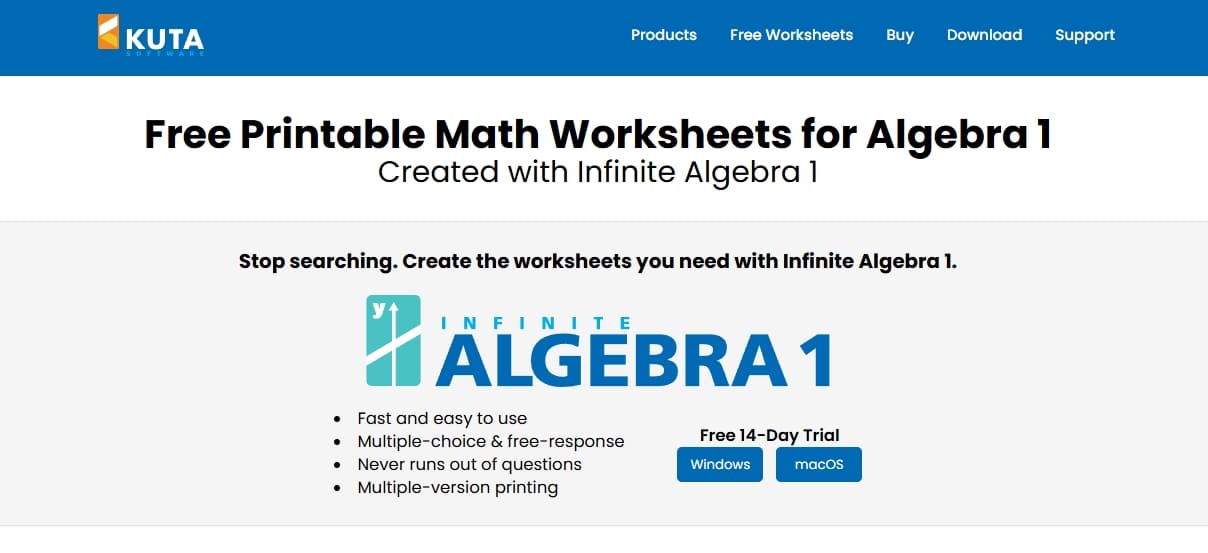
- Infinite Algebra 1
- Infinite Geometry
- Infinite Algebra 2
- Infinite Precalculus
- Infinite Calculus
Each product is a standalone application that provides comprehensive coverage of its respective subject area. The software is available for both Windows and Mac operating systems, ensuring compatibility with most school and personal computers. You can try free version here.
Pricing Structure
Kuta Software offers flexible pricing options to meet different needs and budgets:
For single-user licenses (lifetime license for one person, limit two computers):
- One program: $150
- Two programs: $260
- Three programs: $370
- Four programs: $480
- Five programs: $590
- Six programs: $700
For site licenses (unlimited use at one campus of one school for three years, with installation on home computers):
- One program: $400
- Two programs: $690
- Three programs: $980
- Four programs: $1,270
- Five programs: $1,560
- Six programs: $1,850
Kuta Works: The Online Platform
Kuta Works is an additional software platform that allows teachers to post assignments online for students to complete digitally. This add-on service is particularly valuable for distance learning, flipped classrooms, or schools with 1:1 device programs.
Kuta Works seats are priced at $1 per seat, with each seat being good for one student in one course for one semester. Unused seats never expire and can be transferred between teachers, providing flexibility for changing class sizes and enrollment.
Features of Kuta Works include:
- Online assignment completion
- Automatic grading
- Tracking of student progress and time spent
- Student-flagged questions for teacher review
- Course cloning capabilities
- Integration with standard assignment banks
Benefits of Using Kuta Software
Time Savings for Teachers
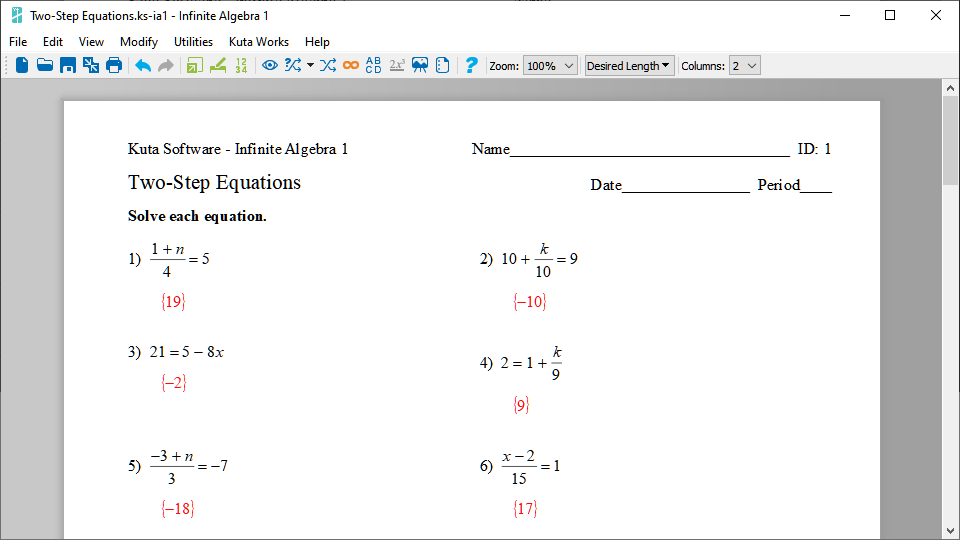
Kuta Software significantly reduces the time teachers spend creating worksheets, quizzes, and tests. Instead of spending hours writing problems, formatting documents, and creating answer keys, teachers can generate professional-quality materials in minutes. This time savings allows educators to focus more on lesson planning, student interaction, and individualized instruction.
The software’s ability to regenerate questions with a single click means that teachers can quickly create new materials each year without starting from scratch. This feature is particularly valuable for teachers who teach multiple sections of the same course or who want to provide fresh practice problems for students who need additional support.
Consistency and Quality
Kuta Software ensures consistency in the quality and formatting of mathematical materials. All problems generated by the software follow proper mathematical notation and conventions, eliminating errors that can occur when manually creating complex mathematical expressions. The consistent formatting also helps students focus on the mathematical concepts rather than deciphering poorly presented problems.
The accuracy of diagrams and graphs in Kuta Software materials supports visual learning and helps students develop better intuition about mathematical relationships. This consistency in visual representation is difficult to achieve when creating materials by hand, especially for complex geometric concepts or graphical representations.
Differentiation and Personalization
Kuta Software makes it easy for teachers to differentiate instruction and provide personalized practice materials. Teachers can quickly create assignments at different difficulty levels by adjusting the parameters of generated questions. They can also create targeted practice sets for students who need additional support on specific concepts.
The ability to generate multiple versions of assignments allows teachers to provide appropriate challenges for different students while covering the same core concepts. This flexibility supports inclusive teaching practices and helps meet the diverse needs of students in mixed-ability classrooms.
Alignment with Educational Standards
Kuta Software aligns with the Common Core Curriculum and other educational standards. The topics covered in each subject area correspond to standard high school mathematics curricula, making it easier for teachers to develop lesson plans that meet required standards. This alignment reduces the time teachers spend searching for or creating materials that address specific standard requirements.
The software’s comprehensive coverage of mathematical topics ensures that teachers can find appropriate problems for virtually any concept in the secondary mathematics curriculum. This extensive coverage makes Kuta Software a valuable resource throughout the entire school year.
How to Use Kuta Software: A Step-by-Step Guide
Getting Started
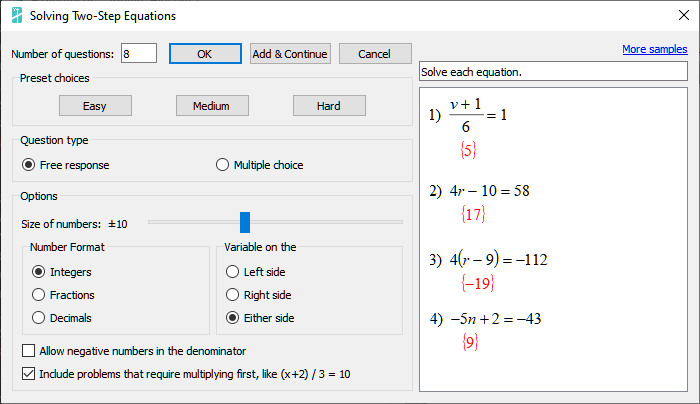
Using Kuta Software begins with downloading and installing the desired subject-specific program. The company offers a free 14-day trial for each of its six products, allowing teachers to evaluate the software before purchasing. The installation process is straightforward, and the software runs locally on the teacher’s computer, requiring no internet connection for basic functionality.
Once installed, teachers can immediately begin creating assignments by following these simple steps:
- Choose the type of question to create: Select from the comprehensive list of topics organized by mathematical concept and difficulty level.
- Customize the questions: Adjust parameters such as difficulty level, number of problems, and question format (multiple-choice or free-response).
- Set the title and review the assignment: Add a title, teacher name, course information, and other identifying details, then review the generated assignment.
- Print or export the assignment: Choose from various printing options or export questions for use in other documents.
Creating Customized Assignments
Creating customized assignments with Kuta Software is intuitive and efficient. The software’s user interface is designed to be user-friendly, with clear menus and options that make it easy to generate exactly the type of problems needed for a particular lesson or assessment.
Teachers can customize assignments in numerous ways:
- Select specific topics or mix multiple topics in a single assignment
- Adjust the difficulty level of problems
- Control the number of problems generated
- Choose between multiple-choice and free-response formats
- Add custom directions or instructions
- Include diagrams, graphs, or other visual elements
- Control spacing and formatting for optimal student use
Managing and Organizing Materials
Kuta Software helps teachers organize and manage their instructional materials efficiently. Assignments can be saved for future use, modified as needed, and organized by topic, unit, or course. The software maintains a library of created assignments, making it easy to find and reuse materials from previous years or semesters.
The ability to merge assignments allows teachers to combine materials from different lessons or units to create comprehensive reviews or assessments. This feature is particularly valuable at the end of grading periods or when preparing students for cumulative exams.
Kuta Software vs. Alternatives
Comparison with Traditional Worksheet Creation
Kuta Software offers significant advantages over traditional methods of creating math worksheets. Manually creating worksheets involves writing problems, formatting mathematical notation, creating answer keys, and ensuring consistency—all time-consuming tasks that can take hours for a single assignment. Kuta Software automates these processes, reducing creation time from hours to minutes.
Traditional methods also limit the number of practice problems available, as teachers must create each one individually. With Kuta Software, teachers can generate unlimited variations of problems, ensuring that students always have fresh practice materials. This unlimited generation capability is impossible to achieve with manual creation methods.
Comparison with Online Worksheet Banks
Unlike static online worksheet banks that offer a fixed set of problems, Kuta Software provides dynamic question generation. Worksheet banks typically have a limited number of problems for each topic, and once students have completed them, teachers must find new sources. Kuta Software can generate new problems indefinitely, ensuring that practice materials never run out.
Online worksheet banks also offer limited customization options. Teachers must use the problems as they appear, with little ability to adjust difficulty, format, or content. Kuta Software provides extensive customization capabilities, allowing teachers to tailor materials precisely to their instructional needs and student requirements.
Comparison with Other Educational Software
Kuta Software distinguishes itself from other educational software through its specialized focus on mathematics and worksheet generation. While many educational platforms offer math content, few provide the depth and flexibility of Kuta Software’s question generation capabilities. The software’s mathematical accuracy, attention to detail in diagrams and graphs, and alignment with standard curricula make it a preferred choice for many math teachers.
Other educational software often requires internet connectivity and may involve subscription fees. Kuta Software’s desktop applications work offline and involve a one-time purchase rather than recurring subscription costs. This pricing model can be more economical for schools and teachers in the long run.
Real-World Applications of Kuta Software
Classroom Instruction
Kuta Software enhances classroom instruction through its presentation mode and instant problem generation capabilities. Teachers can use the software to display problems during lessons, work through examples with students, and provide immediate practice opportunities. The ability to generate new problems instantly allows teachers to respond to student questions and needs in real-time.
For example, if students are struggling with a particular type of problem, the teacher can immediately generate additional examples for practice. If the class masters a concept quickly, the teacher can generate more challenging problems to extend learning. This responsiveness to student needs is difficult to achieve with pre-made materials.
Homework and Practice
Kuta Software simplifies the creation of homework assignments and practice materials. Teachers can quickly generate assignments that reinforce concepts taught in class, with appropriate difficulty levels and sufficient practice opportunities. The ability to create multiple versions of assignments allows for differentiated homework that meets individual student needs.
The software’s formatting options ensure that homework assignments are clear, well-organized, and provide adequate space for students to show their work. This attention to detail in presentation helps students focus on the mathematical content rather than struggling with poorly formatted materials.
Assessment and Evaluation
Kuta Software streamlines the assessment process by enabling teachers to create quizzes, tests, and exams efficiently. The software’s question generation capabilities ensure that assessments cover the appropriate content and difficulty levels. The ability to create multiple versions of tests helps maintain academic integrity while allowing for fair evaluation of all students.
The automatic creation of answer keys saves teachers significant time in grading and allows for quick feedback to students. This efficiency in assessment creation and grading enables teachers to spend more time analyzing student performance and planning subsequent instruction.
Tips for Maximizing the Benefits of Kuta Software
Start with the Free Trial
Teachers should take advantage of Kuta Software’s 14-day free trial to explore the software’s capabilities before purchasing. The trial allows full access to all features except the ability to print to PDF, giving teachers a comprehensive understanding of how the software can meet their needs. During the trial period, teachers can experiment with different question types, formatting options, and features to determine which products would be most beneficial for their specific teaching context.
Explore All Features
Kuta Software offers numerous features beyond basic question generation that can enhance teaching and learning. Teachers should take time to explore all the capabilities of the software, including presentation mode, graphing utilities, assignment merging, and customization options. Understanding these features allows teachers to use the software more effectively and creatively in their instructional practice.
The software’s user guide and tutorial videos provide valuable information about using all features effectively. Teachers who invest time in learning about these capabilities often discover new ways to integrate the software into their teaching.
Create a Personal Library
Building a personal library of assignments and resources in Kuta Software maximizes long-term efficiency. Teachers should save well-designed assignments, quizzes, and tests for future use, organizing them by topic, unit, or course. Over time, this library becomes a valuable resource that can be adapted and reused year after year.
The ability to modify and regenerate questions means that saved assignments can be easily updated to reflect changes in curriculum, teaching emphasis, or student needs. This adaptability ensures that materials remain relevant and effective over time.
Combine with Other Teaching Strategies
Kuta Software works best when integrated with a variety of teaching strategies and approaches. While the software excels at generating practice problems and assessments, effective mathematics instruction involves conceptual development, collaborative learning, and real-world applications. Teachers should use Kuta Software as one component of a comprehensive instructional program.
For example, teachers might use Kuta Software to generate practice problems after introducing a concept through hands-on activities or real-world examples. The software’s problems can then reinforce and extend student understanding developed through other instructional methods.
Challenges and Limitations of Kuta Software
Learning Curve
New users of Kuta Software may experience a learning curve as they become familiar with the software’s interface and features. While the basic functions are intuitive, mastering all the capabilities and customization options takes time and practice. Some teachers report that it takes several weeks of regular use to become fully proficient with the software.
The company provides user guides and technical support to help teachers overcome this initial learning curve. Additionally, many schools have experienced Kuta Software users who can mentor and support colleagues who are new to the software.
Limited Presentation Features
Kuta Software’s presentation mode, while useful, has some limitations compared to dedicated presentation software. Teachers cannot mark up questions directly in presentation mode, which limits interactive teaching possibilities. To annotate or mark up problems during instruction, teachers must export questions to other software or use additional tools.
This limitation can be addressed by using Kuta Software in combination with other presentation tools or interactive whiteboard software. Many teachers develop workflows that integrate Kuta Software with their existing presentation systems.
Standardized Question Types
The questions generated by Kuta Software follow standard formats and may not include the creative or challenging problems that some teachers prefer. While the software offers difficulty level adjustments, the problems generally follow conventional structures and approaches. Teachers who specialize in creating highly original or unconventional problems may find the software’s output somewhat predictable.
This limitation can be mitigated by using Kuta Software for basic practice and assessment while creating more specialized problems manually. The software’s export features allow teachers to integrate Kuta-generated problems with their own original materials.
Future Developments and Trends
Integration with Learning Management Systems
Future developments in Kuta Software may include enhanced integration with learning management systems (LMS) and other educational technology platforms. As schools increasingly adopt digital ecosystems for instruction and assessment, seamless integration between different tools becomes more important. Enhanced LMS integration would allow for easier assignment distribution, submission, and grading workflows.
The Kuta Works platform already represents a step in this direction by offering online assignment completion and automatic grading. Future iterations may expand these capabilities and improve integration with popular LMS platforms.
Expanded Subject Coverage
Kuta Software may expand its offerings to include additional mathematical subjects or grade levels. Currently, the software focuses on secondary mathematics from Pre-Algebra through Calculus. There is potential for expansion into elementary mathematics, advanced college-level topics, or specialized mathematical applications.
Such expansion would make the software valuable to a broader range of educators and educational contexts. The company’s commitment to mathematics education suggests that they will continue to develop and refine their product offerings based on teacher needs and educational trends.
Enhanced Customization and Artificial Intelligence
Future versions of Kuta Software may incorporate artificial intelligence to provide enhanced customization and adaptive learning capabilities. AI could help teachers create assignments that adapt to individual student needs, provide more sophisticated problem generation, or offer insights into student learning patterns.
These advancements would build on Kuta Software’s existing strengths in question generation and customization, making the software even more powerful and responsive to teacher and student needs.
Conclusion
Kuta Software has established itself as an essential tool for mathematics educators through its powerful question generation capabilities, user-friendly interface, and comprehensive coverage of secondary mathematics topics. The software addresses a critical need in mathematics education by enabling teachers to create unlimited practice problems, worksheets, and assessments efficiently and effectively. This capability saves teachers significant time while ensuring that students have access to high-quality, mathematically accurate practice materials.
The software’s success stems from its foundation in actual classroom experience and understanding of teachers’ needs. Developed by math educators with years of classroom teaching experience, Kuta Software reflects a deep understanding of the challenges and requirements of mathematics instruction. This teacher-centered approach is evident in the software’s practical features, intuitive design, and focus on solving real problems that teachers face daily.
As education continues to evolve with technological advancements and changing instructional approaches, Kuta Software is well-positioned to remain a valuable resource for mathematics teachers. The company’s commitment to continuous improvement, responsiveness to teacher feedback, and focus on mathematical accuracy and educational effectiveness ensures that its products will continue to meet the needs of educators and students. Whether used for classroom instruction, homework assignments, or assessment, Kuta Software provides a powerful solution that enhances mathematics teaching and learning.
Frequently Asked Questions About Kuta Software
Is Kuta Software suitable for elementary school mathematics instruction?
No. Kuta Software is specifically designed for secondary mathematics education, covering Pre-Algebra through Calculus. The software’s content and features are tailored to middle school, high school, and early college mathematics instruction.
Can Kuta Software be used on both Windows and Mac computers?
Yes. Kuta Software offers versions for both Windows and Mac operating systems, ensuring compatibility with most school and personal computers used by educators.
Does Kuta Software require an internet connection to function?
No. The core Kuta Software applications run locally on the teacher’s computer and do not require an internet connection for basic functionality. However, the Kuta Works online platform does require internet connectivity for student access and assignment submission.
Is Kuta Software aligned with Common Core State Standards?
Yes. The topics covered in Kuta Software products align with the Common Core Curriculum and other educational standards, making it easier for teachers to develop materials that meet standard requirements.
Can teachers create their own custom questions in Kuta Software?
Yes. While the software excels at automatically generating questions, teachers can also create custom questions from scratch or modify automatically-generated questions to meet specific instructional needs.
Does Kuta Software offer solutions and answer keys for generated problems?
Yes. Kuta Software automatically generates answer keys for all assignments, with options for how answers are reported (on separate sheets, in context, etc.), saving teachers significant time in grading and assessment.
Is there a mobile version of Kuta Software available?
No. Kuta Software is currently available only as desktop applications for Windows and Mac computers. However, the Kuta Works platform allows students to complete assignments online using various devices.
Can multiple teachers share a Kuta Software license?
No. Single-user licenses are intended for individual use and are limited to installation on two computers per person. Schools should purchase site licenses for multiple teacher access.
Does Kuta Software provide training or support for new users?
Yes. Kuta Software offers user guides, technical support, and a 14-day free trial to help teachers learn to use the software effectively. The company also provides phone and email support during business hours.
Can Kuta Software problems be exported to other document formats?
Yes. Kuta Software allows questions to be exported as bitmap images that can be pasted into word processors or other software, enabling integration with existing documents and presentations.
You May Also Like
 Best Software
10 Best Inventory Control Software for Small Business in 2026
 Best Software
Top 10 Free & Open Source Inventory Management Software in 2026
 Best Software
12 Best AI Chatbot Software To Increase Your Conversions In 2026
 Best Software
23 Best Free Avatar Creator Sites Online To Create Your Own Avatars
 SaaS
SaaS11 Best VoIP Call Center Solutions for Small Business 2026 (Comparison Guide)
 Best Software
6 Best Software to Record Mouse and Keyboard Actions and Automate Repetitive Tasks
 Best Software
Jira vs Hive: Which Project Management Tool is Right for Your Team?
 Best Software
8 Best Free Registry Cleaners Tools to Clean Junk and Registry on Windows PC
 Best Software