AI phishing attacks use smart technology to create fake messages that look real. These attacks combine machine learning and artificial intelligence to craft personalized scams that trick both people and security systems. The global cost of cybercrime will reach $13.82 trillion by 2028, with AI-powered scams driving much of this growth. As artificial intelligence becomes easier to access, criminals use these tools to launch sophisticated attacks that were once impossible to create at scale.
AI phishing combines automation with personalization to create threats that spread widely yet target specific individuals. Unlike old phishing emails filled with spelling mistakes and generic messages, AI-generated scams can copy writing styles, include personal details, and adapt in real-time. Research shows that only 0.7% to 4.7% of current phishing emails are fully AI-generated, but this number will rise quickly as the technology improves. Understanding these threats helps you and your organization stay safe in this new era of cybercrime.
What Are AI Phishing Attacks?
AI phishing attacks are cyber threats that use artificial intelligence to create and run fake schemes. These attacks rely on machine learning algorithms, large language models (LLMs), and other AI tools to generate convincing fake communications. Unlike traditional phishing, AI-powered attacks can produce thousands of unique, personalized messages in minutes instead of hours. The technology lets criminals overcome many limits that once made phishing easier to spot.
The main parts of AI phishing include natural language processing, data scraping, and automation tools. Natural language processing helps AI systems understand and create human-like text, while data scraping collects personal information from social media, company websites, and public records. Automation lets attackers launch huge campaigns with little human help. These parts work together to create phishing attempts that are more advanced, personalized, and harder to detect than traditional ones.
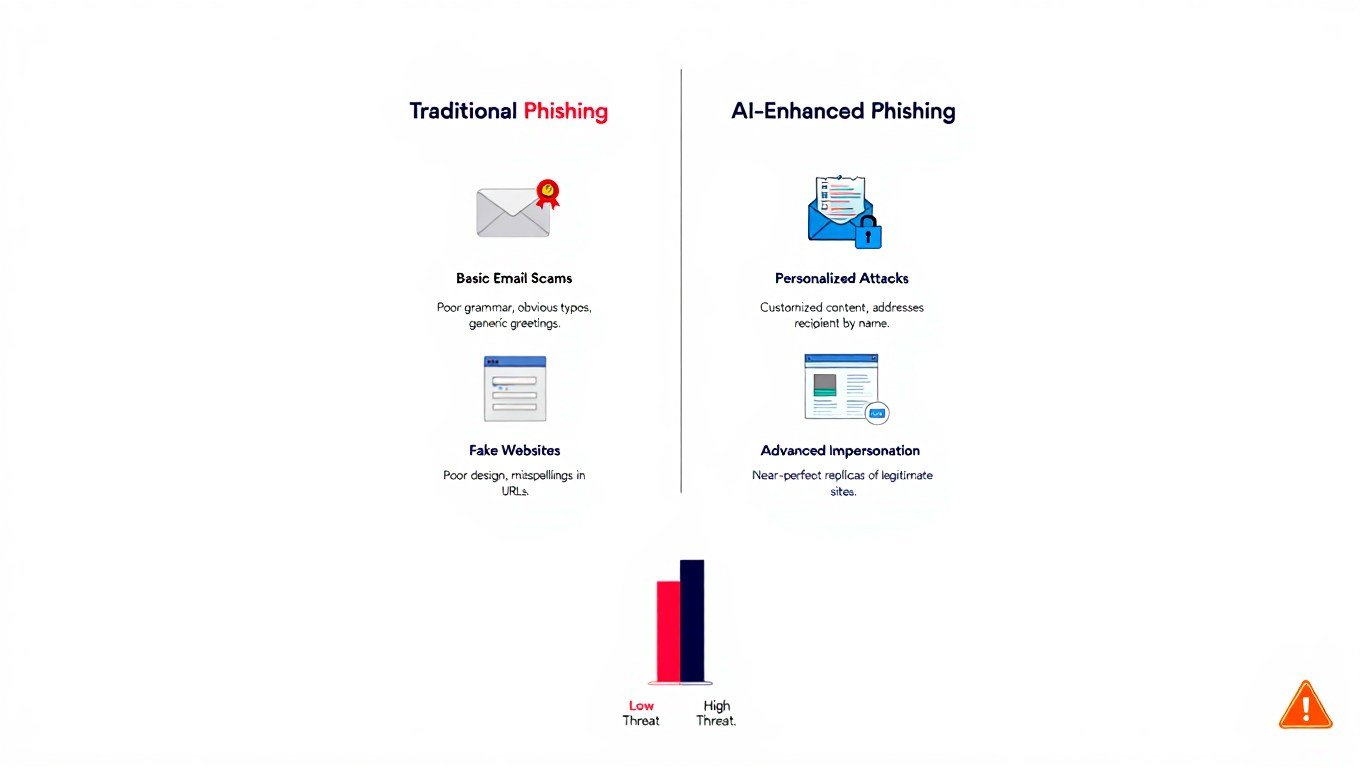
To protect yourself, understanding your digital footprint is essential since attackers use this information to craft convincing messages. AI phishing attacks differ from traditional phishing in several ways. Traditional phishing often uses generic messages with spelling errors, while AI phishing creates personalized content with perfect grammar. Traditional phishing requires manual effort for each message, but AI phishing can generate thousands of unique messages automatically. Traditional phishing is static and doesn’t adapt, whereas AI phishing can change based on how victims respond.
How Does AI Make Phishing More Effective?
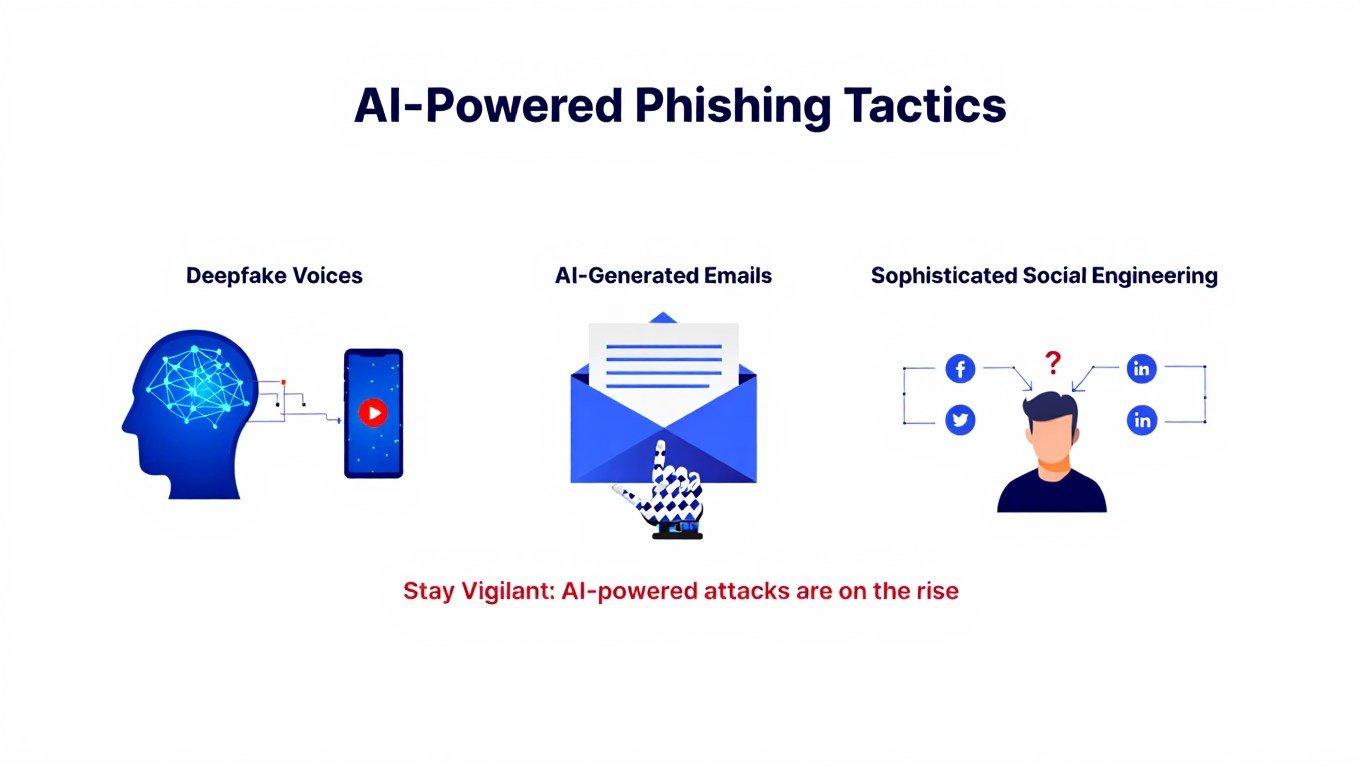
AI makes phishing more effective by removing traditional warning signs and enabling mass personalization. Machine learning algorithms can study millions of real communications to understand writing patterns, company jargon, and personal communication styles. This lets AI systems create phishing messages that sound exactly like they come from trusted sources such as bosses, coworkers, or service providers. The technology has cut the time and skill needed to create convincing phishing attempts.
Large language models like ChatGPT have changed phishing by creating context-appropriate messages in seconds. While these models have rules against harmful use, criminals have found ways to bypass these limits through clever prompts. Attackers can now produce hundreds of phishing email variations in the time it would take a person to write just one. Some have even created harmful versions of these models, such as FraudGPT, WormGPT, and PoisonGPT, which you can find on the dark web specifically for criminal activities.
According to Barracuda’s research, AI enhances phishing effectiveness through several key capabilities: natural language generation that removes spelling and grammar errors, contextual awareness that includes current news and events, behavioral analysis that adapts messages based on victim responses, multi-channel coordination that combines email, voice, and video elements, and continuous learning that improves attack success rates over time.
The biggest advantage of AI in phishing is its ability to create highly personalized attacks. AI systems can scrape social media profiles, company websites, and public records to gather specific details about targets. This information then gets woven into phishing messages to create a sense of authenticity that traditional phishing cannot achieve. For example, an AI might mention a recent company merger, reference specific projects, or use personal details like vacation plans to make the fake message more convincing.
What Types of AI Phishing Attacks Exist?
AI phishing attacks come in many forms, each using different artificial intelligence technologies to deceive victims. These attacks range from advanced email campaigns to multi-channel operations that combine text, audio, and video elements. Understanding the different types of AI phishing helps you develop effective defense strategies against these evolving threats. As AI technology continues to advance, criminals find new ways to exploit these tools for fraudulent purposes.
Email-Based AI Phishing Attacks
AI-generated email phishing is the most common form of AI-powered cyber attacks today. These attacks use large language models to create convincing emails that mimic real communications. The technology can generate thousands of unique email variations, each with personalized content designed to trick specific recipients. Unlike traditional phishing emails that often contain obvious errors, AI-generated messages feature perfect grammar, natural tone, and contextually relevant content.
Business Email Compromise (BEC) attacks have become especially effective with AI help. In these scams, AI analyzes company communication patterns to create messages that sound exactly like they come from executives or trusted partners. A 2024 study found that 60% of participants fell victim to AI-generated phishing emails, with success rates similar to human-crafted attacks. The AI can even copy the specific writing style of the person being impersonated, making these attacks extremely hard to detect.
Voice Cloning and Vishing Attacks
AI-powered voice cloning has transformed vishing (voice phishing) into a highly effective threat. Modern AI systems can create near-perfect voice replicas using just a few minutes of audio recordings. In one notable case, a UK energy firm CEO was tricked into transferring $243,000 after receiving a call from an AI-generated voice that perfectly copied his German boss, including accent and speech patterns. The technology has become so advanced that victims often cannot tell the difference between real and cloned voices.
Voice cloning attacks typically follow a predictable pattern. First, attackers gather voice samples from social media, company videos, or recorded calls. Then, AI systems learn the target’s speech patterns, accent, and intonation. Next, AI creates convincing dialogue based on the situation. After that, attackers use the cloned voice in real-time calls or pre-recorded messages. Finally, additional AI-generated communications reinforce the scam.
Deepfake Video Phishing
Deepfake video phishing represents one of the most sophisticated forms of AI-powered attacks. These attacks use AI to create realistic video content that shows people saying or doing things they never actually did. In early 2024, a finance employee at Arup’s Hong Kong office was deceived into transferring $25 million after participating in a video conference with AI-generated deepfakes of the company’s CFO and other senior executives. The level of detail in these deepfakes, including realistic facial movements and lip synchronization, made the fraudulent video call completely convincing.
Deepfake phishing attacks are particularly dangerous because they exploit our natural tendency to trust visual evidence. The technology can create fake video conferences, impersonate authority figures during important meetings, or generate fake news announcements. As video conferencing becomes standard in business operations, the threat of deepfake phishing continues to grow. Security experts predict that these attacks will become more common as the technology becomes more accessible to criminals.
Multi-Channel AI Phishing Campaigns
The most sophisticated AI phishing attacks combine multiple channels to create complete deception campaigns. These multi-pronged attacks might start with an AI-generated email, include a follow-up voice call with cloned audio, and feature social media posts from AI-generated fake accounts. This approach creates a consistent story across different platforms, making the scam much more convincing and difficult to question. Victims receive the same fraudulent message through multiple trusted channels, reinforcing the illusion of legitimacy.
Multi-channel AI phishing typically includes email communications that perfectly mimic organizational tone and style, voice synthesis that can clone executives’ voices for phone calls, video manipulation creating convincing deepfake meetings, real-time chat responses from AI-powered chatbots, and social media manipulation with armies of fake accounts supporting the scam. According to IT Governance, these coordinated attacks represent the future of cybercrime.
How Can You Detect AI-Generated Phishing?
Detecting AI-generated phishing requires a combination of technological tools and human vigilance. As AI technology improves, traditional warning signs like spelling errors and awkward phrasing become less reliable indicators of fake communications. You and your organization must adopt new detection strategies that focus on behavioral analysis, verification protocols, and advanced security technologies. The key is to create multiple layers of defense that can identify AI-generated content even when it appears perfectly legitimate.
Visual Detection Methods
Visual detection remains one of the first lines of defense against AI phishing attacks. While AI-generated text has become nearly flawless, visual elements often contain subtle inconsistencies that can reveal fraudulent content. For deepfake videos, look for unnatural facial movements, inconsistent lighting or shadows, and unusual blinking patterns. These visual artifacts occur because AI systems still struggle to perfectly replicate the complex physics of human movement and lighting interactions.
Key visual indicators of AI-generated content include facial inconsistencies such as unnatural expressions or movements, lighting and shadow anomalies that don’t follow real-world physics, unusual blinking patterns or eye movements that seem robotic, edge distortion around faces or objects in videos, and inconsistent backgrounds that don’t match the foreground properly.
For profile pictures and images, reverse image searches can help identify AI-generated or stolen content. Many AI phishing attacks use profile pictures created by generative AI or taken from other sources without permission. A quick reverse image search can reveal if the picture has been used elsewhere or was generated by an AI system. This simple verification step can prevent many social engineering attacks that rely on fake identities.
Audio Detection Techniques
Audio detection techniques focus on identifying the subtle imperfections in AI-generated voice content. While modern voice cloning can produce remarkably realistic results, there are still technical limitations that create detectable artifacts. Listen for unnatural pauses, odd speech rhythms, and inconsistencies in tone or emotion that might indicate AI-generated audio. These audio cues often become more apparent when you know what to listen for.
Common audio indicators of AI voice cloning include unnatural pauses or rhythm patterns that don’t match normal speech, strange background noises or audio artifacts, inconsistent emotional tone that doesn’t match the content, robotic qualities or processed-sounding elements, and lack of natural breathing sounds or other human vocal characteristics.
Background noise analysis can also reveal AI-generated audio. Human recordings typically contain consistent background noise throughout, while AI-generated audio might have inconsistent or artificial-sounding background elements. Pay attention to how the ambient sound changes during the conversation, as sudden shifts might indicate AI manipulation. This technique requires careful listening but can be effective for identifying voice cloning attacks.
Behavioral Analysis
Behavioral analysis focuses on identifying patterns and inconsistencies in how the communication unfolds. AI phishing attacks often follow predictable patterns that differ from legitimate human interactions. Be suspicious of unexpected messages that create a sense of urgency or pressure you to act quickly. These psychological pressure tactics are common in phishing attacks because they prevent victims from taking time to verify the request.
Behavioral red flags include unexpected communications from people who don’t normally contact you, urgent requests that demand immediate action, unusual payment methods or financial requests, deviations from established communication patterns, and requests to bypass normal security procedures. Following a personal cybersecurity checklist can help you stay vigilant against these tactics.
Context verification is crucial for behavioral analysis. If you receive an unusual request from a colleague or executive, verify it through a separate communication channel. For example, if your boss emails you requesting an urgent wire transfer, call them at their known phone number to confirm the request. This simple verification step can prevent even the most sophisticated AI phishing attacks.
Technological Detection Tools
AI detection software and advanced security tools provide technological solutions for identifying AI-generated phishing attempts. These tools use machine learning algorithms to analyze content for patterns that indicate AI generation. While no detection tool is 100% foolproof, they can significantly improve your ability to identify AI phishing attacks. Organizations should implement multiple layers of technological protection to defend against these evolving threats.
Advanced detection technologies include AI-powered email security that analyzes communication patterns, blockchain-based verification for important communications, multifactor authentication to prevent unauthorized access, behavioral analysis tools that flag unusual activities, and deepfake detection software that identifies synthetic media. Endpoint protection solutions are also evolving to address these new threats.
Security awareness training platforms now incorporate AI phishing simulations to help employees recognize these new threats. These training programs use actual AI-generated content to teach people how to spot the subtle indicators of AI phishing. Regular training and simulation exercises are essential for maintaining vigilance against AI-powered attacks. As the technology continues to evolve, ongoing education becomes increasingly important for effective defense.
What Are Real-World Examples of AI Phishing Attacks?
Real-world examples of AI phishing attacks show the serious threat these technologies pose to individuals and organizations. These cases demonstrate how criminals are already using AI to execute sophisticated scams that result in significant financial losses. Understanding these examples helps you recognize the patterns and tactics used in AI phishing attacks. The following cases illustrate the current state of AI-powered cybercrime and its potential impact.
The $25 Million Deepfake Video Conference Scam
In early 2024, a finance employee at Arup’s Hong Kong office was deceived into transferring $25 million after participating in a video conference with AI-generated deepfakes. The employee received a message seemingly from the company’s UK-based CFO requesting a confidential transaction. To alleviate any doubts, the employee was invited to a video conference where they interacted with what appeared to be the CFO and other senior staff members. Unknown to the employee, these individuals were AI-generated deepfakes that looked and sounded exactly like the real executives.
This case demonstrates several key aspects of modern AI phishing attacks. It shows multi-channel coordination combining email and video elements, high-level impersonation targeting C-suite executives, financial motivation with significant monetary impact, technical sophistication using advanced deepfake technology, and psychological manipulation creating a sense of legitimacy through video confirmation.
The $25 million loss represents one of the largest known cases of AI phishing to date. This incident sent shockwaves through the cybersecurity community and highlighted the urgent need for new defense strategies against AI-powered attacks. The case also showed how traditional verification methods can fail when faced with sophisticated deepfake technology. Organizations worldwide began reevaluating their security protocols in response to this high-profile incident.
The UK Energy Firm Voice Cloning Attack
A UK-based energy firm was defrauded of $243,000 when attackers used AI-generated audio to mimic the voice of the company’s German CEO. In one of the first public attacks of its type, the fraudsters convinced the UK CEO to transfer funds to a Hungarian supplier. The voice replication was so convincing that it included the CEO’s slight German accent and speech patterns. The funds were subsequently moved through accounts in Hungary and Mexico before disappearing, making recovery nearly impossible.
This voice cloning attack revealed several important characteristics of AI-powered phishing. It showed minimal data requirements – only a few minutes of audio were needed. It demonstrated accent and speech pattern replication making the clone highly realistic. It involved international coordination with funds moved across multiple countries. It exploited trust in authority figures within organizations. It showed rapid execution with the entire scam completed in a short timeframe.
The case highlighted how voice cloning technology has advanced to the point where even familiar voices can no longer be trusted. Security experts noted that the CEO recognized the voice as authentic, demonstrating the effectiveness of modern AI voice synthesis. This attack prompted many organizations to implement additional verification steps for financial transactions, even when requests come from seemingly legitimate sources.
The Canadian Deepfake Investment Scam
Three Canadian men lost $373,000 (€342,000) after being tricked by deepfake videos featuring Justin Trudeau and Elon Musk. The victims believed these videos to be real and invested based on the fraudulent endorsements. This case showed how AI phishing can target individuals rather than organizations, using celebrity deepfakes to promote investment scams. The realistic nature of the videos made the fraudulent investment opportunities seem legitimate and trustworthy.
Key elements of this AI phishing attack included celebrity impersonation using high-profile public figures, financial fraud promoting fake investment opportunities, social proof through seemingly legitimate endorsements, individual targeting rather than corporate focus, and exploitation of trust in well-known personalities.
This case demonstrated the rise of ‘deepfake as a service’ on the dark web, where cybercriminals can purchase custom deepfake videos for their scams. The accessibility of this technology means that sophisticated AI phishing attacks are no longer limited to well-funded criminal organizations. Individual scammers can now access AI tools that were once available only to nation-state actors or large criminal enterprises.
The Polymorphic Email Campaign
A sophisticated polymorphic phishing campaign used AI to generate thousands of unique email variations during a single attack. Unlike traditional phishing campaigns that send the same message to all recipients, this attack randomized content, subject lines, and sender display names for each email. The polymorphic nature made each message appear personalized and unique, significantly increasing the success rate. Security systems struggled to detect the campaign because no two emails were exactly alike.
This AI-powered campaign showcased several advanced phishing techniques. It included content randomization creating unique messages for each recipient, automated personalization incorporating victim-specific details, evasion techniques designed to bypass traditional security filters, scalability allowing thousands of variations to be generated automatically, and adaptation with the ability to modify messages based on responses.
Security researchers noted that this type of AI-powered polymorphic attack represents the future of phishing. The ability to generate unique, personalized messages at scale makes traditional detection methods increasingly ineffective. Organizations must adopt AI-powered security solutions that can analyze communication patterns rather than just looking for specific keywords or sender information. This case highlighted the ongoing arms race between AI-powered attacks and AI-powered defenses.
How Can Organizations Protect Against AI Phishing?
Organizations can protect against AI phishing attacks by implementing comprehensive security strategies that combine technology, training, and procedural controls. As AI-powered attacks become more sophisticated, traditional security measures are no longer sufficient. A multi-layered defense approach is essential for protecting against these evolving threats. Organizations must adapt their security postures to address the unique challenges posed by AI-generated phishing attempts.
Technological Defense Solutions
Advanced AI-powered security tools provide the first line of defense against AI phishing attacks. These solutions use machine learning algorithms to analyze communication patterns and identify anomalies that might indicate AI-generated content. Unlike traditional security systems that rely on keyword matching or sender reputation, AI-powered defenses can understand the context and intent of communications. This contextual awareness is crucial for detecting sophisticated AI phishing attempts that appear legitimate on the surface.
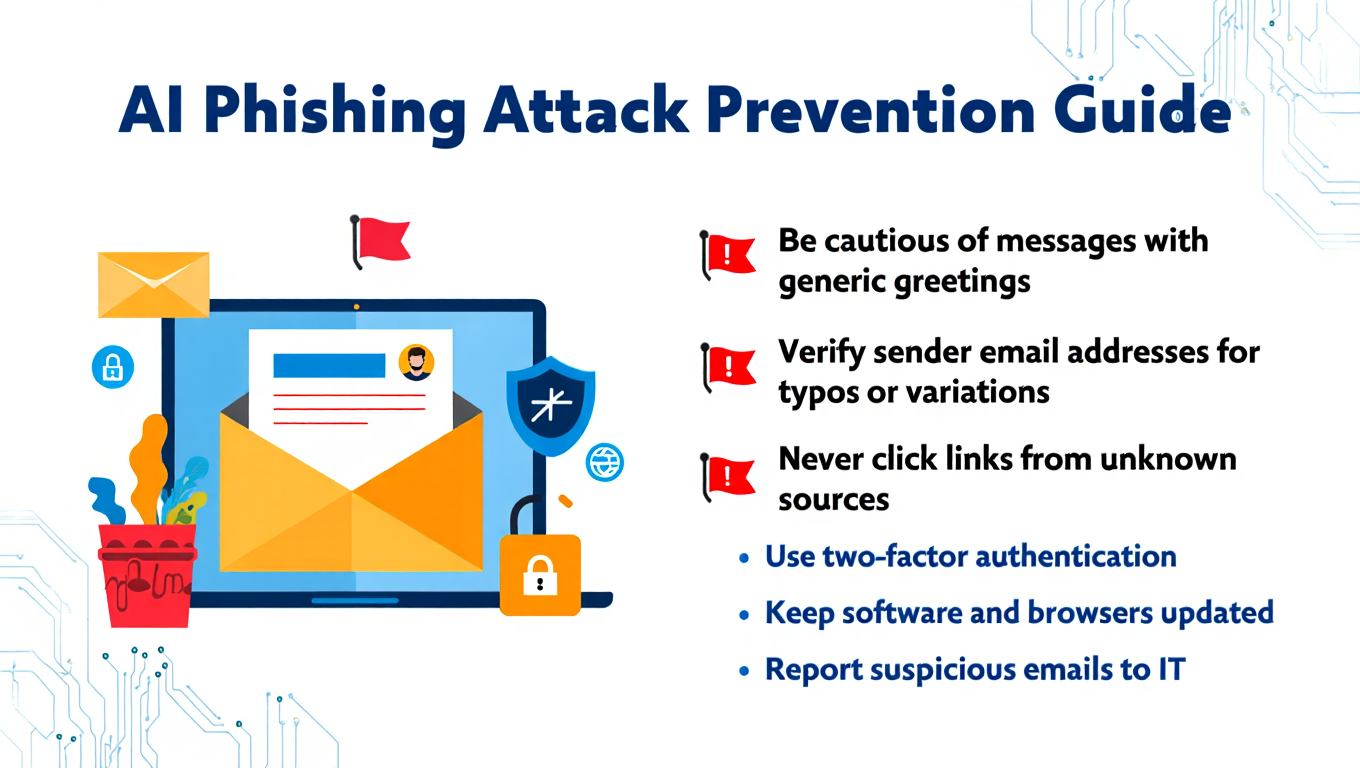
Essential technological defenses include AI-enhanced email security that analyzes communication patterns between senders and receivers, deepfake detection software that can identify synthetic media in real-time, voice authentication systems that can verify the identity of speakers during calls, behavioral analysis tools that flag unusual activities or requests, and multifactor authentication that prevents unauthorized access even if credentials are compromised. Data encryption technologies also play a vital role in protecting sensitive information.
Email security systems must evolve beyond traditional spam filters to address AI-generated content. Modern solutions like Check Point Harmony analyze each user’s historical email conversations to establish trust levels between senders and receivers. This approach allows the system to measure the intent of each message against established communication patterns. When a message deviates from these patterns, even if it appears legitimate, the system can flag it for further review.
Employee Training and Awareness
Employee training and awareness represent the human element of AI phishing defense. Technology alone cannot protect against all AI phishing attacks, especially those that exploit psychological manipulation. Organizations must foster a culture of security awareness where employees feel empowered to question suspicious communications. Regular training programs that evolve alongside emerging threats are essential for maintaining vigilance.
Effective security awareness training should include recognition of AI-generated content through visual and audio cues, verification procedures for unusual requests regardless of source, psychological awareness of manipulation tactics used in phishing attacks, reporting protocols for suspected phishing attempts, and continuous education about evolving AI phishing techniques. Privacy engineering principles can help organizations design systems that minimize the risk of data exposure.
Simulation exercises that incorporate AI-generated content help employees practice identifying these new threats. These simulations should include various types of AI phishing attempts, such as deepfake videos, voice cloning attacks, and AI-generated emails. Regular practice helps employees develop the skills and confidence needed to recognize and respond to AI phishing attacks in real-world situations. Training should be updated regularly to reflect the latest attack techniques and technologies.
Procedural Controls and Verification
Procedural controls and verification processes create safety nets that can catch AI phishing attempts even when other defenses fail. These controls establish specific protocols for high-risk activities like financial transactions or data access. By requiring multiple verification steps, organizations can significantly reduce the risk of successful AI phishing attacks. These procedures should be designed to be secure without creating excessive friction that might encourage employees to bypass them.
Key procedural controls include multi-step verification for financial transactions above certain thresholds, out-of-band confirmation using separate communication channels, segregation of duties so no single individual can complete high-risk actions alone, approval workflows that require multiple levels of authorization, and time delays for critical transactions to allow for verification.
The principle of least privilege should be applied rigorously to limit the potential damage from successful phishing attacks. Employees should only have access to the systems and data necessary for their specific roles. This approach minimizes the impact if an employee’s credentials are compromised through an AI phishing attack. Regular access reviews ensure that permissions remain appropriate as employees change roles or leave the organization.
Incident Response and Recovery
Incident response and recovery planning prepare organizations to act quickly when AI phishing attacks succeed. Despite the best defenses, some attacks will inevitably succeed, especially as AI technology continues to advance. A well-prepared incident response plan can minimize damage and accelerate recovery when phishing attacks occur. Organizations should regularly test and update their response plans to address the unique challenges of AI-powered attacks.
Essential elements of incident response planning include clear reporting channels for suspected phishing incidents, rapid response protocols to contain and mitigate damage, forensic investigation procedures to understand attack methods, communication plans for internal and external stakeholders, and recovery strategies to restore normal operations quickly. Understanding what is cybersecurity fundamentals is crucial for developing effective response plans.
Post-incident reviews provide valuable insights that can strengthen defenses against future attacks. Each successful phishing attack should be thoroughly analyzed to understand how it bypassed existing security measures. These lessons learned should inform updates to security technologies, training programs, and procedural controls. Continuous improvement based on real-world experience is essential for staying ahead of evolving AI phishing threats.
What Does the Future Hold for AI Phishing?
The future of AI phishing attacks will likely see increased sophistication, accessibility, and automation as artificial intelligence technology continues to advance. Cybersecurity experts predict that AI-powered attacks will become more common and more difficult to detect in the coming years. Organizations must prepare for a future where AI-generated phishing attempts are the norm rather than the exception. Understanding these future trends is essential for developing long-term defense strategies.
Increasing Sophistication of AI Attacks
AI phishing attacks will become increasingly sophisticated as artificial intelligence technology advances. Future attacks will likely feature more realistic deepfakes, more convincing voice cloning, and more natural language generation. The gap between AI-generated and human-created content will continue to narrow, making detection increasingly challenging. Security experts predict that by 2026, AI-powered malware will become a standard tool for cybercriminals, further enhancing the effectiveness of phishing attacks.
Expected advancements in AI phishing technology include real-time adaptation where attacks modify based on victim responses, emotional intelligence allowing AI to understand and exploit human emotions, cross-platform coordination creating consistent narratives across all channels, contextual awareness that incorporates real-time events and information, and autonomous operation with minimal human intervention required.
The development of more advanced AI models will enable cybercriminals to create attacks that are virtually indistinguishable from legitimate communications. These future attacks will be able to understand context, adapt to individual communication styles, and respond naturally to questions or challenges. The level of sophistication will make traditional detection methods increasingly ineffective, requiring new approaches to cybersecurity.
Greater Accessibility of AI Tools
AI phishing tools will become more accessible to a wider range of cybercriminals as the technology matures and costs decrease. Currently, sophisticated AI phishing attacks require technical expertise and resources that limit their use to well-funded criminal organizations. However, as AI technology becomes more commoditized, these barriers to entry will decrease significantly. The rise of ‘deepfake as a service’ and malicious AI models like FraudGPT and WormGPT already signal this trend toward greater accessibility.
Factors contributing to increased accessibility include lower costs of AI technology and computing power, user-friendly interfaces that require minimal technical expertise, commercial availability of AI tools designed for malicious purposes, open-source alternatives that can be modified for criminal use, and cloud-based services that eliminate the need for specialized hardware.
The democratization of AI technology will likely lead to an increase in the volume and variety of phishing attacks. Small-scale criminals and even individuals will be able to launch sophisticated AI phishing campaigns that were once only possible for large criminal organizations. This proliferation of AI phishing capabilities will create significant challenges for cybersecurity professionals and law enforcement agencies.
Evolution of Defense Strategies
Defense strategies against AI phishing will need to evolve continuously to keep pace with advancing attack techniques. Traditional security approaches that rely on static rules and signature-based detection will become increasingly ineffective against AI-powered threats. The future of cybersecurity will depend on AI-powered defense systems that can adapt and learn in real-time. Organizations must invest in advanced security technologies and develop more sophisticated approaches to threat detection and prevention.
Future defense strategies will likely include AI vs AI security where defensive AI systems counter offensive AI attacks, behavioral biometrics that analyze unique patterns in user behavior, continuous authentication that verifies identity throughout sessions, predictive threat intelligence that anticipates attacks before they occur, and collaborative defense networks that share threat information in real-time.
The human element will remain crucial even as AI becomes more prominent in cybersecurity. Security awareness training will need to evolve to address new types of AI-powered threats. Organizations must foster a culture of security where employees understand the risks and feel empowered to question suspicious activities. The combination of advanced technology and human vigilance will provide the most effective defense against future AI phishing attacks.
Regulatory and Legal Responses
Regulatory and legal responses to AI phishing will develop as governments and international bodies address these emerging threats. Current legal frameworks are often inadequate for dealing with AI-powered cybercrime, creating challenges for law enforcement and prosecution. New regulations and international cooperation will be necessary to effectively combat AI phishing attacks. The legal landscape will evolve to address the unique challenges posed by AI-generated criminal activities.
Expected regulatory developments include AI-specific legislation that addresses malicious use of artificial intelligence, international treaties to improve cooperation in investigating AI cybercrime, mandatory reporting requirements for AI phishing incidents, liability frameworks for organizations that fail to protect against AI threats, and standards and certifications for AI security technologies.
The challenge of regulating AI technology will require careful balance between security and innovation. Overly restrictive regulations could hinder legitimate AI development while failing to address criminal uses. Effective regulatory approaches will need to be flexible enough to adapt to rapidly changing technology while providing meaningful protections against AI-powered threats. International cooperation will be essential given the global nature of cybercrime and AI development.
FAQ about AI Phishing Attacks
What are AI phishing attacks?
AI phishing attacks are cyber threats that use artificial intelligence technologies to create and execute fraudulent schemes. These attacks leverage machine learning, natural language processing, and deepfake technology to craft personalized scams that bypass traditional security measures. Unlike traditional phishing, AI-powered attacks can produce thousands of unique, personalized messages in minutes rather than hours. The technology enables cybercriminals to overcome many limitations that previously made phishing easier to detect.
How does AI make phishing more effective?
AI makes phishing more effective by eliminating traditional red flags and enabling mass personalization at scale. Machine learning algorithms can analyze millions of legitimate communications to understand writing patterns and create convincing messages. Large language models can generate hundreds of phishing email variations in the time it would take a human to craft just one. AI can also incorporate personal details scraped from social media and other sources to make attacks more convincing and difficult to detect.
What types of AI phishing attacks exist?
AI phishing attacks come in various forms including email-based attacks, voice cloning scams, deepfake video phishing, and multi-channel campaigns. Email-based attacks use AI to generate convincing messages, while voice cloning creates realistic audio replicas of trusted individuals. Deepfake video phishing uses AI to create fake video content, and multi-channel campaigns combine multiple attack vectors for greater effectiveness. Each type leverages different AI technologies to deceive victims in unique ways.
How can you detect AI-generated phishing?
Detecting AI-generated phishing requires looking for visual inconsistencies, audio artifacts, behavioral anomalies, and using technological detection tools. For videos, watch for unnatural facial movements and lighting inconsistencies. For audio, listen for unnatural pauses and robotic qualities. Behavioral analysis focuses on unexpected requests that create urgency, while technological tools use AI to identify patterns indicative of AI-generated content.
What are some real-world examples of AI phishing attacks?
Notable real-world examples include a $25 million deepfake video conference scam, a $243,000 voice cloning attack on a UK energy firm, and a Canadian deepfake investment scam that cost victims $373,000. These cases demonstrate how AI is already being used for sophisticated phishing attacks. The attacks show various techniques including video deepfakes, voice cloning, and celebrity impersonation. Each case resulted in significant financial losses and highlighted the serious threat of AI-powered phishing.
How can organizations protect against AI phishing?
Organizations can protect against AI phishing through technological defenses, employee training, procedural controls, and incident response planning. Advanced AI-powered security tools analyze communication patterns to detect anomalies. Security awareness training helps employees recognize AI-generated content and verify suspicious requests. Procedural controls like multi-step verification create safety nets, while incident response plans prepare organizations to act quickly when attacks succeed.
What does the future hold for AI phishing?
The future of AI phishing will likely see increased sophistication, greater accessibility of AI tools, evolution of defense strategies, and new regulatory responses. Attacks will become more realistic and harder to detect as AI technology advances. AI phishing tools will become more accessible to a wider range of criminals. Defense strategies will evolve to include AI-powered security systems, and new regulations will address the unique challenges of AI-powered cybercrime.
Will AI replace human hackers?
AI will not completely replace human hackers but will become a powerful tool that enhances their capabilities. Human creativity and strategic thinking will remain important for planning sophisticated attacks. However, AI will automate many tasks that currently require human effort, making phishing attacks more efficient and scalable. The most effective cybercriminals will combine AI automation with human intelligence to create increasingly dangerous threats.
What industries are most vulnerable to AI phishing?
Financial services, healthcare, government agencies, and technology companies are among the most vulnerable to AI phishing attacks. These industries handle sensitive data and financial transactions that make them attractive targets. The financial sector has already seen significant losses from AI-powered attacks. Healthcare organizations face risks to patient data, while government agencies must protect national security information. Technology companies are targeted for their valuable intellectual property and access to user data.
How common are AI-powered scams currently?
Currently, AI-powered scams represent a small but rapidly growing portion of overall phishing attacks. Research shows that only 0.7% to 4.7% of phishing emails are fully AI-generated. However, this number is expected to increase significantly as AI technology becomes more accessible and effective. Security experts predict that AI-powered attacks will become much more common in the coming years, potentially dominating the phishing landscape by the end of the decade.
Conclusion
To sum up, AI phishing represents a fundamental shift in cyber threats. These attacks combine automation with personalization to create dangers that spread widely yet target specific individuals. As artificial intelligence continues to advance, these threats will become more common, more convincing, and harder to detect. You and your organization must adapt security strategies to address this new reality. The defense against AI phishing requires multiple approaches: advanced technology, human vigilance, and strong procedures. Organizations that invest in comprehensive security strategies today will be better prepared for the AI phishing threats of tomorrow. The key to success lies in staying informed, remaining vigilant, and embracing security technologies and practices that can effectively counter these evolving threats.
You May Also Like
 Cyber Security
Can Ransomware Infect iCloud? What Mac and iPhone Users Need to Know
 Data Security & Privacy
Is a Password Manager Safe? How to Use One Securely
 WordPress
12 Best Cheap SSL Certificate Providers To Secure Your Website
 Data Security & Privacy
Is Password Protection the Same as Encryption? Differences in Data Security
 Data Security & Privacy
What Is End-to-End Encryption? Your Complete Guide to Secure Communication
 Data Security & Privacy
What Is a Cloud Security Scanner for AWS, Azure, and Google Cloud?
 Cyber Security
Is Temu Legit or a Scam? The Complete Truth You Need to Know
 VPN
VPNHow to Block Ads on FirstRowSports: A Step-by-Step Guide
 Proxies