You’ve probably seen the advice in a gaming Facebook group or Discord server: switch your DNS to 1.1.1.1 and your ping will drop. You’ll also see similar recommendations in browsing guides that promise a faster web experience just by changing your DNS.
There is some truth behind that advice, but it is often oversimplified. DNS can affect how quickly your device resolves a website or online service, but it does not directly control the latency of your game’s network traffic. Those are two different parts of how your internet connection works.
A faster or more reliable DNS resolver can sometimes make domain lookups feel quicker, especially when your current DNS server is slow or unreliable. But once a game has resolved the address it needs and established a connection, changing DNS generally will not reduce the ongoing ping between your device and the game server. That latency depends much more on factors such as server distance, network routing, congestion, Wi-Fi conditions, and your ISP’s connection.
So what is the point of changing DNS? For some users, it can improve DNS lookup performance, reliability, privacy, or security features. Some public DNS providers also offer protections such as malware blocking or encrypted DNS, depending on the service and configuration.
In this guide, we’ll compare 10 of the best public DNS servers for faster browsing and lower gaming latency. We’ll look at what each provider offers, where it may help, what it cannot fix, and how to choose the right DNS for your connection.
What DNS Is Actually Doing in a Gaming Session
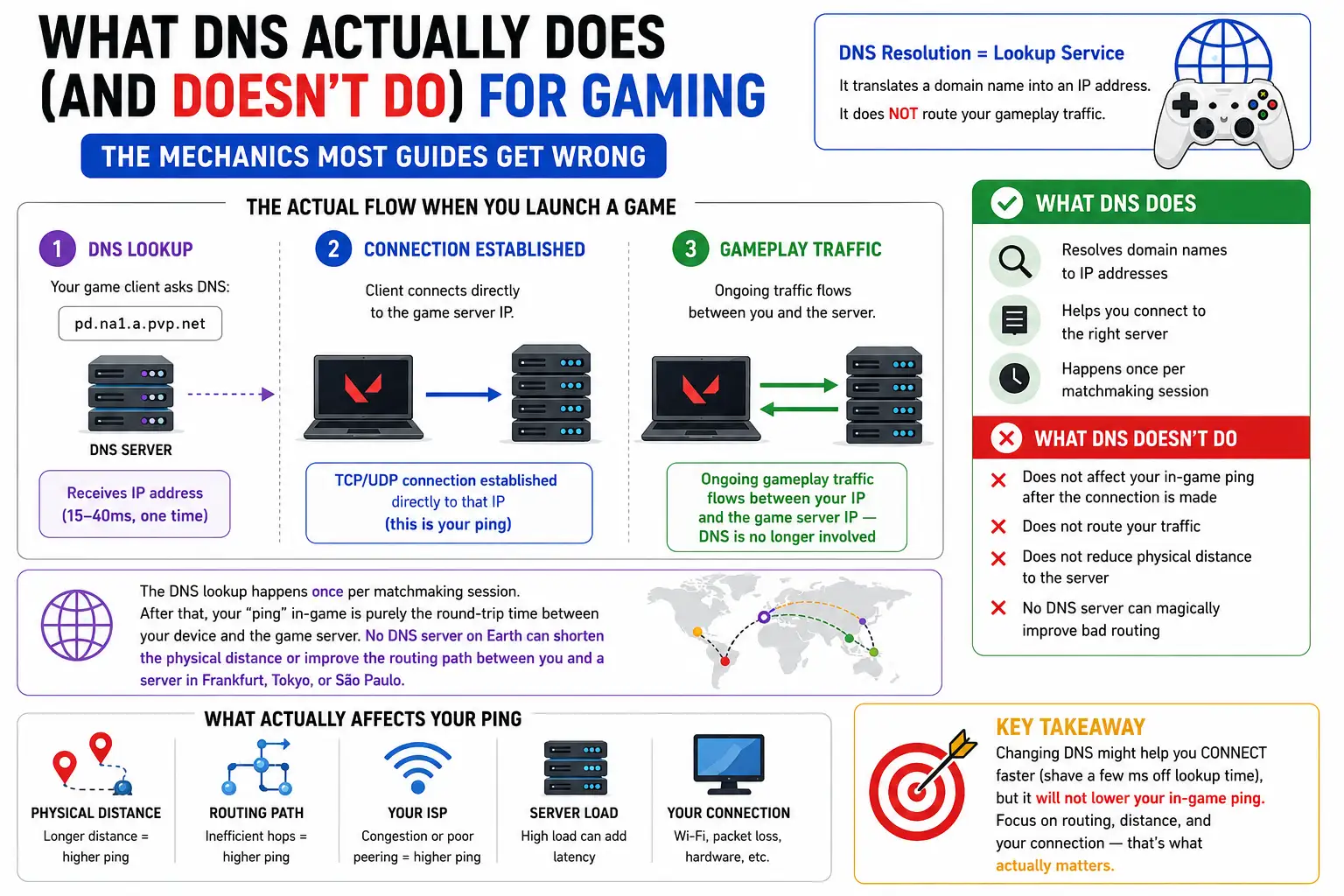
DNS is essentially a lookup service. You can think of it like a phonebook for the internet: it helps your device find the IP address associated with a hostname such as pd.na1.a.pvp.net.
A typical connection can be thought of in three stages:
- DNS lookup: Your game or device asks a DNS resolver for the IP address associated with a hostname. The lookup may take a few milliseconds, but the exact time depends on your resolver, network, location, caching, and other factors.
- Network connection: Your device then connects to the destination IP address. This is where network latency becomes much more important. Ping measures the round-trip time between your device and the destination.
- Gameplay: Once the connection is established, the ongoing game traffic does not normally depend on DNS for every packet. Changing DNS therefore does not usually change the latency of that established connection.
No DNS provider can remove the physical distance between you and a distant game server. Your ISP’s routing, network congestion, Wi-Fi conditions, packet loss, and the location and load of the game server generally have a much larger effect on sustained gaming latency than the DNS resolver you use.
When a Faster DNS Resolver Can Help
DNS can still matter in situations where your device needs to resolve a hostname before connecting to an online service.
- Games that connect to different services or servers: Multiplayer games may contact different hostnames for login, matchmaking, content delivery, analytics, or game services. A faster or more reliable DNS resolver can reduce the time spent waiting for those DNS lookups when they occur.
- Game launchers: Steam, Epic Games Launcher, EA app, Battle.net, and other launchers may contact multiple online services during startup and login. DNS performance can affect the lookup portion of those requests, although it is only one part of the total startup time.
- Online services and matchmaking: A game can use multiple network services before you enter a match. Faster DNS may help with the name-resolution portion of those connections, but it does not automatically make the matchmaking process itself faster.
- Streaming while gaming: Applications such as Twitch or YouTube may need to resolve multiple domains while you are playing. A reliable DNS resolver can help with those lookups, but it will not automatically improve streaming bitrate or eliminate congestion.
- Mobile gaming: The same basic principle applies to games such as PUBG Mobile and Call of Duty: Mobile. A DNS change may help with hostname resolution or reliability, but it is not a direct way to reduce in-game latency.
The important distinction is that DNS can affect the setup of a connection, while ping measures the ongoing network path to the destination.
When Changing DNS Usually Changes Little
- Long gaming sessions: An MMO such as Final Fantasy XIV or World of Warcraft can keep a connection open for a long time. Once the necessary hostnames have been resolved and the connection is established, the DNS provider generally has little influence on the latency of the ongoing game traffic.
- Single-player games with occasional online checks: If a game only needs an online service for licensing, synchronization, or another background function, changing DNS may have little noticeable effect on gameplay.
- NAT problems: A Strict or Moderate NAT type is usually related to router configuration, UPnP, port forwarding, or network architecture. Changing DNS does not normally resolve the underlying NAT configuration.
Why DNS Caching Makes the Difference Even Smaller
DNS results are commonly cached at multiple levels, including your operating system, browser, router, and the DNS resolver itself.
When a hostname is already cached, your device may not need to contact the DNS resolver again. This means the impact of switching providers can be much smaller than a simple DNS benchmark suggests.
DNS records also have a TTL (time to live) that tells caching systems how long a response can normally be retained. The actual TTL varies by service and hostname, so there is no universal cache period for game servers.
This is why a faster DNS resolver does not automatically translate into lower in-game ping. DNS may affect the time needed to find a service, but it generally does not determine the latency of the packets exchanged after the connection has been established.
The 10 Best DNS Servers for Gaming in 2026
We compare these public DNS providers based on factors such as performance, reliability, security features, privacy practices, and availability. Published benchmark data can be useful for comparison, but DNS response times vary significantly by location, ISP, network conditions, and time of day.
Treat benchmark results as a starting point rather than a guarantee. The fastest DNS provider in one city may not be the fastest in another, so testing the candidates on your own connection is the best way to find out which one performs well for you.
1. Cloudflare (1.1.1.1)

Primary DNS: 1.1.1.1 Secondary DNS: 1.0.0.1
Cloudflare’s resolver is one of the most widely used public DNS services and operates on a global anycast network. Its broad network coverage can give many users a fast DNS lookup, although the actual response time depends on your location, ISP, routing, and network conditions.
That is why Cloudflare often appears in searches for the “best DNS for low ping gaming“. Just keep the earlier distinction in mind: a fast DNS resolver can reduce the time needed for DNS lookups, but it does not normally reduce the ongoing latency of an established game connection.
- Strong performance: Cloudflare is commonly among the faster public DNS resolvers in independent DNS benchmarks, although results vary by location.
- Privacy-focused policy: Cloudflare publishes a privacy policy for its DNS service and has commissioned independent audits related to aspects of its DNS privacy practices.
- Security features: Cloudflare offers DNS-related security features and protections, with additional filtering available through specific resolver addresses.
- Free to use: The standard public resolver is available without a paid subscription or account.
- Optional filtering: The standard
1.1.1.1service does not add content filtering by default. Cloudflare also offers1.1.1.2for malware blocking and1.1.1.3for malware and adult-content blocking.
Worth knowing: Cloudflare is a US-based company, so jurisdiction may matter to users who consider the legal and privacy implications of where their DNS provider operates. For most users, though, the more immediate question is whether the resolver performs reliably on their own connection.
2. Google Public DNS (8.8.8.8)

Primary DNS: 8.8.8.8 Secondary DNS: 8.8.4.4
Google’s Public DNS resolver has been available since 2009 and is one of the most widely used public DNS services. Its global infrastructure and broad platform support make it a practical set-it-and-forget-it option for many users.
- Global availability: Google operates DNS infrastructure in many locations around the world, which can help provide consistent access for users in different regions.
- Security protections: Google Public DNS includes measures designed to help protect against threats such as DNS spoofing and certain forms of denial-of-service attacks.
- Broad compatibility: It is well documented and supported across major operating systems, routers, browsers, and other network devices.
- Free to use: Google Public DNS is available without a paid subscription or account.
Worth knowing: Google collects certain DNS query information for operational, security, and service purposes under its published privacy policy. Google says some data is retained temporarily and that it does not use DNS query data to serve personalized ads. Even so, users who prioritize minimizing data collection may prefer a provider with a different logging and privacy model.
Google Public DNS is a strong general-purpose choice when you want reliability, broad compatibility, and a well-documented resolver. However, it is not automatically the fastest option for every location. DNS performance can vary by ISP, geography, routing, and network conditions, so testing it against other providers is still worthwhile.
3. Quad9 (9.9.9.9)

Primary DNS: 9.9.9.9 Secondary DNS: 149.112.112.112
Quad9 is a Swiss-based nonprofit public DNS service with a strong focus on security. Its resolver uses threat-intelligence data from multiple security partners to block access to domains associated with malware, phishing, and other threats.
- Threat blocking: Quad9 can block domains identified as malicious by its threat-intelligence sources.
- Privacy-focused approach: Quad9 states that it does not retain the personal data associated with DNS query activity for marketing purposes and operates under Swiss legal jurisdiction.
- Modern DNS security: It supports technologies including DNSSEC, DNS over HTTPS (DoH), DNS over TLS (DoT), and DNS over QUIC (DoQ).
- Free to use: The standard Quad9 resolver is available without a paid subscription.
Worth knowing: Quad9’s DNS response time may be faster or slower than Cloudflare, Google, or other public resolvers depending on your location, ISP, and network path. Its security filtering is also a trade-off: a domain that has been classified as malicious may be blocked even when you believe the site is legitimate. If you run into a false positive or need unrestricted DNS resolution, keeping an alternative unfiltered resolver available can be useful.
For gamers, Quad9 is especially interesting when security matters more than chasing the smallest possible DNS lookup time. It can help block known malicious domains at the DNS level, but that protection should not be confused with lower in-game ping.
4. Control D (76.76.2.0)
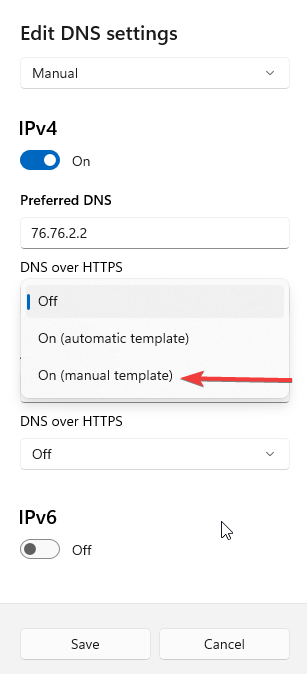
Primary DNS: 76.76.2.0 or 76.76.2.2 Secondary DNS: 76.76.10.0
Control D is a public DNS service aimed at users who want more control over DNS behavior than a basic resolver typically provides. Along with standard DNS resolution, Control D offers filtering and routing features, with the available options depending on the resolver or subscription you use.
- Modern DNS protocols: Control D supports encrypted DNS protocols such as DNS over HTTPS (DoH), DNS over TLS (DoT), and DNS over QUIC (DoQ).
- Security and filtering: Its DNS services can provide malware and phishing protection, while some configurations also support blocking ads, trackers, and other categories.
- Custom routing: Control D offers more granular DNS routing and filtering options, allowing users to apply different rules to specific domains or services.
- Free and paid options: Control D provides free DNS resolvers, while its paid plans add more advanced customization, filtering controls, and analytics.
Worth knowing: The free resolvers are more limited than Control D’s paid service. If you mainly want a free public DNS resolver, the available endpoints can still be useful. Advanced users who want detailed filtering, custom rules, or broader control may need a paid plan.
For gaming, Control D is most interesting as a DNS customization and filtering option, not as a guaranteed way to lower in-game ping. Custom DNS rules may help with how specific domains are resolved, but they do not automatically change the network route used by the game’s actual traffic.
5. NextDNS (45.90.28.0)

Primary DNS: 45.90.28.0 Secondary DNS: 45.90.30.0
NextDNS is designed for users who want more control over DNS filtering than a basic public resolver provides. You can create rules and policies for different devices and configure filtering, blocklists, and other DNS settings from its control panel.
That makes NextDNS particularly useful when you want to understand what your devices are querying and which domains are being blocked. Its logs and analytics can also help troubleshoot whether a DNS request may be contributing to a connection or app problem.
- Threat protection: NextDNS can block domains associated with malware, phishing, and other unwanted content based on its configured security services and blocklists.
- Ad and tracker blocking: You can enable filtering for advertising and tracking domains.
- Custom blocklists and rules: Users can create more granular filtering policies for different devices and networks, which can be useful for households and managed devices.
- Detailed analytics: NextDNS provides DNS activity information that can help you see which domains are being requested and blocked.
Worth knowing: NextDNS’s Free plan currently includes 300,000 DNS queries per month. After you reach that limit, NextDNS continues to answer DNS queries as a standard non-blocking resolver, but filtering and logging features are no longer available until the quota resets.
NextDNS also offers paid plans with unlimited queries and access to its features. Pricing and plan details can change, so check the current NextDNS pricing page before subscribing.
For gamers, NextDNS is more useful for its visibility, filtering, and customization than for raw gaming latency. A responsive DNS resolver can reduce the time needed for DNS lookups, but that does not necessarily translate into lower in-game ping. If your priority is DNS control and filtering rather than simply finding the lowest possible DNS latency, NextDNS is a more feature-rich option than a basic public resolver.
6. OpenDNS (208.67.222.222)

Primary DNS: 208.67.222.222 Secondary DNS: 208.67.220.220
OpenDNS, now part of Cisco’s DNS security ecosystem, is a better fit for users who want DNS-based security and policy controls rather than a resolver chosen purely for raw response time. Cisco currently lists 208.67.222.222 and 208.67.220.220 as its public IPv4 DNS addresses.
- Security-focused DNS controls: OpenDNS is built around DNS-based security and policy controls that can help block unwanted or risky domains.
- Cisco-backed infrastructure: OpenDNS is part of Cisco’s broader DNS security portfolio.
- Useful for shared networks: Its policy-oriented approach can be useful when multiple devices need consistent DNS controls.
For gamers: OpenDNS is more useful for managing and filtering a gaming network than for trying to reduce in-game ping. On a shared home or gaming-cafe network, DNS-based filtering can help control unwanted domains without requiring separate settings on every device.
Worth knowing: OpenDNS is not necessarily the fastest resolver for every location. DNS performance depends on your ISP, routing, and geographic location, so it is better to judge OpenDNS by its security and management features rather than assume it will improve gaming latency.
7. AdGuard DNS (94.140.14.14)

Primary DNS: 94.140.14.14 Secondary DNS: 94.140.15.15
AdGuard DNS is designed for users who want DNS-level ad and tracker blocking without installing a separate blocker on every device. Its default public servers block advertising and tracking domains, while separate resolver addresses are available for non-filtering and family-protection configurations.
- Ad and tracker blocking: The default servers block advertising and tracking domains.
- Security filtering: AdGuard DNS also blocks phishing and other unwanted domains through its filtering system.
- Multiple filtering options: AdGuard provides default, non-filtering, and family-protection resolver addresses for different use cases.
- Encrypted DNS support: AdGuard DNS supports encrypted DNS configurations for compatible devices.
For gamers: AdGuard DNS can be useful when you want to reduce unwanted DNS requests and tracking domains across a gaming setup, particularly on PCs, phones, or other devices used alongside gaming. However, its main benefit is filtering—not lower game-server latency. Aggressive filtering can also create compatibility issues with some launchers, updates, or game-related services.
Worth knowing: DNS filtering can occasionally block a domain that a game, launcher, update service, or app needs. If something stops working after switching to AdGuard DNS, temporarily testing a non-filtering resolver can help determine whether the DNS filter is responsible.
8. Mullvad DNS (194.242.2.2)

Primary DNS: 194.242.2.2
Mullvad DNS takes a privacy-first approach and is operated by the Sweden-based VPN provider Mullvad. Its public DNS service supports encrypted DNS, while separate resolver options can add filtering for ads, trackers, malware, adult content, gambling, and social media.
- Privacy-focused DNS: Mullvad emphasizes minimizing the collection and retention of DNS-related data.
- Optional filtering: Separate Mullvad DNS endpoints can add blocking for ads, trackers, malware, and other categories.
- Encrypted DNS: Mullvad supports DNS-over-HTTPS and DNS-over-TLS.
- Simple public resolver: The standard
194.242.2.2resolver provides DNS resolution without requiring the user to enable additional content filtering.
For gamers: Mullvad DNS makes the most sense for gamers who want privacy and encrypted DNS without relying on DNS as a gaming-speed tweak. It can be a sensible choice on gaming PCs and other devices where you want DNS requests handled through a privacy-focused service. It should not, however, be expected to automatically reduce in-game ping.
Worth knowing: DNS resolution and game-server latency are different parts of the connection. Changing DNS may affect how quickly a hostname is resolved, but once you are connected to a game server, your ping is influenced by the route between your network and that server.
9. DNS4EU (86.54.11.1)

Primary DNS: 86.54.11.1 Secondary DNS: 86.54.11.201
DNS4EU is a European public DNS service built around EU-based resolution and privacy protections. Its Protective Resolution blocks malware, phishing, and command-and-control domains, while DNS4EU says queries are anonymised and resolved on infrastructure operated within the European Union.
- EU-based resolution: DNS4EU says lookups are answered on infrastructure operated within the European Union.
- Protective DNS: The Protective Resolution variant blocks malware, phishing, and command-and-control domains.
- Privacy-focused design: DNS4EU states that queries are anonymised and are not sold, profiled, or used to build advertising audiences.
- Multiple resolver variants: DNS4EU also provides variants with different filtering policies, including ad blocking and unfiltered resolution.
For gamers: DNS4EU can be interesting for gamers in Europe who want a locally oriented DNS service with security and privacy controls. Its European infrastructure may make it a reasonable option to test from a European ISP, but it should not be assumed to provide lower gaming ping without comparing it against other resolvers from the same connection.
Worth knowing: DNS4EU is primarily aimed at individual users in Europe. Outside Europe, routing can be less favorable, so benchmark it from your own network rather than assuming its European positioning will translate into better performance everywhere.
10. CleanBrowsing (185.228.168.9)

Primary DNS: 185.228.168.9 Secondary DNS: 185.228.169.9
CleanBrowsing focuses on DNS filtering for security and family-oriented use cases. The 185.228.168.9 and 185.228.169.9 addresses are specifically the Security Filter, which blocks malware, phishing, and cryptomining domains.
- Security filtering: The Security Filter blocks malware, phishing, and cryptomining domains.
- Separate family options: CleanBrowsing also provides Adult and Family filters with stronger content restrictions and SafeSearch controls.
- Free filtering: CleanBrowsing provides free filtering options without requiring an account for basic use.
- Encrypted DNS support: CleanBrowsing supports DNS-over-HTTPS and DNS-over-TLS for its filtering services.
For gamers: CleanBrowsing is particularly relevant when gaming devices are part of a family or shared network where you want DNS-level security or content controls. It also provides dedicated gaming-console setup guides for Xbox, PlayStation, Nintendo Switch, and Wii U. However, its value for gaming is primarily network control and filtering, not a promise of lower ping.
Worth knowing: The Security Filter is not the same as the Family Filter. The Security Filter focuses on malicious domains, while the Family Filter adds broader content restrictions and SafeSearch enforcement. Choose the resolver based on the type of filtering you actually need.
Encrypted DNS: Is It Worth the Extra Time?
DNS over HTTPS (DoH) and DNS over TLS (DoT) encrypt DNS traffic between your device and the DNS resolver. That prevents devices and network operators along that path from simply reading the contents of your DNS queries, although the DNS provider itself can still see queries and encrypted DNS does not hide every other signal about where you connect. Cloudflare, for example, explains that DoH and DoT prevent parties between the device and resolver from reading DNS queries. (Cloudflare)
There can be a small connection-setup cost when an encrypted DNS session has to be established. The important part is that this is not paid on every individual lookup when the connection stays open. Modern protocols can also reuse connections and, depending on the protocol and implementation, use session resumption or 0-RTT to reduce setup delays. DNS-over-QUIC (DoQ), standardized in RFC 9250, was specifically designed with low-latency connection handling in mind.
For gaming, the practical difference is usually small because DNS is mainly involved when your device needs to resolve a hostname. Once the connection to the game server is established, encrypted DNS does not add latency to every game packet.
A practical approach is to use encrypted DNS on laptops and phones that regularly connect to public or otherwise untrusted networks, where protecting DNS traffic has a clearer privacy benefit. On a trusted home network, the decision is more about your privacy preferences and device support than gaming performance. DoQ can be useful when your resolver and client support it, but it should not be treated as a guaranteed gaming-speed upgrade. RFC 9250 describes DoQ’s support for long-lived connections and optional 0-RTT session resumption.
Things Most “Best DNS” Lists Skip
Your ISP’s own resolver might already be your fastest option
Your ISP’s DNS resolver can sometimes be surprisingly competitive because it may be close to you from a network-routing perspective and may have strong local cache performance. That does not mean it will always beat public resolvers such as Cloudflare or Google.
The important point is that DNS performance is location-dependent. A resolver that performs extremely well in one city or ISP network may be less impressive somewhere else. Cloudflare notes that regional caches and its global network can improve DNS performance, but your own ISP connection and routing still matter.
Privacy and policy also differ between providers. Some ISPs retain or use DNS-related data under their own policies, so check your provider’s documentation rather than assuming every resolver handles queries the same way.
You can test the difference instead of guessing. For example:
dig @your.isp.dns google.com
dig @1.1.1.1 google.com
Run several queries rather than judging the result from a single request. A small difference of a few milliseconds is unlikely to matter for actual gameplay.
DNS can influence content routing, not just lookup speed
DNS does more than translate a hostname into an IP address. For some services, the resolver’s location can influence which CDN or service endpoint is returned. This is one reason a DNS resolver can sometimes affect download or connection performance even when DNS lookup time itself looks good.
The effect depends on how the service uses DNS-based traffic steering and how the resolver communicates location information. Some DNS systems support mechanisms that allow content providers to make more geographically appropriate decisions, while privacy-focused configurations may intentionally provide less location information.
This does not mean changing DNS will automatically improve game-server routing. It simply means DNS resolver selection can sometimes affect which endpoint your device is directed toward, especially for large CDNs and distributed services.
Consoles and phones give you different levels of DNS control
Gaming consoles generally provide much less control over DNS transport than modern phones and computers. For example, Cloudflare’s current console instructions allow manual DNS configuration on Nintendo Switch and Xbox One, while its PlayStation and Xbox guidance focuses on entering DNS resolver addresses rather than configuring DoH or DoT directly.
Android offers more flexibility. Android 9 and later include Private DNS, which uses encrypted DNS transport, and the setting applies across Wi-Fi and cellular connections. Android’s documentation identifies DNS-over-TLS as part of the platform’s private DNS support, with later Android versions also supporting DNS-over-HTTP/3.
For example, Cloudflare’s current Android documentation uses:
one.one.one.one
as the Private DNS hostname for its standard resolver.
The result is a meaningful difference in how much DNS control each platform provides: PCs and Android devices offer more flexibility, while consoles generally keep DNS configuration simpler.
DNS filtering can interfere with game and anti-cheat services
A DNS filter can block a domain that a game, launcher, update service, or security component legitimately needs. When that happens, the symptom may look like a game problem even though the underlying issue is the DNS block.
This is especially worth remembering with aggressive blocklists from services such as AdGuard DNS, NextDNS, or a local Pi-hole. The safest troubleshooting approach is to temporarily switch to an unfiltered resolver and test again. If the problem disappears, inspect the DNS logs or filtering rules and allow the required domain instead of immediately changing other network settings.
Do not assume that a DNS block will cause an anti-cheat system to identify you as a cheater. More commonly, a blocked or interrupted dependency can result in a failed launch, failed update, connection error, or inability to initialize a service. BattlEye, for example, specifically recommends unrestricted Internet access for its launcher and service when troubleshooting update and initialization problems.
Setting It Up
Windows 11
Go to:
Settings → Network & Internet → Advanced network settings → More network adapter options
Right-click your active connection and select Properties. Open Internet Protocol Version 4 (TCP/IPv4) → Properties, then choose Use the following DNS server addresses.
For Cloudflare, enter:
Preferred DNS: 1.1.1.1 Alternate DNS: 1.0.0.1
For IPv6, you can use:
2606:4700:4700::1111 2606:4700:4700::1001
Cloudflare currently lists these as its standard IPv4 and IPv6 resolver addresses.
After changing DNS, you can run:
ipconfig /flushdns
in Command Prompt to clear the local DNS cache.
macOS
Open:
System Settings → Network → your active connection → Details → DNS
Add:
1.1.1.1 1.0.0.1
You can also add Cloudflare’s IPv6 resolver addresses if your network uses IPv6.
Android
On Android 9 and later, open:
Settings → Network & internet → Private DNS
The exact menu name can vary by manufacturer.
Choose Private DNS provider hostname and enter:
one.one.one.one
Cloudflare documents this hostname for its standard 1.1.1.1 resolver. Android Private DNS uses encrypted DNS transport and applies to both Wi-Fi and cellular connections.
PlayStation 5
On PS5, open the network setup options and choose manual DNS configuration. For Cloudflare:
Primary DNS: 1.1.1.1 Secondary DNS: 1.0.0.1
Sony’s support documentation confirms that DNS can be configured manually and can sometimes help resolve connection problems.
Xbox Series X|S
Open:
Settings → General → Network Settings → Advanced Settings → DNS Settings
Choose Manual and enter:
Primary DNS: 1.1.1.1 Secondary DNS: 1.0.0.1
Cloudflare also documents manual DNS configuration for Xbox consoles.
Router-level setup
For a whole household, changing DNS on the router is usually the simplest approach. Devices that receive DNS settings from the router can then use the selected resolver without requiring individual configuration.
Open your router’s administration page, locate the WAN, Internet, or DNS settings, and enter your chosen resolver. The exact menu depends on the router manufacturer. Cloudflare’s router documentation notes that common admin addresses include 192.168.1.1 and 192.168.0.1, but the correct address varies by device.
Router-level DNS is particularly convenient when you want the same filtering or resolver policy across PCs, phones, consoles, and other household devices.
FAQ
Will switching DNS lower my ping in Valorant, Call of Duty, or Fortnite?
Usually, no. DNS can affect how quickly a hostname is resolved, but it does not reduce the round-trip latency between you and the game server once the connection is established.
Is there a best DNS for low-ping gaming specifically?
There is no universal winner. What you are really looking for is a resolver that responds reliably and quickly from your particular network. Cloudflare is a strong default because of its global infrastructure and published performance focus, but your ISP’s resolver or another public service can perform better from a particular location.
What’s the best DNS for PUBG or other battle royale games?
Cloudflare or Google are sensible starting points because their standard public resolvers do not apply aggressive content filtering by default. However, there is no guarantee that either will provide better in-game latency. Test the resolver from your own network before deciding.
What’s the best DNS for gaming on Android?
Cloudflare or Google through Android’s built-in Private DNS feature are good starting points if you want encrypted DNS without installing a separate DNS app. Android’s Private DNS applies system-wide, including cellular connections.
Is Cloudflare really the fastest?
Cloudflare currently says 1.1.1.1 has been measured as the fastest public DNS resolver, and its network spans hundreds of cities. However, DNS performance remains location- and network-dependent, so your own connection can produce a different result.
Can DNS cause lag spikes mid-match?
Not normally. DNS is generally involved when a hostname needs to be resolved, not continuously for every game packet. An unreliable or filtered resolver can cause problems during matchmaking, login, updates, or service discovery, but that is different from adding latency to an established game session.
Why did my game break right after I switched DNS?
A filtering resolver may have blocked a domain that the game or launcher needs. Try an unfiltered resolver such as 1.1.1.1 or 8.8.8.8. If the problem disappears, review the filtering rules before making other network changes.
What’s the best option for console gaming?
There is no universal best option. Cloudflare and Google are useful starting points because their standard public resolvers are broadly compatible and unfiltered by default. Since console DNS configuration is relatively limited, reliability and resolver performance from your own network matter more than advanced encrypted-DNS features.
The Bottom Line
DNS is a small but real part of the overall connection experience. It can affect hostname resolution, influence which service endpoint a distributed platform returns, add DNS-level security or filtering, and provide encrypted DNS when your device supports it.
What DNS cannot do is overcome a poor route to a distant game server, high packet loss, Wi-Fi interference, congestion, or an overloaded ISP connection. A resolver change might make a launcher or matchmaking request feel slightly quicker, but it will not turn a 150 ms server route into a 30 ms one.
The best approach is simple: choose a resolver based on what you actually value—speed, reliability, privacy, security, filtering, or regional requirements—then test it on your own connection.
For a gaming setup, start with an unfiltered resolver such as Cloudflare or Google. If privacy or network-wide filtering matters more, consider an encrypted or filtering DNS provider instead. Router-level configuration is convenient for whole households, while Android’s Private DNS is a practical option for mobile devices.
Give the change enough time to observe real-world behavior rather than judging it from a single speed test. Watch for login failures, launcher problems, blocked services, or unusual download behavior. If nothing improves, switching back is easy—and you have tested the change rather than relying on generic claims about which DNS is supposedly “best.”
You May Also Like
 VPN
VPNCloudflare WARP as a Free VPN Alternative: Review After Months of Daily Use
 Proxies
Residential Proxies vs. ISP Proxies: What Actually Sets Them Apart
 Proxies
REST APIs Explained: Everything You Need to Know to Build and Use Them
 VPN
VPNHow to Block Ads on FirstRowSports: A Step-by-Step Guide
 Proxies
Is CroxyProxy Safe to Use for YouTube? Privacy, Security, and Risks
 Proxies
Top 10 Free Proxy Websites in 2026: My Complete Testing Guide
 VPN
VPNCan You Use a VPN on a School Chromebook? (What Works + What’s Allowed)
 Proxies
What Are Residential Proxies: Use Cases and Best Providers in 2026
 Tiktok