Hashing and encryption are two important tools that keep your digital information safe. They work in different ways to protect data from hackers and unauthorized access. Understanding how they differ helps you make better choices about your online security. To learn more about cybersecurity fundamentals, check out our guide on what is cybersecurity.
You use both hashing and encryption every day, even if you don’t realize it. When you log into websites, send messages, or store files, these technologies work behind the scenes to keep your information secure. This article will help you understand what each one does and when to use them.
What is Hashing?
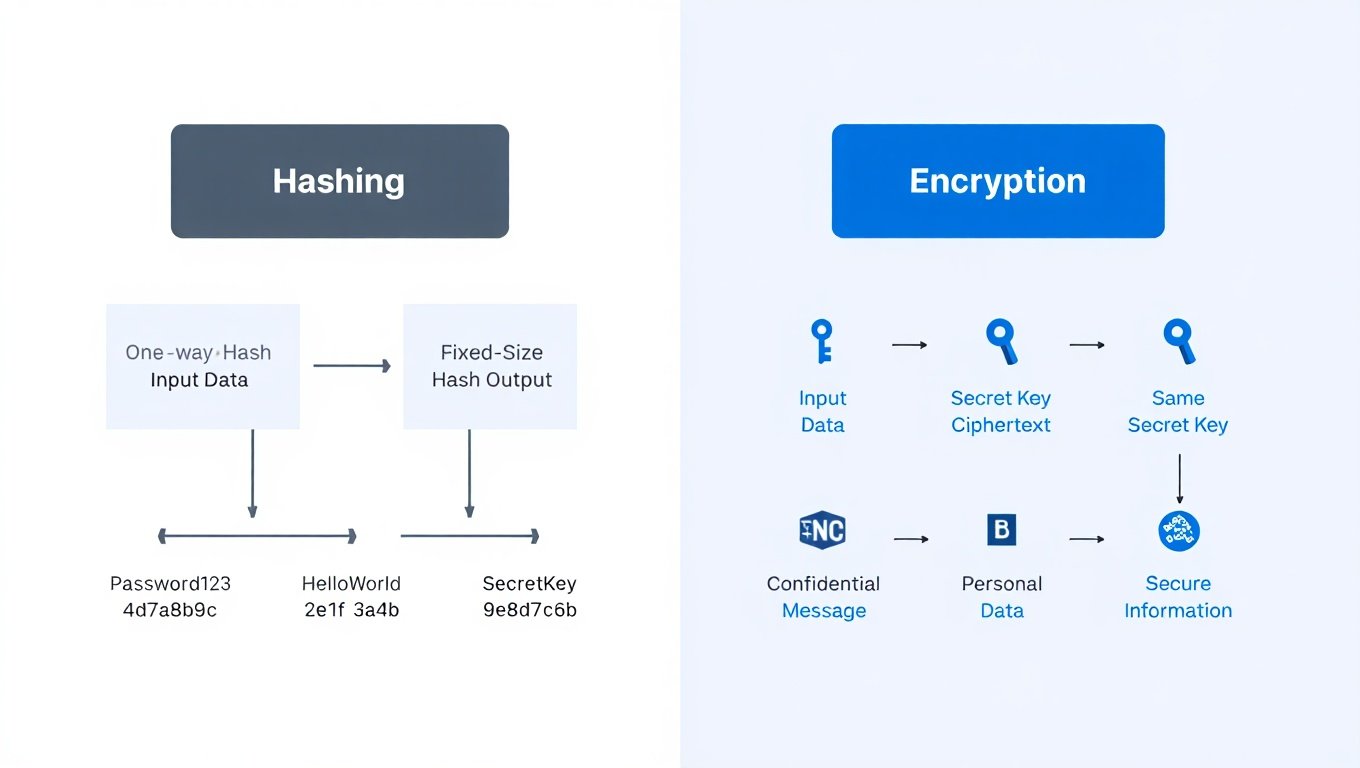
Hashing turns your data into a unique code that cannot be reversed. Think of it like a blender that mixes ingredients into a smoothie. Once blended, you can’t separate the ingredients back to their original form. Hashing works the same way with your information.
How Hashing Works
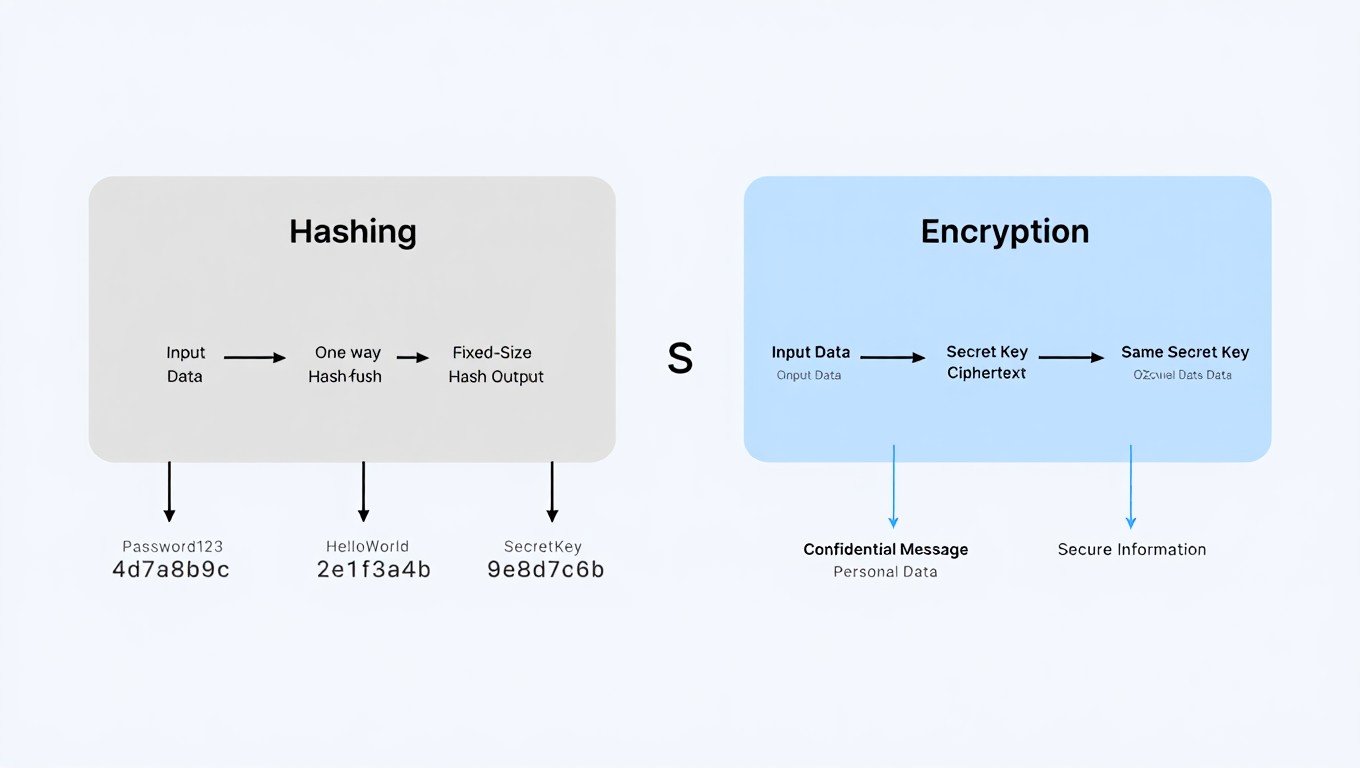
Hashing takes any input and creates a fixed-length output called a hash value. This output looks like a random string of letters and numbers. The same input will always produce the same hash value. Even a tiny change in the input creates a completely different hash value.
Here’s how hashing works in simple steps:
- You input data into a hash function
- The function processes the data using math
- It produces a unique hash value
- You store or use this hash value instead of the original data
Hashing is a one-way street. You can go from data to hash, but not from hash back to data. This makes it perfect for verifying information without revealing the original content.
Common Hashing Algorithms
Different hashing algorithms serve different security needs. Some are faster but less secure. Others are slower but provide better protection. Here are the most common ones you’ll encounter:
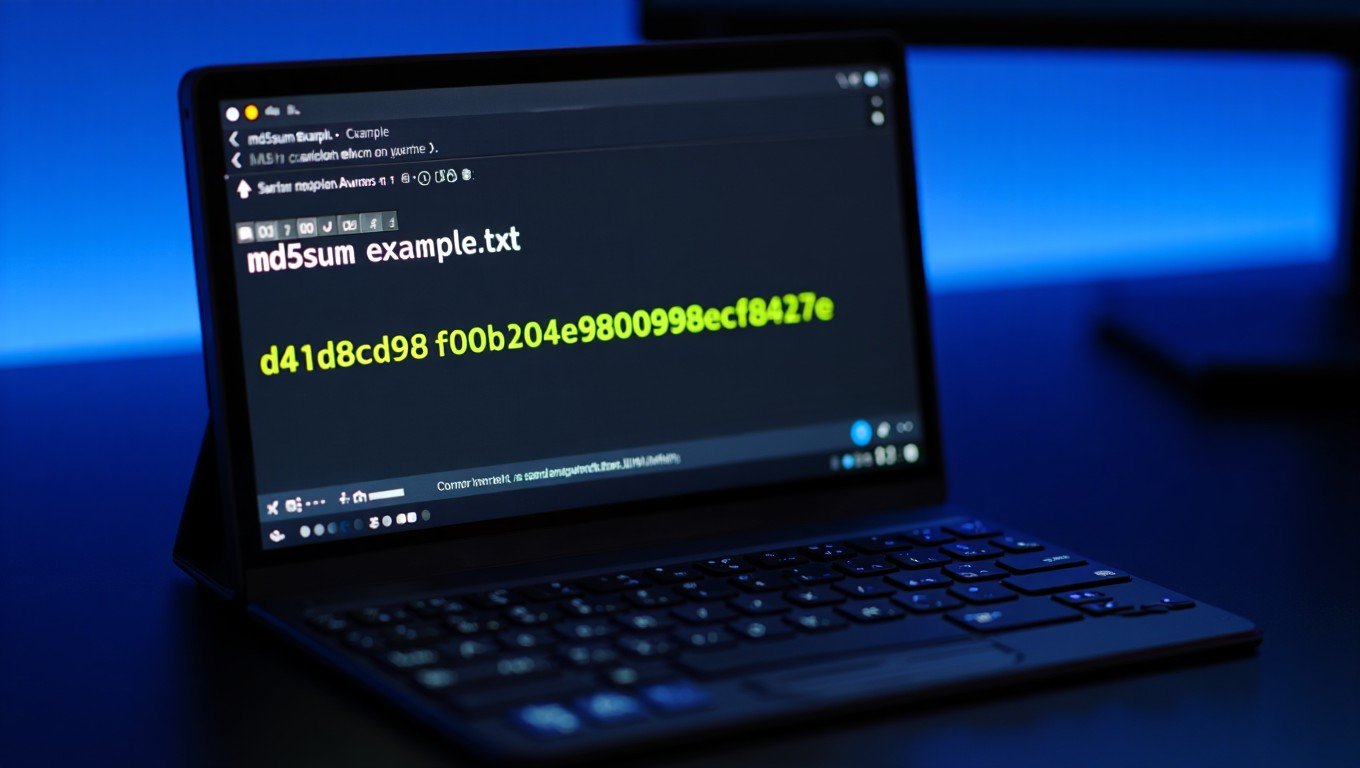
- MD5: Creates 128-bit hash values. It’s fast but no longer considered secure for sensitive applications.
- SHA-1: Produces 160-bit hash values. Like MD5, it’s now considered outdated for security purposes.
- SHA-256: Generates 256-bit hash values. It’s currently secure and widely used in many applications.
- SHA-3: The newest standard offering enhanced security features.
- bcrypt: Designed specifically for password hashing. It’s slow on purpose to make hacking harder.
- Argon2: The winner of the Password Hashing Competition. It resists modern hacking techniques.
Real-World Uses of Hashing
You interact with hashing more often than you think. Here are some everyday examples where hashing protects your information:
- Password Storage: Websites don’t store your actual password. They store a hash of it. When you log in, they hash what you type and compare it to the stored hash. To understand how password protection differs from encryption, read our article on is password protection the same as encryption.
- File Verification: When you download software, you might see a SHA-256 checksum. This hash value lets you verify the file wasn’t corrupted or tampered with during download.
- Digital Signatures: Hashing helps create digital signatures that prove who sent a message and that it wasn’t changed.
- Blockchain: Cryptocurrencies like Bitcoin use hashing to link blocks of transactions together, making the system secure and tamper-proof.
- Data Deduplication: Storage systems use hashing to find and eliminate duplicate files, saving space.
What is Encryption?
Encryption scrambles your data so only authorized people can read it. Unlike hashing, encryption is a two-way process. You can encrypt data to make it unreadable, then decrypt it to restore the original content. For a deeper understanding of encryption fundamentals, check out our guide on what is data encryption and why is it important.
How Encryption Works
Encryption uses mathematical algorithms and keys to transform readable data into unreadable ciphertext. The process requires two main components: an encryption algorithm and a cryptographic key. The algorithm is the method used to scramble the data, while the key is the secret that controls the scrambling.
Here’s the encryption process in simple terms:
- You start with plaintext (readable data)
- You apply an encryption algorithm with a key
- The data becomes ciphertext (scrambled data)
- To read it again, you apply the decryption algorithm with the correct key
- The ciphertext returns to its original plaintext form
Encryption is like a locked box. Only someone with the right key can open it and see what’s inside. This makes it perfect for protecting sensitive information during storage or transmission.
Types of Encryption
Encryption comes in two main forms: symmetric and asymmetric. Each has its own strengths and best use cases in cybersecurity.
Symmetric Encryption
Symmetric encryption uses the same key for both encryption and decryption. It’s like having one key that both locks and unlocks a door. This approach is fast and efficient, making it ideal for encrypting large amounts of data.
Common symmetric encryption algorithms include:
- AES (Advanced Encryption Standard): The gold standard for symmetric encryption. It supports key sizes of 128, 192, and 256 bits. Governments and businesses worldwide use AES to protect sensitive information.
- DES (Data Encryption Standard): An older algorithm that uses a 56-bit key. It’s now considered insecure due to its short key length.
- 3DES (Triple DES): Applies DES three times to each data block. It’s more secure than DES but slower than modern alternatives.
- Blowfish: A fast, free alternative to DES that supports variable key lengths up to 448 bits.
- Twofish: A successor to Blowfish with enhanced security features.
Asymmetric Encryption
Asymmetric encryption uses a pair of mathematically related keys: a public key and a private key. It’s like having a mailbox where anyone can drop letters (public key), but only you have the key to open it (private key). For a detailed explanation of how asymmetric encryption works, read our article on what is asymmetric encryption.
Common asymmetric encryption algorithms include:
- RSA: One of the first public-key cryptosystems. It’s widely used for secure data transmission and digital signatures.
- ECC (Elliptic Curve Cryptography): Offers equivalent security to RSA but with smaller key sizes, making it more efficient for mobile devices and IoT applications.
- Diffie-Hellman: A method for securely exchanging cryptographic keys over a public channel.
- DSA (Digital Signature Algorithm): Used for creating digital signatures that verify the authenticity of digital messages.
Real-World Uses of Encryption
Encryption protects your data in many everyday situations. Here are some common examples:
- Secure Websites: When you see HTTPS in your browser’s address bar, encryption protects the data between your device and the website.
- Email Encryption: Services like PGP and S/MIME encrypt your emails so only the intended recipient can read them.
- File Encryption: Tools like BitLocker and FileVault encrypt your entire hard drive, protecting your data if your device is lost or stolen.
- Messaging Apps: Apps like Signal and WhatsApp use end-to-end encryption to keep your conversations private. To learn more about this specific type of encryption, check out our guide on what is end-to-end encryption.
- VPNs: Virtual Private Networks encrypt your internet traffic, protecting your privacy on public Wi-Fi networks.
- Payment Processing: When you buy something online, encryption protects your credit card information during transmission.
Key Differences Between Hashing and Encryption
Hashing and encryption serve different purposes in data security. Understanding their differences helps you choose the right tool for each security need. Let’s explore the main distinctions.
Directionality: One-Way vs Two-Way
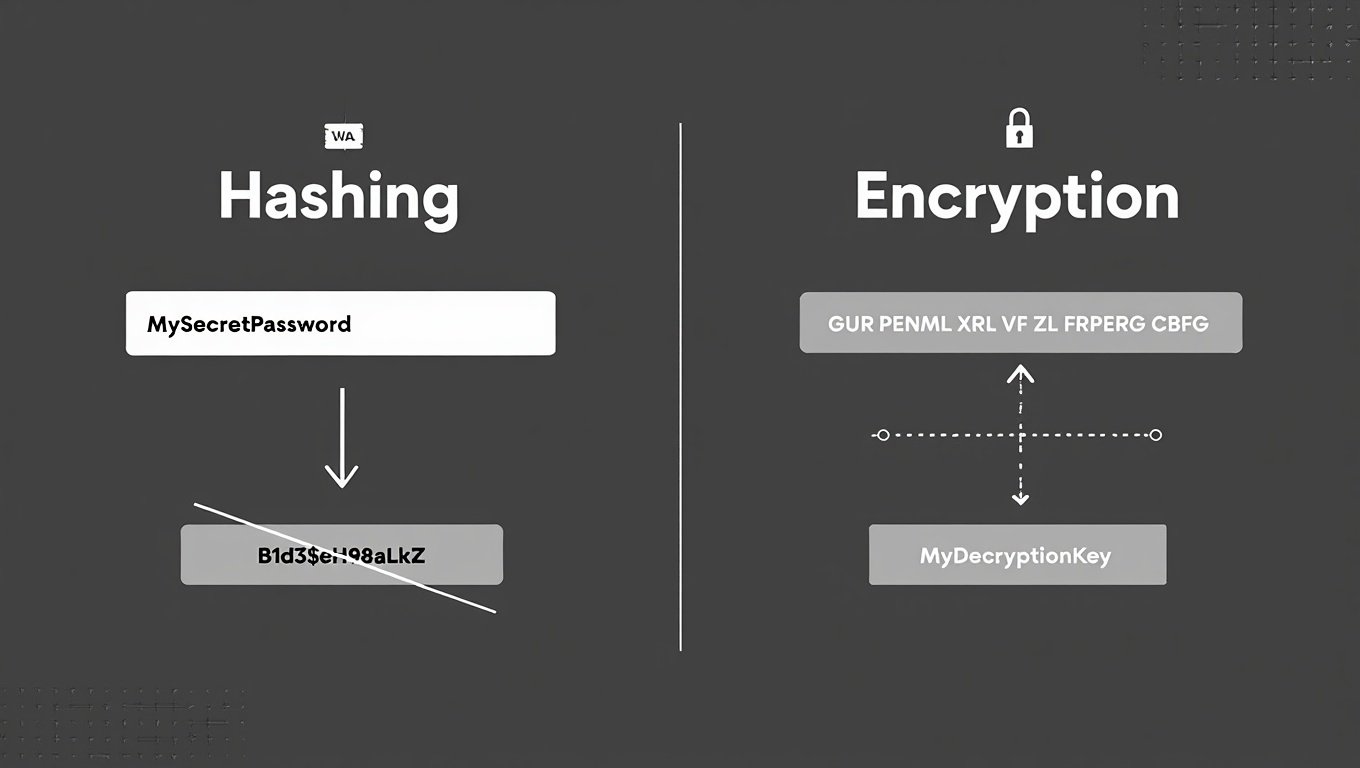
The biggest difference between hashing and encryption is their directionality. Hashing is a one-way process. Once data is hashed, you cannot reverse it to get the original data back. This makes hashing perfect for verifying information without storing the original content.
Encryption is a two-way process. You encrypt data to make it unreadable, then decrypt it to restore the original content. This makes encryption ideal for protecting sensitive information that needs to be accessed later.
Think of hashing like shredding a document. You can’t put the shredded pieces back together. Encryption is like locking a document in a safe. You can unlock it anytime with the right key.
Purpose and Use Cases
Hashing and encryption solve different security problems. Hashing focuses on data integrity and verification. Encryption focuses on data confidentiality and access control.
Hashing is best for:
- Password Storage: Storing hashed passwords instead of actual passwords protects user accounts even if the database is compromised.
- Data Integrity: Verifying that files or messages haven’t been altered during transmission or storage.
- Digital Signatures: Creating unique identifiers that prove the authenticity of digital documents.
- Duplicate Detection: Finding identical files or data blocks in large storage systems.
Encryption is best for:
- Confidential Data Protection: Keeping sensitive information like financial records or personal data safe from unauthorized access.
- Secure Communication: Protecting messages and data transmitted over networks from interception.
- Access Control: Restricting access to sensitive files or systems to authorized users only.
- Regulatory Compliance: Meeting legal requirements for data protection in industries like healthcare and finance.
Key Requirements
Hashing doesn’t require keys. It uses a mathematical algorithm to transform data into a fixed-length hash value. The same input always produces the same output, regardless of who performs the hashing.
Encryption requires keys. These keys control the encryption and decryption process. The security of encrypted data depends entirely on keeping these keys secret. If someone obtains the encryption key, they can decrypt and access the protected information.
Output Characteristics
Hashing produces fixed-length outputs regardless of input size. Whether you hash a single word or an entire book, the hash value will always be the same length. This makes hashing predictable and efficient for comparison operations.
Encryption produces outputs that are typically similar in size to the input. The encrypted data (ciphertext) is usually about the same size as the original data (plaintext), though some encryption algorithms add padding that slightly increases the size.
Security Focus
Hashing security focuses on preventing collisions and reversibility. A good hash function makes it computationally infeasible to find two different inputs that produce the same hash value (collision resistance). It also makes it impossible to determine the original input from the hash value (preimage resistance).
Encryption security focuses on preventing unauthorized decryption. A good encryption algorithm makes it computationally infeasible to decrypt the ciphertext without the correct key. This involves protecting both the algorithm and the keys from attacks.
When to Use Hashing vs Encryption
Choosing between hashing and encryption depends on your specific security needs. Each technique excels in different scenarios. Understanding when to use each one helps you build stronger security systems.
Best Scenarios for Hashing
Use hashing when you need to verify data without storing the original information. Here are the best use cases for hashing:
- Password Storage: Always hash passwords before storing them in a database. When users log in, hash their input and compare it to the stored hash. This protects user accounts even if your database is compromised.
- File Verification: Use hashing to verify that downloaded files haven’t been corrupted or tampered with. Many software providers publish hash values (checksums) that you can use to verify file integrity.
- Digital Signatures: Combine hashing with asymmetric encryption to create digital signatures. Hash the document first, then encrypt the hash with the sender’s private key. This proves the document hasn’t been altered and confirms the sender’s identity.
- Data Deduplication: Use hashing to identify duplicate files in storage systems. By comparing hash values, you can quickly find and eliminate redundant data, saving storage space.
- Blockchain Technology: Use hashing to link blocks of transactions together in blockchain systems. Each block contains the hash of the previous block, creating an immutable chain that prevents tampering.
Best Scenarios for Encryption
Use encryption when you need to protect the confidentiality of data that will be accessed later. Here are the best use cases for encryption:
- Sensitive Data Storage: Encrypt sensitive files and databases to protect them from unauthorized access. This includes financial records, personal information, and intellectual property.
- Secure Communication: Encrypt data transmitted over networks to prevent interception. This includes emails, instant messages, and web traffic.
- Data Backup Protection: Encrypt your backups to ensure that stolen backup media doesn’t compromise your data.
- Regulatory Compliance: Use encryption to meet legal requirements for data protection in industries like healthcare (HIPAA), finance (PCI DSS), and general data protection (GDPR).
- Access Control: Implement file and folder encryption to restrict access to sensitive information. Only users with the correct decryption keys can access the protected data.
Combining Hashing and Encryption
Sometimes you need both hashing and encryption for complete security. Here are scenarios where combining both techniques provides the best protection:
- Authenticated Encryption: Combine encryption with message authentication codes (MACs) based on hashing. This provides both confidentiality (through encryption) and integrity/authentication (through hashing).
- Password-Based Encryption: Use hashing to derive encryption keys from passwords. This approach, used in systems like PBE (Password-Based Encryption), combines the security benefits of both techniques.
- Digital Signatures: As mentioned earlier, digital signatures combine hashing with asymmetric encryption to provide authentication, integrity, and non-repudiation.
- Secure Protocols: Many secure communication protocols, like SSL/TLS use both hashing and encryption to provide comprehensive security for web traffic.
Common Hashing and Encryption Algorithms
Different algorithms offer varying levels of security and performance. Understanding the most common algorithms helps you choose the right one for your specific needs.
Popular Hashing Algorithms
Hashing algorithms have evolved over time to address security vulnerabilities. Here are the most widely used hashing algorithms today:
MD5 (Message Digest Algorithm 5):
- Produces 128-bit hash values
- Very fast but now considered insecure
- Vulnerable to collision attacks
- Best for non-security applications like checksums
SHA-1 (Secure Hash Algorithm 1):
- Produces 160-bit hash values
- Faster than SHA-2 but less secure
- Deprecated for most security applications
- Being phased out in favor of stronger algorithms
SHA-256 (Secure Hash Algorithm 256-bit):
- Part of the SHA-2 family
- Produces 256-bit hash values
- Currently considered secure for most applications
- Widely used in blockchain technology and digital certificates
SHA-3 (Secure Hash Algorithm 3):
- The latest standard from NIST
- Uses a different internal structure than SHA-2
- Provides enhanced security against certain attacks
- Available in multiple output sizes (224, 256, 384, 512 bits)
bcrypt:
- Designed specifically for password hashing
- Includes a salt to prevent rainbow table attacks
- Computationally expensive to slow down brute-force attacks
- Adaptive work factor can be increased as computers get faster
Argon2:
- Winner of the Password Hashing Competition (2015)
- Resistant to both GPU and ASIC attacks
- Available in three variants: Argon2d, Argon2i, and Argon2id
- Considered the state-of-the-art for password hashing
Popular Encryption Algorithms
Encryption algorithms have also evolved to address security threats and performance needs. Here are the most widely used encryption algorithms today:
Symmetric Encryption Algorithms
AES (Advanced Encryption Standard):
- The current standard for symmetric encryption
- Supports key sizes of 128, 192, and 256 bits
- Fast and efficient in both hardware and software
- Used by governments and organizations worldwide
DES (Data Encryption Standard):
- Older standard with a 56-bit key
- Now considered insecure due to short key length
- Vulnerable to brute-force attacks
- Largely replaced by AES and 3DES
3DES (Triple DES):
- Applies DES three times to each data block
- More secure than DES but slower than modern alternatives
- Being phased out in favor of AES
- Still used in some legacy systems
Blowfish:
- Fast, free alternative to DES
- Supports variable key lengths from 32 to 448 bits
- No effective cryptanalysis to date
- Used in many software applications
Twofish:
- Successor to Blowfish
- Supports key sizes up to 256 bits
- Slightly slower than AES but considered very secure
- One of the finalists in the AES competition
Asymmetric Encryption Algorithms
RSA (Rivest-Shamir-Adleman):
- One of the first public-key cryptosystems
- Based on the difficulty of factoring large prime numbers
- Widely used for secure data transmission
- Key sizes typically range from 1024 to 4096 bits
ECC (Elliptic Curve Cryptography):
- Based on the algebraic structure of elliptic curves
- Offers equivalent security to RSA with smaller key sizes
- More efficient for mobile devices and IoT applications
- Gaining popularity as an alternative to RSA
Diffie-Hellman:
- Method for securely exchanging cryptographic keys
- Allows two parties to establish a shared secret over an insecure channel
- Foundation for many secure communication protocols
- Vulnerable to man-in-the-middle attacks without authentication
DSA (Digital Signature Algorithm):
- Used for creating digital signatures
- Based on the mathematical concept of modular exponentiation
- Federal Information Processing Standard
- Typically used with SHA-256 for better security
Security Considerations for Hashing and Encryption
Both hashing and encryption require careful implementation to be effective. Even the strongest algorithms can be compromised if used incorrectly. Here are important security considerations for each technique.

Hashing Security Best Practices
Proper hashing implementation prevents common vulnerabilities. Follow these best practices to ensure your hashing provides strong security:
- Use Modern Algorithms: Avoid outdated algorithms like MD5 and SHA-1 for security applications. Use SHA-256 or stronger algorithms from the SHA-2 or SHA-3 families.
- Add Salt to Passwords: Always use a unique salt for each password. A salt is a random value added to the password before hashing. This prevents attackers from using precomputed tables (rainbow tables) to crack multiple passwords at once.
- Use Appropriate Hash Functions for Passwords: General-purpose hash functions like SHA-256 are too fast for password hashing. Use specialized password hashing functions like bcrypt, Argon2, or PBKDF2 that are designed to be slow and computationally expensive.
- Implement Rate Limiting: Limit the number of password attempts to prevent brute-force attacks. This gives attackers fewer opportunities to guess passwords by comparing hashes.
- Store Salts Securely: While salts don’t need to be secret, they should be stored securely and associated with their respective passwords. Losing salts makes password verification impossible.
- Consider Pepper for Additional Security: A pepper is a secret value added to passwords before hashing. Unlike salts, peppers are the same for all passwords and must be kept secret. They add an extra layer of protection if the database is compromised.
Encryption Security Best Practices
Proper encryption implementation protects against various attack vectors. Follow these best practices to ensure your encryption provides strong security:
- Use Strong Algorithms: Choose well-vetted encryption algorithms like AES for symmetric encryption and RSA or ECC for asymmetric encryption. Avoid creating your own encryption algorithms.
- Implement Proper Key Management: Encryption is only as secure as its keys. Implement secure processes for generating, storing, distributing, and rotating encryption keys. Consider using hardware security modules (HSMs) or key management services for critical applications.
- Use Appropriate Key Sizes: Larger key sizes provide stronger security but require more computational resources. For AES, use at least 128-bit keys. For RSA, use at least 2048-bit keys (3072-bit or higher for long-term security).
- Generate Keys Properly: Use cryptographically secure random number generators to create encryption keys. Poorly generated keys can compromise the entire encryption system.
- Protect Keys in Transit and at Rest: Encrypt encryption keys when storing them (key encryption keys) and use secure channels for key distribution. Never transmit keys in plaintext.
- Implement Perfect Forward Secrecy: For secure communication protocols, implement perfect forward secrecy to ensure that the compromise of a long-term key doesn’t compromise past session keys.
- Regularly Update Encryption Protocols: Stay informed about the latest developments in cryptography and update your encryption protocols as needed. Deprecated algorithms and protocols may have vulnerabilities that can be exploited by attackers.
Real-World Examples of Hashing and Encryption
Understanding how hashing and encryption are applied in real-world scenarios helps illustrate their importance. Here are some practical examples of both techniques in action.
Hashing in Practice
Hashing protects your digital life in many ways. Here are some real-world examples of hashing applications:
- User Authentication Systems: When you create an account on a website, your password is hashed and stored in the database. When you log in, the website hashes the password you enter and compares it with the stored hash. If they match, you’re granted access. This approach protects your password even if the database is compromised.
- Blockchain Technology: Cryptocurrencies like Bitcoin use hashing to link blocks of transactions together. Each block contains the hash of the previous block, creating a chain that makes it extremely difficult to alter past transactions without being detected. This is why blockchain is often called an immutable ledger.
- File Verification Systems: When downloading software or large files, websites often provide hash values (like SHA-256 checksums) that you can use to verify that the file hasn’t been corrupted or tampered with during download. This is especially important for security-critical software like operating systems or antivirus programs.
- Digital Forensics: Investigators use hashing to create unique identifiers for digital evidence. By hashing files and storage devices, they can prove that evidence hasn’t been altered during the investigation process. This is crucial for maintaining the chain of custody in legal cases.
- Content Addressable Storage: Systems like IPFS (InterPlanetary File System) use hashing to address content by its hash value rather than its location. This allows for efficient deduplication and verification of content integrity across distributed networks.
Encryption in Practice
Encryption keeps your sensitive information safe in numerous everyday situations. Here are some real-world examples of encryption applications:
- Secure Web Browsing (HTTPS): When you visit a website with HTTPS (the padlock icon in your browser), your connection is encrypted using SSL/TLS protocols. This prevents eavesdroppers from intercepting and reading the data exchanged between your browser and the website. This is especially important for online banking, shopping, and logging into accounts.
- Encrypted Messaging Apps: Apps like Signal and WhatsApp use end-to-end encryption to ensure that only the sender and recipient can read the messages. Even the service providers cannot access the content of the messages. This protects your private conversations from hackers, governments, and even the companies that provide the messaging service.
- Full Disk Encryption: Operating systems like Windows (BitLocker) and macOS (FileVault) offer full disk encryption that protects all data on a device. If the device is lost or stolen, the data remains inaccessible without the encryption key. This is essential for protecting sensitive information on laptops and mobile devices.
- Virtual Private Networks (VPNs): VPNs use encryption to create secure tunnels for data transmission over public networks. This protects user privacy and enables secure remote access to private networks. When you use a VPN, all your internet traffic is encrypted, preventing your ISP or other parties from monitoring your online activities.
- Payment Processing Systems: When you make a purchase online or in person, encryption protects your credit card information during transmission and storage. Payment systems like PCI DSS require strong encryption to protect cardholder data and prevent fraud.
- Email Encryption: Services like PGP (Pretty Good Privacy) and S/MIME encrypt your emails so only the intended recipient can read them. This is crucial for protecting sensitive business communications, personal information, and confidential documents sent via email.
Future Trends in Hashing and Encryption
The field of cryptography continues to evolve to meet new challenges and threats. Understanding future trends helps organizations prepare for the changing landscape of data security. For more on how privacy engineering fits into this evolution, read our article on what is privacy engineering.
Post-Quantum Cryptography
Quantum computers pose a significant threat to current encryption algorithms. Unlike classical computers, quantum computers can solve certain mathematical problems much faster, potentially breaking many of the encryption algorithms we use today.
Post-quantum cryptography aims to develop new encryption algorithms that can resist attacks from quantum computers. These new algorithms rely on mathematical problems that are believed to be resistant to quantum attacks, such as:
- Lattice-based Cryptography: Based on the difficulty of finding short vectors in high-dimensional lattices.
- Code-based Cryptography: Relies on the difficulty of decoding random linear codes.
- Multivariate Cryptography: Based on the difficulty of solving systems of multivariate polynomial equations.
- Hash-based Cryptography: Uses hash functions to create quantum-resistant digital signatures.
Organizations should start planning for the transition to post-quantum cryptography, as it will require updating systems, protocols, and standards.
Quantum-Resistant Hashing
While current hash functions are generally considered resistant to quantum attacks, research is ongoing to develop hash functions with enhanced security properties for the post-quantum era. Quantum computers can potentially find collisions in hash functions faster than classical computers, though the impact is less severe than for encryption algorithms.
New hash function designs are being explored that offer stronger guarantees against collision and preimage attacks in the face of quantum computing capabilities. These include:
- Larger Output Sizes: Increasing the output size of hash functions to maintain security against quantum attacks.
- New Hash Function Designs: Developing entirely new hash function constructions that are specifically designed to resist quantum attacks.
- Hybrid Approaches: Combining multiple hash functions or hash functions with other cryptographic primitives to enhance security.
Lightweight Cryptography
As the Internet of Things (IoT) continues to expand, there’s a growing need for cryptographic techniques that can operate efficiently on resource-constrained devices. Lightweight cryptography focuses on developing optimized hashing and encryption algorithms that provide strong security with minimal computational resources.
Key areas of development in lightweight cryptography include:
- Optimized Algorithms: Designing hashing and encryption algorithms that require less memory, processing power, and energy.
- Hardware Implementation: Creating specialized hardware implementations of cryptographic algorithms that are more efficient than software implementations.
- Standardization Efforts: Organizations like NIST are working on standardizing lightweight cryptographic algorithms for IoT and other constrained environments.
Zero-Knowledge Proofs
Zero-knowledge proofs allow one party to prove to another that they know a value without revealing the value itself. This advanced cryptographic technique often combines hashing and encryption to enable privacy-preserving verification and authentication.
Applications of zero-knowledge proofs include:
- Privacy-Preserving Authentication: Proving you know a password without revealing the password itself.
- Confidential Transactions: Proving you have sufficient funds for a transaction without revealing your account balance.
- Identity Verification: Proving you meet certain criteria without revealing personal information.
- Secure Voting Systems: Verifying that votes were counted correctly without revealing individual votes.
Homomorphic Encryption
Homomorphic encryption allows computations to be performed on encrypted data without decrypting it first. This revolutionary technology enables secure cloud computing and data analysis while maintaining privacy.
Types of homomorphic encryption include:
- Partially Homomorphic Encryption: Allows either addition or multiplication on ciphertexts, but not both.
- Somewhat Homomorphic Encryption: Allows a limited number of both addition and multiplication operations.
- Fully Homomorphic Encryption: Allows unlimited addition and multiplication operations on ciphertexts.
While fully homomorphic encryption is still too slow for many practical applications, ongoing research is improving its performance and making it more viable for real-world use.
FAQ: Hashing vs Encryption
Can hashing be reversed to get the original data? No. Hashing is a one-way process designed to be irreversible. The purpose of hashing is to create a unique fingerprint of data that cannot be reversed to reveal the original input. This property makes hashing ideal for password storage and data integrity verification.
Is encryption more secure than hashing? No. Encryption and hashing serve different purposes and cannot be directly compared in terms of security. Encryption protects data confidentiality by making it unreadable without the proper key, while hashing protects data integrity by creating a unique fingerprint that cannot be reversed. Both are essential for comprehensive data security.
Can hashing and encryption be used together? Yes. Hashing and encryption are often used together to provide enhanced security. For example, digital signatures combine hashing with asymmetric encryption to provide authentication, integrity, and non-repudiation. Similarly, authenticated encryption modes combine encryption with message authentication codes based on hashing.
Is hashing faster than encryption? Yes. Hashing is generally faster than encryption because it’s a one-way process that doesn’t require the complex key management associated with encryption. This makes hashing suitable for high-volume applications like password verification and data integrity checks.
Can encrypted data be hashed? Yes. Encrypted data can be hashed just like any other data. In fact, hashing encrypted data can provide an additional layer of security by ensuring that the encrypted data has not been altered. This technique is often used in secure communication protocols to provide both confidentiality and integrity.
Are there algorithms that combine hashing and encryption? Yes. There are several cryptographic algorithms and modes that combine hashing and encryption. Authenticated encryption modes like AES-GCM combine symmetric encryption with message authentication based on hashing. Key derivation functions like PBKDF2 and Argon2 use hashing techniques to derive cryptographic keys from passwords.
Is hashing used in blockchain technology? Yes. Hashing is a fundamental component of blockchain technology. Each block in a blockchain contains the hash of the previous block, creating a chain that makes it extremely difficult to alter past transactions without being detected. Hashing is also used in the mining process for cryptocurrencies like Bitcoin.
Can encryption protect against data breaches? Yes. Encryption is one of the most effective tools for protecting against data breaches. If data is properly encrypted, even if it’s stolen, it remains unreadable without the proper decryption key. This is why encryption is often required by data protection regulations and is considered a best practice for data security.
Is hashing suitable for storing sensitive information? Yes. Hashing is suitable for storing certain types of sensitive information, particularly passwords. By storing hash values instead of actual passwords, organizations can protect user credentials even if the database is compromised. However, hashing is not suitable for information that needs to be retrieved in its original form.
Can quantum computers break current encryption and hashing algorithms? Yes and no. Quantum computers pose a significant threat to current asymmetric encryption algorithms like RSA and ECC, which rely on mathematical problems that quantum computers can solve efficiently. However, symmetric encryption and hashing algorithms are generally considered more resistant to quantum attacks, though they may require larger key sizes or output lengths to maintain security.
Conclusion
Hashing and encryption are two essential tools that keep your digital information safe in different ways. Hashing creates unique fingerprints of your data that cannot be reversed, making it perfect for verifying information and storing passwords securely. Encryption scrambles your data so only authorized people can read it, making it essential for protecting sensitive information during storage and transmission.
Understanding the difference between hashing and encryption helps you make better decisions about your online security. When you need to verify data without storing the original content, hashing is your best choice. When you need to protect confidential information that will be accessed later, encryption is the right tool. Sometimes, you need both techniques working together to provide complete security.
Both hashing and encryption are important tools for protecting your digital life. New threats like quantum computers are driving the development of next-generation cryptographic algorithms. By staying informed about these developments and implementing best practices for both hashing and encryption, you can ensure your data remains secure against emerging threats.
Remember that good security is about using the right tool for the right job. Hashing and encryption aren’t competitors—they’re complementary techniques that work together to create comprehensive security solutions. By understanding when and how to use each one, you can build stronger defenses for your digital information and enjoy greater peace of mind in an increasingly connected world.
You May Also Like
 Cyber Security
Can Ransomware Infect iCloud? What Mac and iPhone Users Need to Know
 Data Security & Privacy
Two-Factor Authentication (2FA): How It Works, Which Method to Use, and How to Stay Safe
 Data Security & Privacy
Is a Password Manager Safe? How to Use One Securely
 Data Security & Privacy
19 Best Email Service Providers for Personal and Business Use
 WordPress
12 Best Cheap SSL Certificate Providers To Secure Your Website
 Data Security & Privacy
Is Password Protection the Same as Encryption? Differences in Data Security
 Data Security & Privacy
How Your Digital Footprint Can Make or Break Your Career Opportunities
 Data Security & Privacy
What Is End-to-End Encryption? Your Complete Guide to Secure Communication
 Data Security & Privacy