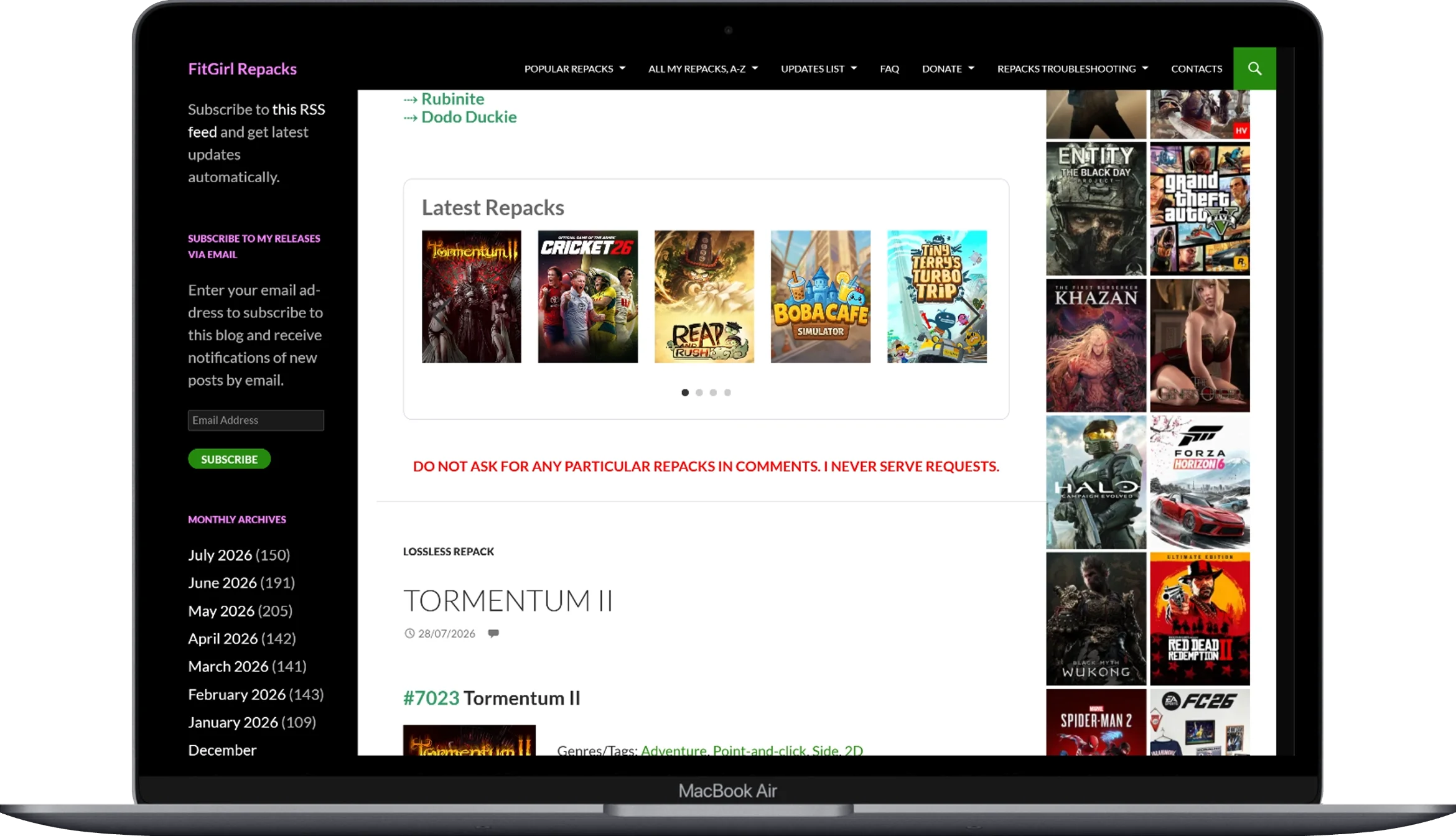
FitGirl Repacks distributes pirated PC games, so no, it isn’t legal anywhere. On safety, the picture is split: the official uploads have a long-standing reputation in piracy communities for being free of intentional malware, but the ecosystem around the site — fake mirrors, disabled antivirus software, exposed torrent traffic, and even the occasional bad actor inside the repack scene itself — creates real risk. As of mid-2026, the site is also increasingly hard to reach at all, after a wave of ISP-level blocks in Germany and reported outages across dozens of other countries.
If you’ve landed here after a search for “fitgirl not working” or “is fitgirl safe,” this guide covers both: what’s actually happening with the site right now, and the safety and legal picture underneath it.
What Is FitGirl Repacks?
FitGirl Repacks is a website that distributes highly compressed, cracked copies of commercial PC games via torrents and magnet links. The person behind it goes by “FitGirl,” operates pseudonymously, and — according to Wikipedia’s entry on the site — founded the project on July 6, 2016, claiming a base in Latvia (the operator’s exact identity and location have never been independently confirmed). By 2024, TorrentFreak’s annual ranking of the most-visited piracy sites placed FitGirl Repacks sixth worldwide, which gives a rough sense of scale even without a precise visitor count.
The appeal is straightforward: a game that ships as an 80 GB install might be repackaged down to 15–25 GB. For someone on a slow connection or a limited data plan, that’s the difference between a download that finishes tonight and one that doesn’t finish this week.
How a Repack Actually Gets Made
FitGirl doesn’t crack DRM protections directly. The workflow, pieced together from the site’s own FAQ and community documentation, looks like this:
- A crack already exists. Scene groups or independent crackers (names like CODEX and EMPRESS show up regularly) break a game’s copy protection first. FitGirl repackages their work, not the original.
- The files get compressed. Using archiving tools, FitGirl shrinks the cracked game files, often by 50–70%.
- A custom installer wraps it all. The installer decompresses everything on your machine during setup — a process that can run from 30 minutes to several hours depending on your CPU and drive speed.
- Verification is built in. Most repacks include an integrity-check step so you can confirm your download matches what was uploaded.
- It goes out through torrents and mirrors. The finished repack is seeded on public trackers and mirrored on assorted file hosts.
Every one of those steps is also where risk gets introduced, which is really the whole safety conversation in miniature.
Is FitGirl Repacks Down Right Now, and Why?
This is one of the most common searches around the site, and the honest answer as of mid-2026 is: often, yes, depending on where you are. Two separate things are going on:
- Germany implemented a formal block. German ISPs, coordinated through the industry body CUII, began blocking FitGirl Repacks in 2025 alongside sites like Anna’s Archive. Unlike some of the other blocks issued around the same time, TorrentFreak reported that the FitGirl block was not backed by a court order — it came from CUII’s own internal panel under the older version of its blocking agreement, which has since been tightened to require judicial sign-off going forward.
- Widespread outages and blocks elsewhere. Independent status-tracking sites logged FitGirl Repacks as unreachable across a long list of ISPs in June and July 2026 — including providers in Canada, Belgium, Portugal, and several Latin American and Asian countries — with users also reporting DDoS activity against the site itself. Some of this is deliberate blocking tied to national anti-piracy enforcement (Italy’s “Piracy Shield” system, for instance, is known for blocking sites quickly and without much public process); some of it appears to be plain server instability or attacks unrelated to any government action.
The practical upshot: availability is inconsistent, unofficial, and can change week to week. That instability is itself worth weighing before you invest time figuring out how to reach the site.
Is FitGirl Repacks Safe From Malware?
The official uploads have a genuine track record. Users on communities like Reddit’s r/PiratedGames have cross-checked FitGirl’s releases against scanners for years without turning up a pattern of intentional malware from the operator’s own account. That reputation is real, and it’s the main reason the site is as popular as it is within the piracy scene.
But “the operator’s own uploads are usually clean” is a much narrower claim than “this is safe,” for a few reasons:
- Impersonators are the biggest single risk. The genuine site repeatedly warns that domains like fitgirlrepacks.co, fitgirl-repacks.cc, and similar variants are unaffiliated clones built to push malware, ad fraud, and fake donation pages. Security scanners have flagged several of these lookalike domains directly — one analysis of a common .com variant found it tied to typosquatting and malware distribution, and another scored a similarly-named .net domain a 1-out-of-100 trust rating over blacklist detections. Because search results and social shares routinely surface these fakes ahead of (or instead of) the real domain, telling them apart takes real effort.
- Even the “trusted” repack scene isn’t immune. In January 2026, FitGirl’s own account publicly accused another repacker of bundling a hidden cryptocurrency miner into installers, released a 280MB evidence package, and called on outside malware analysts to confirm it. The accused party disputed the claim as a false positive. Whatever the resolution, the episode is a useful reminder that “reputable within the piracy community” is a moving target, not a fixed guarantee — and that the surrounding ecosystem includes uploaders FitGirl itself doesn’t vouch for.
- Antivirus warnings become background noise. Cracked executables reliably trigger heuristic antivirus flags, because the modifications that bypass DRM look similar to what real malware does. Over time, this trains people to click “ignore” or add broad antivirus exclusions — a habit that offers no protection the one time a file genuinely is malicious.
- Third-party mirrors are outside anyone’s control. The file-hosting services used for direct-download mirrors aren’t vetted by FitGirl, and some are known for injecting adware or redirecting through ad networks.
The Broader Numbers on Game-Related Malware
FitGirl-specific infection data isn’t independently published, but the wider pattern for pirated and cracked game downloads is well documented. Kaspersky’s June 2025 threat report recorded more than 19 million attempted infections disguised as popular game titles between April 2024 and March 2025, affecting over 400,000 users worldwide — with Grand Theft Auto, Minecraft, and Call of Duty as the most-abused names. That figure covers fake installers, cracks, and cheat tools broadly, not FitGirl uploads specifically, but it’s the realistic backdrop for anyone downloading cracked executables from any source.
| Risk | What’s actually going on | How likely |
|---|---|---|
| Malware via fake/impersonator sites | Clone domains built specifically to distribute trojans and adware under FitGirl’s name | High |
| Malware from unverified uploaders in the scene | As the January 2026 miner dispute showed, not every repacker operating in the same space is vetted | Moderate |
| Antivirus habituation | Constant false-positive-style flags train users to disable protection | High |
| Adware from third-party mirrors | Some file hosts bundle unwanted software independent of the game file itself | Moderate |
| Exposed IP address via torrenting | Anyone in a torrent swarm, including monitoring firms, can see your IP | High |
Is FitGirl Repacks Legal?
No and there’s no ambiguity here the way there sometimes is with safety. Downloading, seeding, or installing a FitGirl Repack is copyright infringement virtually everywhere in the world, for reasons that are worth actually understanding rather than just taking on faith:
- Games are copyrighted software. They’re protected under the U.S. Digital Millennium Copyright Act (DMCA), the EU’s Copyright Directive, and equivalent laws almost everywhere else.
- Circumventing DRM is a separate violation. The DMCA specifically outlaws bypassing technical copy-protection measures — which is exactly what the crack inside every repack does, regardless of who applied it.
- Downloading is not a loophole. In the U.S., U.K., Germany, Canada, Australia, and most other jurisdictions, receiving an unauthorized copy is itself infringement, not just distributing one.
- Torrenting means you’re uploading too. BitTorrent works by having every downloader simultaneously share pieces of the file with others, so torrenting a repack makes you a distributor, not just a recipient — which is legally the more exposed position.
What the Penalties Actually Look Like
Real enforcement against individual, non-commercial downloaders is uneven and, in most countries, rare compared to the sheer number of people who pirate games. But the legal exposure is genuine where it does happen:
| Country | Legal framework | What it actually targets |
|---|---|---|
| United States | Statutory damages up to $150,000 per work for willful infringement (17 U.S.C. § 504); criminal penalties up to 5 years for large-scale, commercial infringement | Civil suits from rightsholders are more common than criminal cases against individual downloaders; ISPs may throttle or warn |
| Germany | Cease-and-desist (“Abmahnung”) letters from rightsholder law firms, often demanding a few hundred to low-thousands of euros | Actively pursued against individuals identified via torrent monitoring — this is the most consistently enforced regime in this list |
| United Kingdom | Civil claims under the Copyright, Designs and Patents Act; the Digital Economy Act’s harsher criminal penalties (up to 10 years) apply mainly to commercial-scale infringement | Individual downloaders rarely face criminal charges; ISP warning letters are more common |
| France | HADOPI graduated-response warnings, with fines possible after repeated notices | Warning-first system aimed at individual downloaders |
| Japan | Criminal penalties for illegal downloading of copyrighted material, including games | Enforcement has historically focused on manga/anime, but the law covers games too |
The pattern across all of these: the legal risk is real and non-zero, but it scales with how much you do it, how you do it (torrenting vs. one-off download), and which country you’re in — Germany specifically has built infrastructure to identify and bill individual downloaders in a way most countries haven’t.
Verifying the Real Site vs. Impersonators
Because fakes are the single biggest safety risk here, and because the real site’s availability now fluctuates by country due to the blocking activity described above, verification matters more than it used to:
- The operator has changed domains before due to takedowns, and now due to ISP-level blocks — so there’s no single URL that’s reliably correct over time.
- Impersonator domains are deliberately similar — extra words, different endings (.co, .cc, .net instead of .site), or a single swapped letter.
- Search results can’t be trusted to rank the real thing first. Fake sites actively compete for the same search terms, sometimes successfully.
- Community-maintained lists are the most reliable check, since they get updated faster than any static guide can. Reddit’s r/PiratedGames megathread is the reference point most often cited by the community itself.
FitGirl Repacks vs. Buying the Game
| Factor | FitGirl Repacks | Legitimate purchase (Steam, Epic, GOG, etc.) |
|---|---|---|
| Cost | Free | $0–$70, often much less on sale |
| Legal status | Infringing everywhere | Fully legal |
| Malware exposure | Low from official uploads, high from the surrounding ecosystem | Effectively none |
| Online multiplayer | Usually stripped out | Fully supported |
| Updates and patches | Frozen at the version repacked | Automatic |
| Cloud saves / achievements | Not available | Standard on most platforms |
| Support if something breaks | None | Refunds and support tickets |
| DLC and mod support | Limited or complicated | Native |
Cheaper Legal Ways to Play (No, You Don’t Have to Pay Full Price)
The “games are too expensive” argument holds a lot less weight than it used to, given how many legitimate low-cost and free options exist:
- Steam’s seasonal sales regularly discount AAA titles 50–90% within a year or two of launch.
- Epic Games Store’s weekly free games have given away titles like GTA V and Civilization VI over the years at no cost beyond a free account.
- Xbox Game Pass now runs four tiers after Microsoft’s April 2026 price cuts: Essential at $9.99/month, Premium at $14.99/month, PC Game Pass at $13.99/month, and Ultimate at $22.99/month (prices vary by region and are worth double-checking on xbox.com, since Microsoft has adjusted this lineup more than once in the past year).
- GOG.com sells DRM-free games you fully own, with frequent sales of its own.
- Humble Bundle offers pay-what-you-want collections, often with a portion going to charity.
- Free-to-play titles — Fortnite, Apex Legends, Warframe, Genshin Impact, Path of Exile, Dota 2, Counter-Strike 2 — cover hundreds of hours at zero cost.
- Amazon Prime Gaming, bundled with an existing Prime subscription, adds monthly free games and in-game loot.
Does Piracy Actually Hurt Game Developers?
This one deserves more care than the usual talking points on either side give it, because the research is genuinely more mixed than most piracy-discussion articles let on.
The most-cited academic-style evidence here is a 2017 European Commission-commissioned study (conducted by Ecorys, covering France, Germany, Poland, Spain, Sweden, and the UK). For music, books, and — with caveats — recent blockbuster films, it found some evidence of lost sales from piracy. For video games specifically, it found the opposite pattern: no robust statistical evidence that piracy displaced legitimate sales, and some indication that illegal access to games actually correlated with more legitimate spending, plausibly because playing a pirated copy first can hook someone into buying expansions, sequels, or in-game content later.
That finding gets cited a lot, sometimes as if it settles the question — it doesn’t. It’s one study with a wide margin of error, its authors were explicit that “no proof of displacement” isn’t the same as “proof of no effect,” and it doesn’t capture what’s happened to piracy or the industry in the eight years since. Publishers and many indie developers still treat piracy as a real cost, and the general economic argument against it holds regardless of what any one sales study finds: unauthorized copying means developers don’t get paid for a copy that was played, which is a distinct problem from whether it measurably dents the industry’s total revenue.
One trend that is well established and directly tied to piracy pressure: publishers have leaned harder into multiplayer, live-service, and free-to-play models over the past decade partly because those are structurally harder to pirate than single-player games. If you’re someone who misses single-player-focused releases, piracy is at least part of why that shift happened.
How People Actually Get Caught
- Torrent swarms expose your IP to everyone in them, including monitoring firms hired by rightsholders.
- ISPs relay warnings once your IP is logged, and in the U.S. this has historically worked through voluntary ISP programs rather than direct legal action against most individuals.
- Germany’s Abmahnung system is the most active example of individual pursuit, with law firms specializing in identifying downloaders and sending settlement demands.
- VPNs reduce but don’t eliminate exposure. A no-logs VPN hides your IP from the swarm, but VPN quality varies enormously, some providers have handed over data under legal pressure, and a dropped connection can briefly reveal your real IP. None of this changes the legality of what you’re downloading.
The Bottom Line
FitGirl Repacks sits at an odd intersection: a genuinely well-regarded name within a piracy scene that is, by definition, unregulated — which means “well-regarded” only ever means “less risky than the alternatives,” never “safe” in any absolute sense. Add in a legal status that’s unambiguous (it’s infringement, everywhere), a site whose availability now depends on which country you’re in and which week it is, and a January 2026 episode that shows even insiders in this space can’t fully vouch for each other — and the case for using it gets weaker the more closely you look at it.
Between deep Steam sales, Epic’s weekly freebies, a cheaper Xbox Game Pass lineup, and a genuinely large library of good free-to-play games, the financial argument for piracy has gotten harder to make, not easier.
You May Also Like
 Cyber Security
Can Ransomware Infect iCloud? What Mac and iPhone Users Need to Know
 Data Security & Privacy
Is a Password Manager Safe? How to Use One Securely
 WordPress
12 Best Cheap SSL Certificate Providers To Secure Your Website
 Data Security & Privacy
Is Password Protection the Same as Encryption? Differences in Data Security
 Data Security & Privacy
What Is End-to-End Encryption? Your Complete Guide to Secure Communication
 Data Security & Privacy
What Is a Cloud Security Scanner for AWS, Azure, and Google Cloud?
 Cyber Security
Is Temu Legit or a Scam? The Complete Truth You Need to Know
 VPN
VPNHow to Block Ads on FirstRowSports: A Step-by-Step Guide
 Proxies