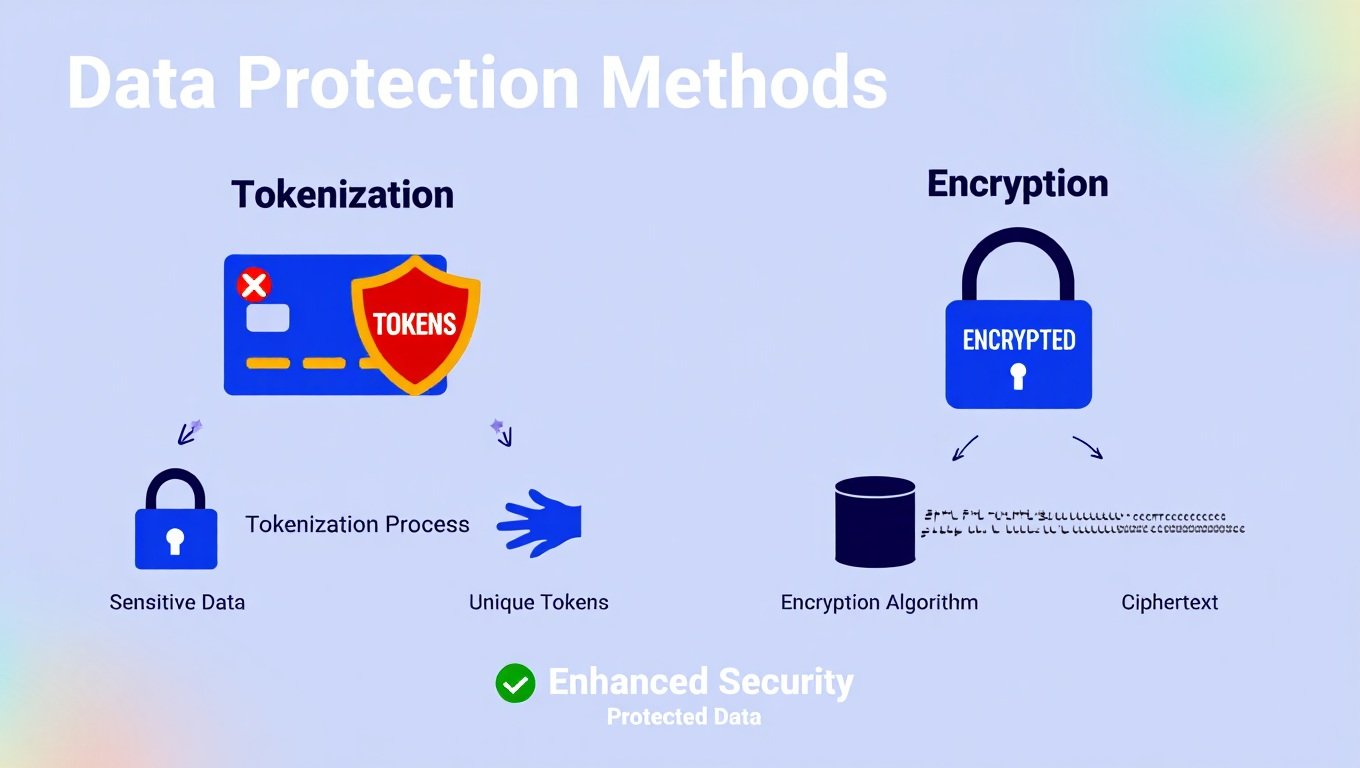
Tokenization and encryption are two different ways to protect sensitive information. While encryption scrambles data using math formulas and keys, tokenization replaces sensitive data with random substitute values stored in a secure vault. Both methods help keep data safe, but they work in completely different ways and serve different purposes.
Understanding the differences between tokenization and encryption matters for businesses that handle sensitive data. Companies need to follow rules like PCI DSS, GDPR, and HIPAA. They must pick the right data protection method based on their security needs, computer systems, and legal requirements.
This guide explains how tokenization and encryption differ, their pros and cons, how to use them, and best practices for keeping sensitive data safe in different business situations.
What Is Tokenization and How Does It Work?
Tokenization is a data security process that replaces sensitive data with non-sensitive substitute values called tokens. The original sensitive data stays locked away in a centralized token vault, while the tokens contain no useful information on their own.
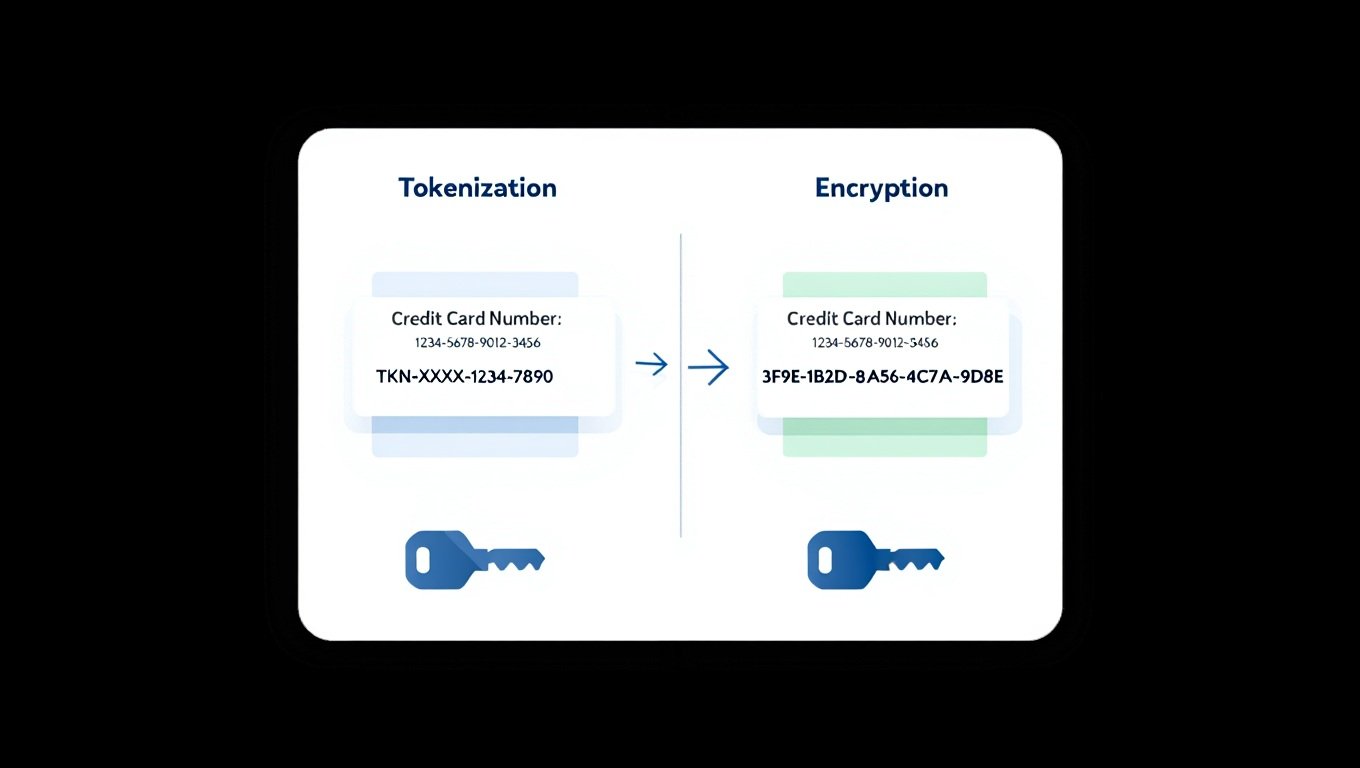
Here’s how tokenization works: When sensitive data comes into the system, the tokenization engine creates a unique, random token that looks similar to the original data. For example, a 16-digit credit card number gets replaced with a 16-digit token that looks like a credit card number but contains no real payment information.
Key features of tokenization include:
- Format preservation: Tokens look like the original data
- Random creation: Each token gets made using unpredictable methods
- Vault storage: Original data stays in a highly secure, separate location
- One-way mapping: You cannot figure out the original data from the token alone
- Independent operation: Tokens work without needing the tokenization system
The token vault acts as the secure storage place where the connection between tokens and original data happens. This vault uses multiple security layers, including data encryption, access controls, and monitoring systems to stop unauthorized access.
Banks commonly use tokenization for payment processing. When a customer buys something, their credit card number gets tokenized at the checkout. The store’s systems only see the token, which reduces their risk with sensitive payment data and makes following PCI DSS rules easier.
Tokenization works best for structured data like credit card numbers, Social Security numbers, bank account information, and medical record identifiers. The process makes sure that even if systems get hacked, attackers cannot access the original sensitive information without breaking into the secure token vault.
What Is Encryption and How Does It Function?
Encryption is a method that turns readable data into unreadable code using math formulas and encryption keys. The scrambled data, called ciphertext, can only get turned back to its original form through decryption using the right key.
Modern encryption uses complex math operations that scramble data in ways that make it nearly impossible to reverse without the proper decryption key. How strong the encryption is depends on the formula used, key length, and how well it gets set up.
There are two main types of encryption:
Symmetric encryption uses the same key for both scrambling and unscrambling data. This method works fast but requires secure key sharing between people. Common symmetric methods include AES (Advanced Encryption Standard), which government agencies and businesses use worldwide.
Asymmetric encryption uses two related keys: a public key for scrambling and a private key for unscrambling. This fixes the key sharing problem but works more slowly than symmetric methods. RSA and Elliptic Curve Cryptography are popular asymmetric methods.
The encryption process includes several steps:
- Data input: Original readable text enters the encryption system
- Key application: The encryption formula applies the key to change data
- Ciphertext creation: Output produces unreadable scrambled data
- Transmission or storage: Scrambled data moves safely through networks or databases
- Decryption: Authorized people use the right key to restore the original data
Organizations use encryption at different levels, including database encryption, file-level encryption, network transmission encryption, and full-disk encryption. Each approach addresses different security needs and threat situations.
Privacy engineering principles often include encryption as a basic component for protecting personal and sensitive information throughout data processing lifecycles. This integration helps organizations meet legal requirements while maintaining smooth operations.
How Do Tokenization and Encryption Differ in Data Protection?
The main difference between tokenization and encryption lies in how they transform and store data. Tokenization replaces sensitive data with unrelated substitute values, while encryption mathematically transforms data using reversible formulas.
Data transformation methods represent the core difference. Encryption applies math formulas to scramble data, creating ciphertext that maintains a mathematical relationship with the original information. Tokenization creates completely random substitute values with no connection to the source data.
Reversibility requirements differ greatly between the two methods. Encrypted data can be unscrambled using the proper key and formula, making the process reversible through mathematical operations. Tokenization requires access to the secure token vault to get back the original data, making it a database lookup operation rather than a math calculation.
Key management complexity varies significantly. Encryption needs sophisticated key management systems to create, distribute, rotate, and securely store encryption keys. Organizations must implement strong endpoint protection measures to protect these keys. Tokenization eliminates traditional key management challenges since tokens have no mathematical relationship to original data.
Performance characteristics show notable differences. Encryption operations require computer power for mathematical transformations, potentially slowing down system performance during high-volume processing. Tokenization typically works faster since it involves simple data substitution and database operations.
Data format preservation capabilities vary between methods. Format-preserving encryption can maintain data structure while providing cryptographic protection, but this comes with some security trade-offs. Tokenization naturally preserves data formats since tokens get designed to match original data characteristics.
Compliance implications differ based on regulatory requirements. Many compliance frameworks treat tokenized data as out of scope for certain security requirements, potentially reducing audit burden. Encrypted data often remains in-scope for compliance purposes, requiring additional security controls and documentation.
The cybersecurity field includes both methods, playing important roles in comprehensive data protection strategies. Organizations often use hybrid approaches, using tokenization for payment data and encryption for general data protection needs.
What Are the Key Security Benefits of Each Method?
Tokenization offers unique security advantages that make it particularly valuable for specific use cases. The primary benefit lies in data de-identification – tokens contain no sensitive information, making them worthless to attackers even if systems get compromised.
Security benefits of tokenization include:
- Reduced attack surface: Tokens eliminate sensitive data from most system components
- Simplified compliance: Many regulations treat tokenized data as out of scope
- Centralized security: All sensitive data protection focuses on the secure token vault
- No key exposure risk: Tokens don’t rely on cryptographic keys that could be stolen
- Format compatibility: Existing systems work with tokens without modification
The token vault architecture provides concentrated security controls. Organizations can implement extensive monitoring, access controls, and security measures around a single, well-defined area. This focused approach often proves more manageable than securing distributed encrypted data across multiple systems.
Encryption delivers different but equally important security benefits. The mathematical protection ensures data remains secure even if unauthorized parties gain access to encrypted files or databases.
Security advantages of encryption include:
- Universal applicability: Works with any type of data, structured or unstructured
- Proven cryptographic strength: Mathematical formulas provide measurable security levels
- Flexible implementation: Can be applied at various system layers
- Key-based access control: Granular permissions through key management
- Regulatory compliance: Meets most data protection regulatory requirements
Modern encryption methods like AES-256 provide security that would take billions of years to break using current computing power. This mathematical certainty gives organizations confidence in their data protection measures.
Both methods address different aspects of data security. Tokenization excels at reducing the scope of sensitive data exposure, while encryption provides mathematical assurance of data confidentiality. Understanding these strengths helps organizations choose the appropriate method for their specific security requirements.
Which Industries and Use Cases Benefit Most from Each Method?
Different industries gravitate toward specific data protection methods based on their unique requirements, regulatory obligations, and operational characteristics. Understanding these industry preferences helps organizations make informed decisions about their data security strategies.
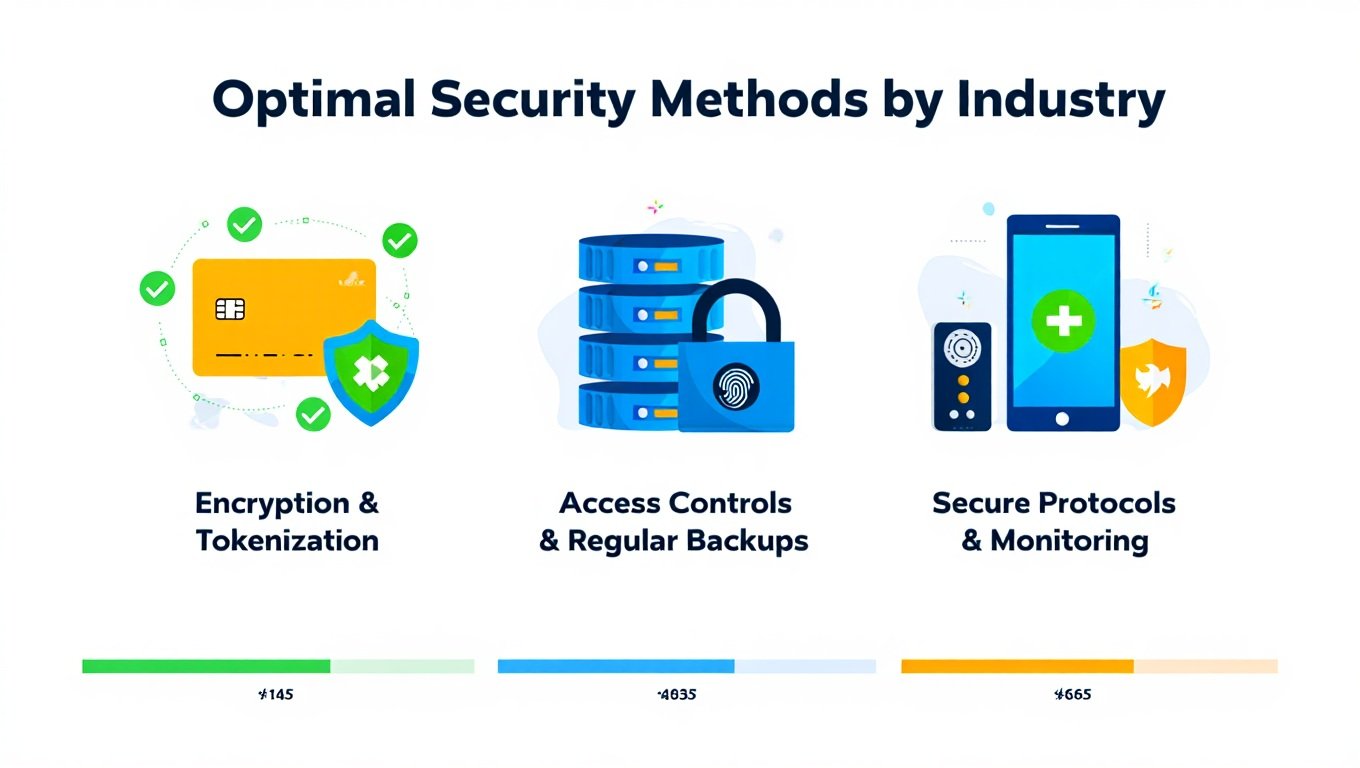
Payment Processing Industry heavily favors tokenization for credit card data protection. Payment processors, merchants, and financial institutions use tokenization to reduce PCI DSS compliance scope. When a customer’s payment card information gets tokenized at the point of sale, merchants can process transactions without storing actual card numbers in their systems.
Major payment networks like Visa and Mastercard promote tokenization through their own token service programs. These services replace primary account numbers with tokens for mobile payments, e-commerce transactions, and recurring billing scenarios. The approach significantly reduces the risk of payment card data breaches.
Healthcare Industry employs both methods depending on specific use cases. Tokenization works well for patient identifiers, insurance numbers, and other structured healthcare data elements. Electronic health record (EHR) systems often tokenize patient identifiers to enable analytics while protecting privacy.
Healthcare organizations also use encryption to protect medical records, diagnostic images, and research data. HIPAA compliance requirements often drive encryption implementation for data at rest and in transit. The industry’s need to share data across multiple organizations makes encryption particularly valuable for secure communications.
Financial Services Sector implements hybrid approaches combining both methods. Banks tokenize account numbers for internal processing while using encryption for customer communications, document storage, and regulatory reporting. Investment firms encrypt trading data and customer portfolios while tokenizing account identifiers for analytics purposes.
The financial sector’s regulatory environment drives the adoption of both technologies. Regulations like GDPR, SOX, and various banking regulations require different approaches to data protection depending on the specific data type and processing context.
Retail and E-commerce primarily use tokenization for payment data while employing encryption for customer personal information. Online retailers tokenize payment methods for stored payment credentials, subscription services, and one-click purchasing features. This approach reduces PCI DSS scope while enabling convenient customer experiences.
Customer data like addresses, phone numbers, and purchase history typically gets encrypted rather than tokenized. This allows for customer analytics, personalization, and marketing while maintaining data security.
Government and Defense sectors predominantly use encryption due to their need for classified information protection. These organizations require mathematically provable security for sensitive documents, communications, and operational data. The ability to apply encryption to any data type makes it suitable for diverse government applications.
Some government agencies explore tokenization for citizen identifier management, particularly in social services and benefits administration. This approach can protect Social Security numbers and other identifiers while enabling program administration.
Understanding software development best practices becomes crucial when implementing either method, as proper implementation significantly impacts security effectiveness.
What Are the Implementation Requirements and Challenges?
Implementing tokenization requires establishing a secure token vault infrastructure. Organizations must deploy high-availability systems that can handle tokenization requests at scale while maintaining strict security controls. The token vault becomes a critical system component that requires extensive backup, monitoring, and disaster recovery capabilities.
Key tokenization implementation requirements include:
- Token vault deployment: Secure, isolated infrastructure for storing sensitive data
- High availability architecture: Redundant systems to prevent service disruptions
- API development: Integration points for applications to request and use tokens
- Database design: Efficient storage and retrieval mechanisms for token mappings
- Security controls: Multi-layered protection around the vault environment
The centralized nature of tokenization creates both advantages and challenges. While it simplifies security management, it also creates a single point of failure that requires careful planning and investment in infrastructure redundancy.
Organizations implementing tokenization must also consider token format requirements. Applications expecting specific data formats need tokens that preserve those formats. This requirement can limit token randomness and potentially impact security if not handled properly.
Encryption implementation involves different but equally complex challenges. Organizations must establish comprehensive key management systems that handle the entire cryptographic key lifecycle. This includes key generation, distribution, rotation, revocation, and secure destruction.
Critical encryption implementation requirements include:
- Key management infrastructure: Systems for secure key lifecycle management
- Algorithm selection: Choosing appropriate encryption methods for different use cases
- Performance optimization: Balancing security strength with operational efficiency
- Integration planning: Incorporating encryption into existing applications and workflows
- Compliance alignment: Ensuring encryption methods meet regulatory requirements
Key management represents the most challenging aspect of encryption implementation. Organizations must protect encryption keys with the same rigor as the data they protect, creating complex security requirements around key storage, access controls, and administrative procedures.
Both methods require significant staff training and operational procedure development. Security teams need expertise in managing the chosen technology, while development teams must understand how to integrate data protection methods into applications effectively.
The choice between methods often depends on existing infrastructure capabilities. Organizations with strong database and application development skills might find tokenization more accessible, while those with established security infrastructure might prefer encryption approaches.
Regular security assessments and penetration testing become essential for both methods. Organizations must validate that their implementations actually provide the intended security benefits and identify potential vulnerabilities before attackers do.
Automation in software testing plays a crucial role in validating both tokenization and encryption implementations, ensuring they work correctly across different scenarios and maintain security properties over time.
How Do Compliance Requirements Differ Between Methods?
Regulatory compliance considerations significantly influence the choice between tokenization and encryption. Different regulations treat these methods differently, creating compliance advantages and challenges that organizations must carefully evaluate.
PCI DSS Compliance shows the most dramatic difference between methods. The Payment Card Industry Data Security Standard treats properly implemented tokenization as removing card data from scope for most security requirements. When merchants use approved tokenization solutions, they can significantly reduce their PCI DSS compliance burden.
Tokenization can eliminate the need for extensive security controls around systems that only handle tokens. This reduction in scope translates to lower compliance costs, reduced audit complexity, and fewer security control requirements. However, the token vault itself must meet strict PCI DSS requirements and undergo rigorous security assessments.
Encryption under PCI DSS provides data protection, but doesn’t remove encrypted data from the compliance scope. Organizations using encryption must still implement comprehensive security controls around systems that process encrypted card data. The encryption keys require the same level of protection as the original card data.
GDPR Compliance presents different considerations for each method. The General Data Protection Regulation focuses on personal data protection and individual privacy rights. Tokenization can support GDPR compliance by reducing the scope of personal data processing, but organizations must carefully implement tokenization to ensure it provides adequate protection.
Under GDPR, properly anonymized data falls outside the regulation’s scope. However, tokenization typically doesn’t meet GDPR’s anonymization requirements because tokens can be linked back to individuals through the token vault. Organizations using tokenization for GDPR compliance must implement additional privacy controls.
Encryption aligns well with GDPR’s security requirements and data protection principles. The regulation explicitly mentions encryption as an appropriate technical measure for protecting personal data. Organizations using encryption can demonstrate compliance with GDPR’s security obligations more directly.
HIPAA Compliance in healthcare presents another compliance scenario. The Health Insurance Portability and Accountability Act allows both tokenization and encryption as safeguards for protected health information (PHI). However, the implementation details determine compliance effectiveness.
Tokenization can remove certain healthcare data elements from the HIPAA scope if implemented correctly. Patient identifiers, insurance numbers, and other structured data elements can be tokenized to enable healthcare operations while reducing PHI exposure. The token vault must implement appropriate HIPAA safeguards.
Encryption provides a safe harbor under HIPAA regulations. Properly encrypted PHI is not considered a breach if the encryption keys remain secure. This creates clear compliance advantages for organizations that can implement and maintain strong encryption practices.
SOX Compliance for financial reporting typically favors encryption approaches. The Sarbanes-Oxley Act requires controls around financial data integrity and access. Encryption provides clear audit trails and access controls that align well with SOX requirements.
Industry-specific regulations like FERPA for education, GLBA for financial services, and various state privacy laws each have different approaches to data protection methods. Organizations must evaluate their specific regulatory environment when choosing between tokenization and encryption.
The compliance implications extend beyond just meeting requirements. Audit processes, documentation requirements, and ongoing compliance monitoring differ significantly between methods. Organizations should consider these operational aspects when making implementation decisions.
Understanding privacy engineering principles helps organizations navigate the complex regulatory environment and implement data protection methods that meet multiple compliance requirements simultaneously.
What Are the Cost and Performance Implications?
The financial and operational impacts of tokenization versus encryption differ significantly, affecting both initial implementation costs and ongoing operational expenses. Organizations must carefully evaluate these implications when making technology decisions.
Initial Implementation Costs vary dramatically between methods. Tokenization requires substantial upfront investment in token vault infrastructure, including high-availability hardware, database systems, and security controls. The centralized architecture demands enterprise-grade infrastructure to ensure reliability and performance.
Organizations implementing tokenization must budget for:
- Secure data center infrastructure or cloud services
- High-performance database systems for token storage
- Load balancing and redundancy systems
- Specialized tokenization software or development resources
- Integration efforts to connect applications to token services
Encryption implementation costs focus more on software, key management systems, and integration efforts. While encryption may require less specialized infrastructure, the key management complexity can drive significant costs in enterprise environments.
Encryption implementation typically includes:
- Key management software and hardware security modules
- Encryption software licenses or development efforts
- Integration and application modification costs
- Staff training and security expertise development
- Ongoing key management operational procedures
Ongoing Operational Costs show different patterns for each method. Tokenization creates ongoing costs around token vault maintenance, database management, and infrastructure scaling. The centralized nature means that performance and availability requirements directly impact operational costs.
Token vault operations require:
- Database administration and maintenance
- Infrastructure scaling to handle growing token volumes
- Security monitoring and incident response capabilities
- Backup and disaster recovery procedures
- Regular security assessments and compliance audits
Encryption operational costs focus on key management, performance optimization, and compliance activities. The distributed nature of encryption can spread operational costs across multiple systems and teams.
Encryption operations typically involve:
- Key rotation and lifecycle management activities
- Performance monitoring and optimization
- Compliance reporting and audit support
- Security monitoring for key compromise indicators
- Staff training on cryptographic best practices
Performance Implications differ based on system architecture and usage patterns. Tokenization performance depends heavily on token vault response times and network latency. High-volume applications may experience performance bottlenecks if the token vault cannot keep up with demand.
Tokenization performance considerations include:
- Database query response times for token lookups
- Network latency between applications and the token vault
- Concurrent request handling capabilities
- Cache effectiveness for frequently accessed tokens
- Scalability limitations of centralized architecture
Encryption performance impacts depend on the chosen algorithms, key sizes, and implementation methods. Modern processors include specialized instructions that accelerate common encryption operations, but high-volume encryption can still impact system performance.
Encryption performance factors include:
- CPU overhead for cryptographic operations
- Memory requirements for key storage and operations
- I/O performance impacts for encrypted storage
- Network bandwidth for encrypted communications
- Battery life impacts on mobile devices
Scalability Costs present different challenges for each method. Tokenization scalability requires scaling the token vault infrastructure, which often means significant cost increases as volume grows. However, application-side scaling remains relatively simple since tokens behave like the original data.
Encryption scalability typically involves distributing cryptographic operations across systems, which can provide more linear scaling characteristics. However, key management complexity increases with scale, potentially offsetting the architectural advantages.
Organizations must also consider the total cost of ownership over time. While tokenization may have higher upfront costs, it might reduce compliance and operational costs in the long term. Encryption might have lower initial costs but higher ongoing operational complexity.
The decision between methods should consider not just immediate costs but long-term financial implications, including compliance savings, operational efficiency gains, and security incident prevention benefits.
Understanding software development best practices helps organizations implement either method efficiently, potentially reducing both initial and ongoing costs through proper architectural decisions.
Which Method Should You Choose for Your Business?
Selecting between tokenization and encryption depends on multiple factors, including data types, compliance requirements, technical infrastructure, and business objectives. Organizations should evaluate their specific situation against key decision criteria to make the most appropriate choice.
Data Type Assessment represents the first consideration. Tokenization works best with structured, predictable data formats like payment card numbers, Social Security numbers, phone numbers, and account identifiers. The method excels when applications need to maintain data format compatibility while removing sensitive information.
Consider tokenization when your organization primarily handles:
- Credit card and payment information
- Government-issued identification numbers
- Account numbers and customer identifiers
- Structured healthcare identifiers
- Any data requiring format preservation
Encryption suits any data type, including unstructured content like documents, images, emails, and free-form text. Organizations dealing with diverse data types or complex data structures often find encryption more flexible for their needs.
Choose encryption for:
- Document and file protection
- Email and communication security
- Database and backup encryption
- Unstructured or variable-format data
- Cross-platform compatibility requirements
Compliance Requirements significantly influence method selection. Organizations subject to PCI DSS often prefer tokenization for payment data due to scope reduction benefits. Healthcare organizations might choose different methods for different data types based on HIPAA requirements.
Evaluate your regulatory environment:
- PCI DSS compliance strongly favors tokenization for payment data
- GDPR requires careful consideration of both methods
- HIPAA allows both but with different implementation requirements
- Industry-specific regulations may mandate particular approaches
- Multiple regulatory requirements might require hybrid solutions
Technical Infrastructure Capabilities affect implementation feasibility and costs. Organizations with strong database expertise and centralized architecture capabilities might find tokenization more natural. Those with distributed systems or existing security infrastructure might prefer encryption approaches.
Assess your technical readiness:
- Database administration capabilities for token vault management
- Network infrastructure for centralized token services
- Security team’s expertise in cryptographic systems
- Development team integration capabilities
- Existing security tools and infrastructure
Business Risk Tolerance influences the choice between methods. Organizations with low risk tolerance might prefer the mathematical certainty of encryption. Those seeking to minimize compliance scope might accept tokenization’s architectural complexity for regulatory benefits.
Consider your risk profile:
- Acceptable single points of failure in the token vault architecture
- Comfort level with key management complexity
- Tolerance for performance impacts
- Budget availability for infrastructure and ongoing operations
- Staff expertise and training capabilities
Performance Requirements can be decisive factors. High-volume applications with strict latency requirements might struggle with token vault round-trip. Applications with occasional security needs might find encryption overhead acceptable.
Evaluate performance needs:
- Transaction volume and peak load requirements
- Acceptable latency for security operations
- Real-time processing versus batch processing
- Mobile device performance considerations
- Network bandwidth and connectivity constraints
Hybrid Approaches often provide the best solution for complex organizations. Many enterprises use tokenization for payment data and customer identifiers while employing encryption for documents, communications, and general data protection.
A hybrid strategy might include:
- Tokenization for structured, high-compliance data
- Encryption for general data protection needs
- Different methods for different business units or applications
- Migration strategies that evolve over time
- Integration approaches that support multiple methods
The decision should align with your organization’s long-term data strategy. Consider how your data protection needs might change, how your technical infrastructure will develop, and how regulatory requirements might shift over time.
Remember that both methods require ongoing investment in security, compliance, and operational excellence. The choice should reflect not just current needs but your organization’s capacity to successfully implement and maintain the chosen approach.
Organizations often benefit from consulting with security professionals who understand both methods and can provide objective assessments based on specific organizational requirements and constraints.
FAQ About Tokenization vs Encryption:
Does tokenization provide stronger security than encryption?
No, tokenization and encryption provide different types of security protection rather than one being universally stronger. Tokenization eliminates sensitive data from most systems but concentrates risk in the token vault. Encryption provides mathematical protection but requires secure key management across distributed systems.
Can tokenized data be reversed without the token vault?
No, properly implemented tokenization cannot be reversed without access to the secure token vault. Tokens contain no mathematical relationship to the original data, making them meaningless without the vault lookup capability. This differs from encryption, which can be reversed using the proper cryptographic keys.
Is encryption always slower than tokenization?
No, performance depends on implementation details and usage patterns. Encryption operations require CPU resources for mathematical calculations, while tokenization requires network round trips to the token vault. High-volume applications might find encryption faster, while applications with occasional security needs might prefer tokenization’s performance characteristics.
Do both methods meet PCI DSS compliance requirements?
Yes, both methods can meet PCI DSS requirements, but they affect compliance scope differently. Properly implemented tokenization can remove card data from PCI DSS scope, significantly reducing compliance burden. Encryption protects card data but keeps encrypted data within compliance scope, requiring additional security controls.
Can organizations use both tokenization and encryption together?
Yes, many organizations implement hybrid approaches using both methods for different data types and use cases. This strategy leverages the strengths of each method while addressing diverse security requirements across different business processes and regulatory obligations.
Does tokenization work for unstructured data like documents?
No, tokenization works best with structured data that has predictable formats. Documents, images, and free-form text cannot be easily tokenized while maintaining usability. Encryption provides better protection for unstructured data types and variable-format content.
Are there industry standards for implementing these methods?
Yes, multiple industry standards guide implementation. PCI DSS provides tokenization guidance for payment data. NIST offers encryption standards and best practices. ISO 27001 includes data protection controls. Industry-specific regulations like HIPAA and GDPR also provide implementation guidance for both methods.
Which method requires more technical expertise to implement?
Both methods require significant technical expertise, but in different areas. Tokenization demands database administration, high-availability architecture, and application integration skills. Encryption requires cryptographic knowledge, key management expertise, and security implementation capabilities. The choice often depends on existing organizational skills and capabilities.
You May Also Like
 Cyber Security
Can Ransomware Infect iCloud? What Mac and iPhone Users Need to Know
 Data Security & Privacy
Two-Factor Authentication (2FA): How It Works, Which Method to Use, and How to Stay Safe
 Data Security & Privacy
Is a Password Manager Safe? How to Use One Securely
 Data Security & Privacy
19 Best Email Service Providers for Personal and Business Use
 WordPress
12 Best Cheap SSL Certificate Providers To Secure Your Website
 Data Security & Privacy
Is Password Protection the Same as Encryption? Differences in Data Security
 Data Security & Privacy
How Your Digital Footprint Can Make or Break Your Career Opportunities
 Data Security & Privacy
What Is End-to-End Encryption? Your Complete Guide to Secure Communication
 Data Security & Privacy